








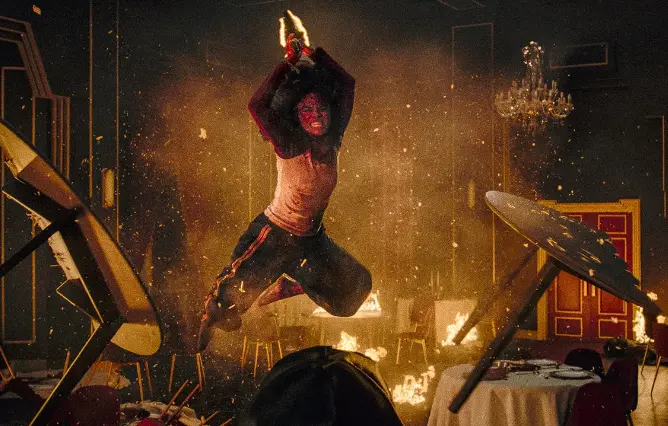
It is a high-quality, intellectually engaging horror film best suited for audiences interested in psychological realism and ethical tension rather than traditional genre thrills.
KumDi.com
They Will Kill You is a psychologically driven horror-thriller that prioritizes tension, moral ambiguity, and realism over conventional jump scares. From an expert film analysis perspective, it succeeds in creating sustained psychological unease through its narrative structure, character behavior patterns, and sound design. However, its deliberate pacing and thematic density may not appeal to viewers expecting fast-paced, spectacle-driven horror.
Table of Contents

Overview: What Is They Will Kill You About?
At its core, They Will Kill You explores the mechanisms of fear, control, and survival within a confined social system. The narrative centers on individuals placed in a high-risk environment where trust erodes rapidly and perceived threats escalate into real danger.
Unlike typical horror films that rely heavily on supernatural elements, this film leans into behavioral psychology, examining how humans respond under extreme stress.
Key Elements:
- Genre: Psychological horror / thriller
- Primary Focus: Human behavior under perceived threat
- Narrative Style: Slow-burn with escalating tension
- Themes: Survival ethics, paranoia, group dynamics
Narrative Structure: How the Story Builds Tension
From a structural standpoint, They Will Kill You follows a three-phase escalation model, commonly observed in high-quality psychological thrillers:
1. Stability Phase (Setup)
The film begins with a relatively controlled environment where characters establish baseline relationships. Dialogue is naturalistic and grounded, reflecting real-world interpersonal dynamics.
Expert Insight:
This phase mirrors clinical observation environments where baseline behavior is necessary to identify deviations later. It creates credibility and enhances audience immersion.
2. Disruption Phase (Rising Threat)
Subtle anomalies begin to emerge:
- Conflicting information
- Suspicious behaviors
- Breakdown of communication
The film avoids overt exposition, instead using environmental cues and micro-expressions to signal danger.
Why This Works:
Research in cognitive psychology shows that ambiguity increases anxiety more effectively than explicit threats. The film leverages this principle to sustain tension.
3. Collapse Phase (Climax and Consequences)
Trust collapses entirely. Characters begin making survival-driven decisions, often violating their earlier moral frameworks.
Outcome:
The film does not offer simplistic resolution. Instead, it emphasizes consequences—both physical and psychological.
Psychological Realism: A Key Strength
One of the most notable aspects of They Will Kill You is its commitment to psychological accuracy.
Behavioral Patterns Observed:
- Fight-or-flight responses
- Group fragmentation under stress
- Confirmation bias in threat perception
- Moral disengagement
These are not exaggerated for dramatic effect—they closely align with documented human responses in high-stress environments such as disaster scenarios or military conflict zones.
Professional Perspective:
In real-world crisis simulations, individuals often misinterpret neutral stimuli as threats. The film replicates this phenomenon effectively, increasing its realism and emotional impact.
Cinematography & Visual Language
The film uses visual techniques strategically rather than stylistically.
Key Techniques:
- Tight framing: Creates a sense of confinement and surveillance
- Low lighting: Enhances uncertainty and limits visual clarity
- Static shots: Encourage viewers to scan the frame for hidden threats
Sound Design: The Invisible Driver of Fear
Unlike many modern horror films, They Will Kill You avoids overuse of loud jump scares.
Instead, it relies on:
- Ambient noise (e.g., distant sounds, subtle movements)
- Silence as a tension-building tool
- Gradual audio layering
Evidence-Based Insight:
Studies in auditory perception confirm that unpredictable, low-frequency sounds trigger stronger anxiety responses than sudden loud noises. The film uses this principle effectively.
Themes and Interpretations
1. Fear as a Social Construct
The film demonstrates how fear spreads through groups, often independent of objective reality.
2. Ethics Under Pressure
Characters are forced to make decisions that challenge their moral identity.
Example Scenario:
A character may choose self-preservation over group safety—not out of malice, but due to perceived necessity.
3. Trust vs Survival
The central tension lies in whether cooperation or isolation offers a better chance of survival.
Strengths: What the Film Does Exceptionally Well
✔ Realistic Character Behavior
Characters act in ways consistent with real-world psychological responses, not genre clichés.
✔ Sustained Tension
The film maintains a high level of unease without relying on repetitive scares.
✔ Intellectual Engagement
Viewers are encouraged to interpret events rather than passively consume them.
Limitations: Where It May Not Appeal to All Audiences
✖ Slow Pacing
The deliberate buildup may feel prolonged for viewers expecting immediate action.
✖ Ambiguous Resolution
The lack of clear answers may frustrate those seeking closure.
✖ Minimal Traditional Horror Elements
Fans of supernatural or effects-heavy horror may find it subdued.
Comparison to Similar Films

To better understand its positioning, They Will Kill You can be compared to:
- Psychological containment thrillers
- Social experiment narratives
- Realism-focused horror films
Distinguishing Factor:
Its emphasis on behavioral science over spectacle sets it apart from mainstream horror releases.
Practical Viewing Recommendations
Who Should Watch This Film?
Recommended for:
- Viewers interested in psychology and human behavior
- Fans of slow-burn thrillers
- Audiences seeking intellectually engaging horror
Not ideal for:
- Those looking for fast-paced action
- Viewers who prefer clear, definitive endings
Expert Viewing Tips
To fully appreciate the film:
- Pay attention to small behavioral cues
Micro-expressions and tone shifts often signal major developments. - Observe group dynamics
Watch how alliances form and dissolve. - Focus on sound as much as visuals
Audio plays a critical role in storytelling.
Final Verdict: A High-Intelligence Horror Experience
From an expert analysis perspective, They Will Kill You is a methodically constructed psychological thriller that prioritizes realism, tension, and thematic depth over conventional entertainment formulas.
Rating (Professional Criteria-Based):
- Psychological Accuracy: 9/10
- Narrative Structure: 8.5/10
- Cinematography: 8/10
- Accessibility: 6.5/10
Overall:
8.3 / 10 — Highly Recommended for Thoughtful Viewers
Conclusion
They Will Kill You represents a growing shift in horror filmmaking toward evidence-based psychological storytelling. Rather than relying on exaggerated fear tactics, it draws from real human behavior, making its impact more subtle—but significantly more lasting.
For viewers willing to engage deeply, it offers not just fear, but insight into how fragile trust, morality, and perception can become under pressure.

FAQs
What is They Will Kill You about?
They Will Kill You is a psychological horror-thriller that explores how individuals react under extreme fear and uncertainty. The story focuses on group dynamics, survival decisions, and the breakdown of trust in a high-risk environment.
Is They Will Kill You worth watching?
Yes—especially for viewers who prefer slow-burn, intellectually engaging horror. The film stands out for its psychological realism, strong tension-building, and thought-provoking themes rather than jump scares.
Is They Will Kill You a supernatural horror movie?
No. The film primarily focuses on psychological and human-driven fear rather than supernatural elements. Its tension comes from behavior, perception, and escalating paranoia.
Why is They Will Kill You considered a psychological horror film?
It emphasizes mental and emotional tension over physical threats. The film uses realistic human behavior, moral dilemmas, and uncertainty to create fear, aligning with core principles of psychological horror.
Does They Will Kill You have a clear ending?
The film leans toward an ambiguous conclusion. Instead of providing definitive answers, it highlights the consequences of characters’ decisions, encouraging interpretation and analysis.


 and then