








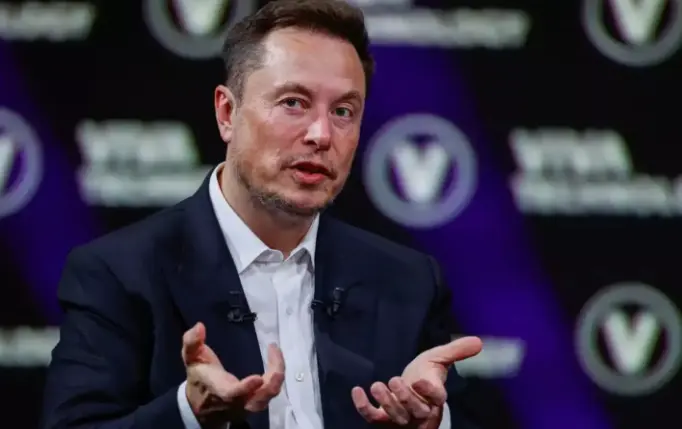
Elon Musk envisions artificial intelligence as a powerful tool to combat global warming. By integrating AI with renewable energy systems, optimizing electric vehicle production, and enhancing carbon capture technologies, Musk believes humanity can accelerate the transition to sustainability and prevent catastrophic climate change on a global scale.
KumDi.com
Elon Musk AI global warming goes beyond electric cars and rockets. He believes artificial intelligence could become Earth’s ultimate climate guardian. Through AI-powered satellites and advanced data modeling, Musk imagines a world where technology can monitor and manage global temperature, transforming how humanity fights climate change.
Table of Contents

The Origin of Musk’s Climate Ambition
Musk’s concern with the planet’s sustainability is not new. His ventures — Tesla, SpaceX, and SolarCity — were all built around solving problems that threaten humanity’s future. Yet, despite rapid growth in renewable energy, global warming remains an escalating crisis. Musk believes the next frontier in climate technology will come not from human action alone but from artificial intelligence — a system that can learn, analyze, and adapt far faster than any government or human institution.
According to Musk’s vision, AI could become humanity’s most powerful ally in the climate battle — provided it’s properly controlled and ethically designed.
The Concept: AI and Satellites Managing Solar Energy
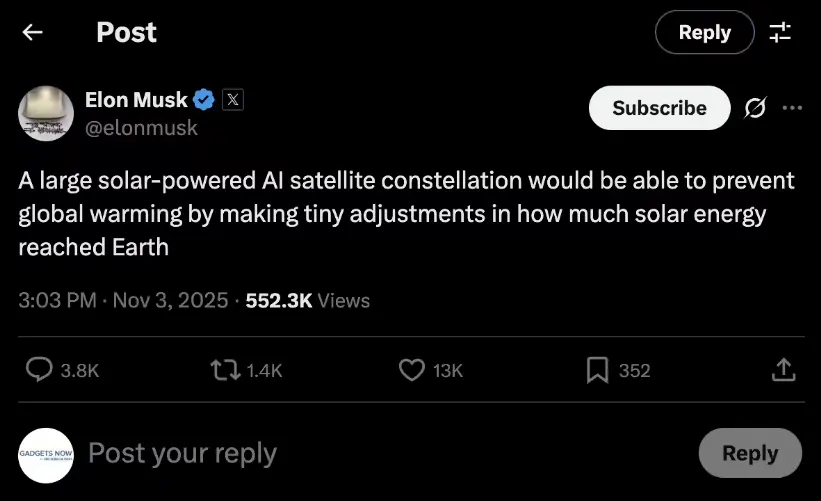
At the heart of Musk’s idea lies an ambitious concept: using an AI-controlled satellite constellation to regulate the amount of solar energy that reaches Earth. These satellites would be equipped with reflective panels or adjustable surfaces capable of subtly reducing or redirecting solar radiation — a modern form of space-based geoengineering.
AI would analyze global climate data in real time — including temperature shifts, atmospheric chemistry, and oceanic changes — to decide when and how much sunlight to deflect. The system would continuously learn from outcomes, improving its precision over time.
In simple terms, the Earth would gain an intelligent “climate thermostat,” capable of cooling or stabilizing the planet without drastic atmospheric interventions.
Why Musk Believes AI Is the Key
Artificial intelligence excels at detecting complex patterns hidden in massive data. Climate systems are chaotic and multidimensional, influenced by countless variables. Human scientists struggle to model them with perfect accuracy, but AI could process billions of data points per second, detecting trends invisible to human analysts.
Musk imagines AI as the brain that coordinates energy systems, satellite activity, and climate forecasting simultaneously. In his vision, AI could:
- Predict global warming trends decades in advance.
- Adjust solar radiation in real time.
- Optimize global energy grids for maximum sustainability.
- Reduce the uncertainty that plagues current climate predictions.
This shift from human-led to AI-driven climate management represents not just technological progress but a philosophical transformation — giving machines a direct role in safeguarding planetary stability.
The Benefits of AI-Driven Climate Intervention
A. Speed and Scale
Unlike traditional policies that take decades to yield measurable results, AI systems can analyze, decide, and act almost instantly. In theory, an AI-controlled satellite network could begin adjusting Earth’s solar balance within weeks of deployment.
B. Global Reach
A satellite constellation operates above national borders, giving it global coverage. This could make climate intervention more coordinated and less dependent on fragmented international agreements.
C. Real-Time Adaptation
AI can continuously learn from environmental feedback. If cooling exceeds safe limits, the system can self-correct, restoring balance. This adaptability is what sets AI apart from rigid geoengineering strategies.
D. Integration with Renewable Energy
Musk’s ecosystem of companies could naturally link to this vision. Tesla’s solar and battery technologies could provide the energy foundation, while SpaceX could handle launches and orbital infrastructure. In theory, the project could become a closed-loop system powered by renewable energy.
The Ethical and Technical Challenges
A. Playing God with the Climate
Handing control of Earth’s temperature to artificial intelligence is a concept that borders on the godlike. Even with the best intentions, unforeseen consequences could arise — altering rainfall patterns, damaging ecosystems, or impacting agriculture in unpredictable ways.
B. Governance and Accountability
Who decides when the AI acts? Who controls the system? A single company, nation, or private individual should not have unilateral control over a planetary thermostat. Establishing a transparent, international governance model would be crucial before any such system could exist.
C. Risk of AI Misjudgment
AI is only as good as the data it’s trained on. A corrupted algorithm, a software bug, or biased data could lead to devastating errors. The same intelligence meant to stabilize Earth could, if miscalibrated, destabilize it further.
D. Cost and Complexity
Building, launching, and maintaining thousands of AI-enabled satellites would cost hundreds of billions of dollars. Beyond financial cost, there’s an environmental one — materials, energy, and space debris all pose major hurdles.
The Paradox: AI’s Climate Cost
Ironically, while AI could help solve global warming, it also contributes to it. The massive computing power behind advanced AI models consumes enormous electricity, much of which still comes from fossil fuels. Training large neural networks can produce carbon emissions comparable to those of entire cities.
Musk’s challenge, therefore, is twofold: make AI not only smart enough to manage the climate but also clean enough to justify its existence as a climate solution. His push for energy-efficient chips, green data centers, and solar-powered AI servers reflects attempts to resolve this paradox.
Could This Idea Actually Work?
Technically, the idea is possible — but extremely difficult. AI-controlled satellites capable of altering sunlight would require ultra-precise coordination, immense computational resources, and global cooperation. The system would need near-perfect accuracy, as even a small misjudgment could have large-scale consequences.
Yet Musk’s track record of turning science fiction into reality suggests that what seems impossible today could be tomorrow’s standard. Just as reusable rockets once seemed absurd, AI-driven climate satellites may one day orbit Earth, protecting it from overheating.
The Bigger Picture: Musk’s Climate Philosophy
Beyond the science, Musk’s idea reveals his core philosophy: when humanity faces an existential threat, innovation — not fear — must lead the way. Instead of treating AI and technology as villains, he sees them as essential tools for survival.
In this framework, global warming isn’t a problem to be merely endured; it’s a system-level challenge that demands equally systemic, intelligent solutions. AI becomes both the problem-solver and, potentially, the protector of civilization.
Global Collaboration Is Essential
Even if Musk’s technology works perfectly, no single person or company should control it. Managing Earth’s climate must be a shared human responsibility. The development of such systems would require transparent international oversight, ethical AI design, and cooperative decision-making involving scientists, policymakers, and citizens worldwide.
Without this, the world risks turning a noble idea into a geopolitical weapon — one that could decide which regions cool or heat at will.
The Future of AI and Climate Technology
AI’s role in addressing climate change will likely expand far beyond Musk’s proposal. Machine learning already enhances renewable energy efficiency, predicts extreme weather, and optimizes agricultural practices. Over the next decades, AI systems could integrate global data to create a “digital twin” of Earth — a simulation that allows humans to test interventions safely before implementing them.
Musk’s AI satellite concept may be one bold chapter in this broader evolution — a vision that inspires future innovation even if it never becomes reality.
Conclusion: A Vision Worth Watching
Elon Musk’s idea of using AI to manage global warming stands at the intersection of genius and audacity. It combines cutting-edge technology, visionary optimism, and an unshakable belief in human ingenuity. Yet it also serves as a warning: solving one problem with another powerful force — like AI — introduces new ethical and existential risks.
Still, Musk’s proposal sparks a critical conversation about how far humanity should go to protect itself — and whether the key to saving the planet might already lie within our machines.
If realized responsibly, AI could become more than a technological revolution; it could be Earth’s greatest ally in survival.
FAQs
What is Elon Musk’s idea about AI and global warming?
Musk proposes using artificial intelligence and satellite technology to regulate the amount of solar energy reaching Earth, potentially helping to stabilize the planet’s temperature.
How would AI help control climate change?
AI would analyze global climate data, predict heat patterns, and direct satellites to reflect or absorb solar radiation as needed, acting as an intelligent climate management system.
What are the risks of this approach?
Potential risks include technical failure, unintended weather effects, ethical concerns about control, and the danger of over-reliance on technology instead of reducing emissions.
Can AI alone stop global warming?
No. AI can assist in climate management and energy optimization, but cutting emissions, restoring ecosystems, and transitioning to sustainable energy remain essential.
When could this technology become reality?
While parts of it — such as AI modeling and satellite coordination — already exist, a fully operational AI climate-control system would likely take decades to develop and regulate.




 and then