








“Wake Up Dead Man: A Knives Out Mystery” delivers a stylish, witty, and tightly crafted mystery filled with sharp dialogue and clever twists. This review breaks down its narrative style, characters, and cinematic approach to explain why the film stands out in the modern whodunit genre.
KumDi.com
Movie Review Wake Up Dead Man: A Knives Out Mystery is the third cinematic outing for detective Benoit Blanc, and it arrives with a radically different tone, deeper thematic ambitions, and a more emotionally charged story than its predecessors. While Knives Out and Glass Onion reveled in sharp satire, witty humor, and vibrant social commentary, this new installment dives straight into something moodier — a gothic, spiritually infused whodunit wrapped in moral conflict, institutional secrets, and existential dread.
This is Rian Johnson’s boldest film in the franchise, a mystery that expands the boundaries of what a modern whodunit can be. The result is a film that is compelling, provocative, occasionally uneven, but undeniably memorable.
Table of Contents

A Mystery Rooted in Faith, Power, and Human Vulnerability
At the heart of Wake Up Dead Man lies a murder set within a religious community, centered around a church brimming with internal conflict and buried sins. When a respected but controversial man of faith is found dead under seemingly impossible circumstances, Benoit Blanc is invited to untangle a crime that blends spiritual symbolism with real-world fallibility.
The setting alone gives the film a heavier atmosphere than previous entries. The church becomes both a crime scene and a metaphor: a space where belief, doubt, guilt, and authority clash in ways that mirror the characters’ personal struggles. Instead of relying on mansions, luxury retreats, or high-tech playgrounds, Johnson anchors the story in a place charged with emotional and moral tension.
This shift pays off. The stakes feel higher, the consequences more personal, and the truth more entangled in themes of redemption, hypocrisy, and the cost of blind faith.
Benoit Blanc Like You’ve Never Seen Him
Daniel Craig’s Benoit Blanc remains as charismatic and sharp as ever, but this film deepens his character in meaningful ways. We see a detective who is both baffled and transformed by the complexities of belief and human vulnerability.
Blanc’s trademark humor is toned down in favor of introspection. He finds himself not only solving a murder but navigating a philosophical maze — a psychological battlefield where logic meets superstition and reason is clouded by moral compromise.
This movie allows Blanc to grow. He’s not just the brilliant outsider; he becomes a participant in the emotional unraveling of the community. His presence feels more compassionate, more involved, and ultimately, more human.
A Standout Performance That Grounds the Film
Although Blanc is the franchise’s anchor, Wake Up Dead Man belongs just as much to the conflicted spiritual leader at the center of the narrative. The priest’s internal turmoil — a blend of guilt, conviction, fear, and uncertainty — adds emotional gravitas to the mystery.
His character provides the film’s most powerful arc. Through him, the movie explores:
- the fragility of trust
- the weight of responsibility
- the tension between personal truth and institutional obligation
- the way communities weaponize faith
It is one of the series’ most layered, vulnerable portrayals, and it elevates the entire story.
A Darker Tone and Haunting Aesthetic
One of the most striking differences between this film and the previous entries is its aesthetic shift. The atmosphere is somber, almost gothic, drenched in shadows, candlelight, and an undercurrent of dread.
The church setting, with its echoing halls and symbolic iconography, becomes a character in itself. The cinematography amplifies mood over spectacle — intimate confessionals, dim corridors, stained-glass reflections, rain-soaked nights.
This darker tone is not merely visual; it permeates the storytelling:
- Secrets feel heavier
- Motives feel more desperate
- Suspects feel more morally gray
- Dialogue feels more loaded with emotional weight
While some viewers may miss the breezy sharpness of the earlier films, many will appreciate the bold shift into deeper, more atmospheric territory.
A Complex Ensemble — With Mixed Results
As expected from a Knives Out film, the ensemble cast is large, flashy, and filled with big personalities. Each character arrives with distinct motives, personal stakes, and layers of duplicity.
Some standouts deliver powerful, memorable performances that elevate the drama. They embody the film’s themes of fragility, righteousness, and self-preservation. Their stories intersect in ways that create a rich tapestry of interpersonal tension.
However, the film’s ambition comes with a trade-off: not every character is given enough space. With so many subplots, a few supporting roles feel underdeveloped or overshadowed. While the mystery benefits from a full cast of suspects, the emotional core occasionally suffers from overcrowding.
This imbalance doesn’t break the film, but it introduces moments where the story feels stretched thin or where certain characters fade into the background without fulfilling their potential.
A Bold Mix of Themes — Sometimes Brilliant, Sometimes Heavy-Handed
One of the most talked-about aspects of Wake Up Dead Man is its thematic ambition. The film tackles:
- the relationship between faith and truth
- the dangers of institutional power
- the psychology of guilt
- the fragile boundaries between belief and delusion
- the way communities protect — or sacrifice — their own
Much of this is handled with nuance, emotional intelligence, and relevance. The film uses its themes not as decoration, but as engines driving the narrative.
Yet, at times, the storytelling leans too heavily into symbolism and metaphor. Certain scenes feel overt, almost sermon-like, which may divide audiences. The desire to balance mystery with emotional depth sometimes causes pacing fluctuations — especially in the second act, where the narrative slows to examine characters’ moral struggles.
Still, even when the themes feel forceful, they contribute to the film’s ambition and depth, distinguishing it from typical murder mysteries.
A Twisty, Well-Constructed Mystery
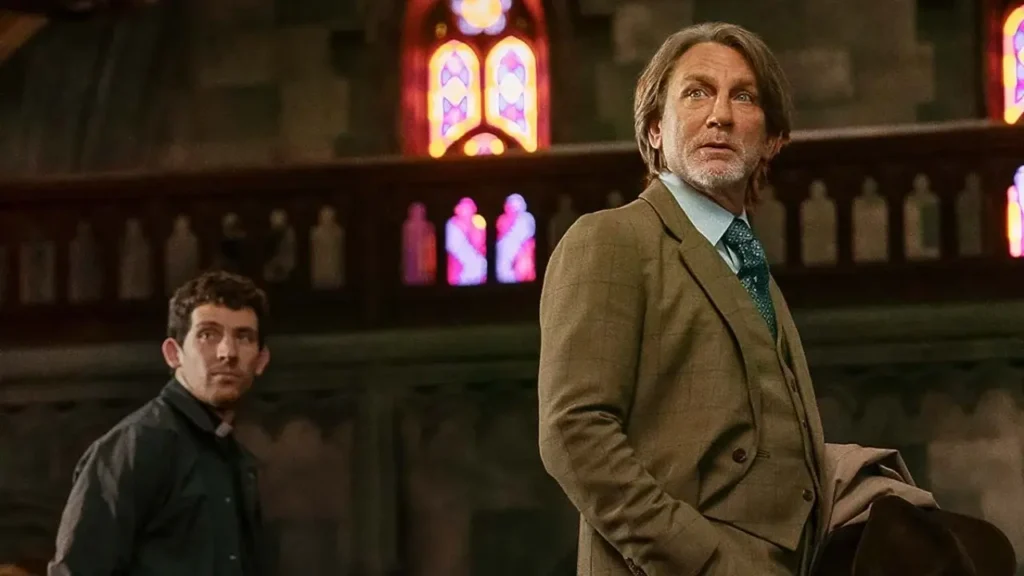
Despite the thematic weight, Wake Up Dead Man remains at its core a puzzle — and a well-constructed one. Johnson plants clues with care, crafts emotionally charged misdirection, and builds tension through both psychological and narrative twists.
The final reveal is satisfying, not because of shock value, but because it ties together:
- character motives
- symbolic storytelling
- thematic threads
- subtle clues hidden throughout the film
For mystery fans, the film offers a rewarding combination of emotional stakes and intellectual challenge.
Strengths of the Film
- A more mature, complex storyline
- Atmospheric visuals and haunting tone
- Layered performances, especially from the spiritual lead
- A deeper, more human portrayal of Benoit Blanc
- A mystery that intertwines with emotionally resonant themes
- Bold thematic ambition rarely seen in modern whodunits
Weaknesses of the Film
- Some supporting characters feel underused
- Tonal shifts may feel uneven to some viewers
- Pacing slows noticeably in the middle
- Certain themes land too heavily or too overtly
- Less lighthearted charm compared to earlier films
Final Verdict: A Bold, Mature Evolution of the Franchise
Wake Up Dead Man: A Knives Out Mystery is a daring reinvention of the series. Instead of repeating the formula that made the first two films hits, it ventures into deeper emotional territory, tackling profound themes against the backdrop of a tightly woven whodunit.
It won’t be everyone’s favorite entry — those who loved the breezy humor of the earlier movies may find this too heavy or somber. But for viewers who appreciate mysteries with depth, atmosphere, emotional stakes, and moral complexity, this is arguably the strongest and richest installment yet.
It is a story that lingers — not just for its twists, but for its questions about humanity.

FAQs
What makes Wake Up Dead Man exceptional compared to previous Knives Out films?
This movie review of Wake Up Dead Man highlights how the film expands the Knives Out Mystery universe with sharper humor, richer characters, and bold narrative choices explored in our Benoit Blanc movie analysis.
Does Wake Up Dead Man continue the Benoit Blanc storyline effectively?
Yes. Our Wake Up Dead Man movie review explains how the sequel deepens Benoit Blanc’s arc through clever tension and layered storytelling, supported by detailed Knives Out Mystery review insights.
Is Wake Up Dead Man worth watching for mystery-film fans?
Absolutely. As noted in this Wake Up Dead Man movie review, fans of Rian Johnson’s mystery films will appreciate its inventive twists and sharp writing, strengthened by our Benoit Blanc movie analysis.
How does Rian Johnson’s direction shape Wake Up Dead Man?
The movie review shows that Johnson elevates the Knives Out Mystery formula with tighter pacing, stronger atmosphere, and refined humor, demonstrating his mastery of the modern whodunit.
Does the film introduce new themes to the Knives Out franchise?
Yes. This Wake Up Dead Man movie review reveals how the story blends suspense with social satire, offering fresh thematic layers discussed in our Knives Out Mystery review.




 and then