








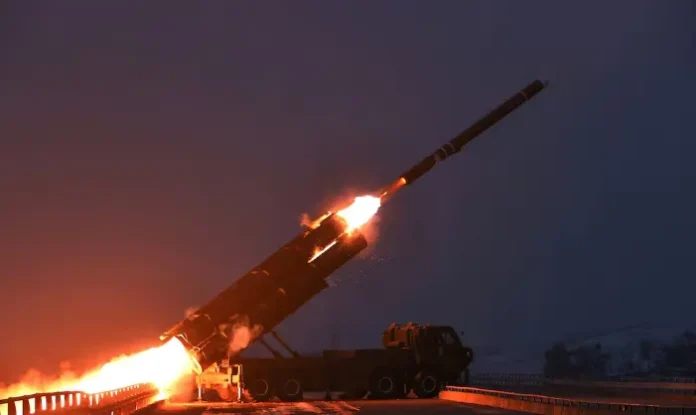
Kim Jong Un oversees cruise missile launches to demonstrate North Korea’s growing military capability and strategic deterrence. These tests showcase low-altitude precision weapons designed to evade defenses, signaling increased regional security risks and reinforcing Pyongyang’s stance against perceived external threats.
KumDi.com
Kim Jong Un cruise missile launches mark a significant step in North Korea’s evolving military strategy, emphasizing precision, survivability, and deterrence. By personally supervising these tests, Kim underscores the importance of cruise missiles in strengthening national defense and shaping regional security dynamics.
North Korea’s leader Kim Jong Un has once again drawn global attention by personally overseeing the launch of long-range cruise missiles, reinforcing Pyongyang’s commitment to strengthening its strategic military posture. The event reflects a deliberate effort by North Korea to demonstrate operational readiness, technological advancement, and deterrence capability amid ongoing tensions on the Korean Peninsula.
Cruise missile launches, unlike more familiar ballistic missile tests, carry distinct strategic implications. They signal not only technical progress but also evolving military doctrine focused on survivability, precision, and flexible response options. Kim Jong Un’s presence at the launch underscores the political importance the regime places on these systems and their role in national defense strategy.
This article examines what happened, why cruise missiles are significant, what message North Korea is sending, and how this development affects regional and global security.
Table of Contents

What Happened: Kim Jong Un Oversees Cruise Missile Launch Drill
According to North Korean state messaging, Kim Jong Un observed a strategic cruise missile launching drill conducted by units of the Korean People’s Army. Multiple missiles were reportedly launched over open waters, following pre-programmed flight paths and successfully striking designated targets.
The exercise was described as a combat readiness verification, designed to test the reliability, accuracy, and responsiveness of the missile system under realistic operational conditions. Kim Jong Un reportedly expressed satisfaction with the results and emphasized the importance of maintaining constant readiness for strategic counter-action.
The launch occurred against a backdrop of heightened military alertness in the region, making its timing as significant as its technical execution.
Why Cruise Missiles Are Strategically Important
Low-Altitude Flight and Stealth
Cruise missiles typically fly at low altitudes, using terrain-hugging trajectories that make detection by radar systems more difficult. This characteristic allows them to evade early warning systems and complicates interception by missile defense networks.
For North Korea, this capability enhances survivability and increases the credibility of its deterrent posture.
High Precision and Flexible Targeting
Modern cruise missiles are designed for precision strikes, enabling accurate engagement of specific targets rather than broad area impact. This precision allows for both conventional and potential nuclear payload delivery with reduced collateral damage.
Such flexibility broadens North Korea’s strategic options beyond traditional ballistic missile use.
Dual-Use Capability
Cruise missiles can be equipped with either conventional or nuclear warheads, making them highly adaptable tools within a broader weapons framework. This dual-use nature introduces strategic ambiguity, forcing adversaries to assume worst-case scenarios during periods of tension.
Not Limited to Fixed Launch Sites
Cruise missiles can be launched from various platforms, including mobile launchers, ships, and potentially submarines. This mobility increases survivability and reduces vulnerability to pre-emptive strikes.
Kim Jong Un’s Strategic Messaging
Kim Jong Un’s personal supervision of the launch sends a clear political and military signal. His presence highlights the importance of cruise missile forces within North Korea’s evolving defense doctrine and reinforces internal messaging about leadership control over strategic assets.
Official rhetoric frames the missile launch as defensive, portraying it as a response to external military pressure and joint exercises conducted by rival states. This narrative is consistent with North Korea’s longstanding position that its weapons development is a necessary measure for national survival.
At the same time, the display of advanced missile capability serves as a deterrent message to regional rivals, signaling that North Korea possesses credible and diverse strike options.
Part of a Broader Military Modernization Effort
The cruise missile launch is not an isolated event. It fits within a broader pattern of military development that includes:
- Expansion of missile delivery platforms
- Emphasis on precision-guided weapons
- Development of layered strike capabilities
- Integration of land, sea, and potentially underwater launch systems
North Korea’s leadership has repeatedly emphasized the goal of building a comprehensive and reliable strategic force, rather than relying on a single type of weapon system.
Cruise missiles complement ballistic missiles by offering alternative attack profiles and complicating adversary defense planning.
Regional Security Implications
Impact on the Korean Peninsula
For South Korea, cruise missile launches heighten concerns about early detection and interception, particularly because low-flying missiles reduce reaction time. This may accelerate investments in advanced radar systems, missile defense upgrades, and intelligence-sharing with allies.
Effect on U.S. Military Posture
The United States, as a key security partner in the region, closely monitors such developments. Cruise missiles capable of extended range may influence operational planning for U.S. forces stationed in East Asia, especially regarding base protection and force dispersal.
Japan and Regional Defense Planning
Japan, within potential range of advanced cruise missiles, is likely to factor these developments into its defense strategy, including air defense modernization and counter-strike capability discussions.
Diplomatic and Political Consequences
North Korea’s continued missile testing complicates diplomatic engagement efforts. Each launch reinforces perceptions that Pyongyang prioritizes military strength over negotiation, reducing trust among potential dialogue partners.
At the same time, missile demonstrations are often used by North Korea as leverage, strengthening its bargaining position ahead of potential talks or political milestones.
Cruise missile tests, in particular, exist in a gray area of international regulation, allowing North Korea to advance its capabilities while avoiding some of the immediate diplomatic fallout associated with ballistic missile launches.
Domestic Messaging and Internal Stability
Internally, the missile launch serves an important propaganda function. State media coverage emphasizes technological success, leadership competence, and national strength. This messaging supports regime legitimacy and reinforces public narratives of resilience against external threats.
By showcasing modern weapons under Kim Jong Un’s direct supervision, the leadership reinforces loyalty within the military and confidence among the population.
What Comes Next: Future Outlook
Looking ahead, several developments are possible:
- Additional cruise missile tests to refine accuracy and range
- Integration with new platforms, including naval assets
- Combined exercises involving multiple weapon systems
- Symbolic launches aligned with political anniversaries or international events
North Korea’s trajectory suggests continued emphasis on diversifying its strategic capabilities rather than slowing weapons development.
Why This Matters Globally
While the immediate impact is regional, the broader implications extend globally. Advances in cruise missile technology contribute to:
- Increased complexity in missile defense systems
- Heightened risk of miscalculation during crises
- Greater challenges for arms control and non-proliferation efforts
North Korea’s actions also influence global security norms by demonstrating how smaller states can leverage asymmetric capabilities to offset conventional disadvantages.
Conclusion: A Calculated Display of Power
Kim Jong Un’s oversight of cruise missile launches represents more than a routine military drill. It is a calculated display of power, blending technical demonstration, political messaging, and strategic signaling.
Cruise missiles now occupy a central role in North Korea’s defense strategy, offering stealth, precision, and flexibility that enhance deterrence. As these systems continue to evolve, they will remain a key factor shaping security dynamics on the Korean Peninsula and beyond.
Understanding this development requires recognizing not just the weapon itself, but the broader strategy behind it — a strategy focused on credibility, survivability, and influence in an increasingly complex security environment.

FAQs
Why does Kim Jong Un oversee cruise missile launches personally?
Kim Jong Un oversees cruise missile launches to highlight their strategic importance, ensure military readiness, and reinforce North Korea’s cruise missile capability within its broader military strategy.
How do cruise missile launches strengthen North Korea’s military strategy?
Cruise missile launches enhance North Korea military strategy by providing low-altitude, precise strike options that complement ballistic missiles and complicate regional defense systems.
What makes North Korea’s cruise missile capability concerning?
North Korea cruise missile capability is concerning because cruise missiles are harder to detect, can carry conventional or nuclear payloads, and increase uncertainty during security crises.
How do Kim Jong Un cruise missile launches affect regional security?
Kim Jong Un cruise missile launches heighten Korean Peninsula security impact by increasing military alert levels in South Korea, Japan, and among allied forces in East Asia.
Are cruise missile launches different from ballistic missile tests?
Yes. Cruise missile launches differ because they fly at low altitudes, maneuver during flight, and are harder to intercept, making them a critical part of North Korea military strategy.


 and then