








Maduro’s arrest is being celebrated as a rare act of accountability against authoritarian leadership, but experts agree it is unlikely to happen in North Korea. Nuclear deterrence, military strength, and geopolitical risk make similar action against Pyongyang extremely improbable under current global conditions.
KumDi.com
Maduro’s arrest has ignited global celebration and controversy, signaling a rare moment where an authoritarian leader faced external accountability. While many applaud the move, it raises serious questions about international law, sovereignty, and whether regimes like North Korea could ever face similar consequences in today’s geopolitical climate.
On January 3–4, 2026, the United States executed a stunning military operation in Venezuela that resulted in the capture and transport of President Nicolás Maduro and his wife, Cilia Flores, to New York to face U.S. federal charges, including narco-terrorism and cocaine trafficking. President Donald Trump publicly stated that the U.S. now “will run Venezuela until a safe transition” occurs, sparking worldwide celebrations among opposition supporters — and intense condemnation from many governments as a violation of international law.
Table of Contents
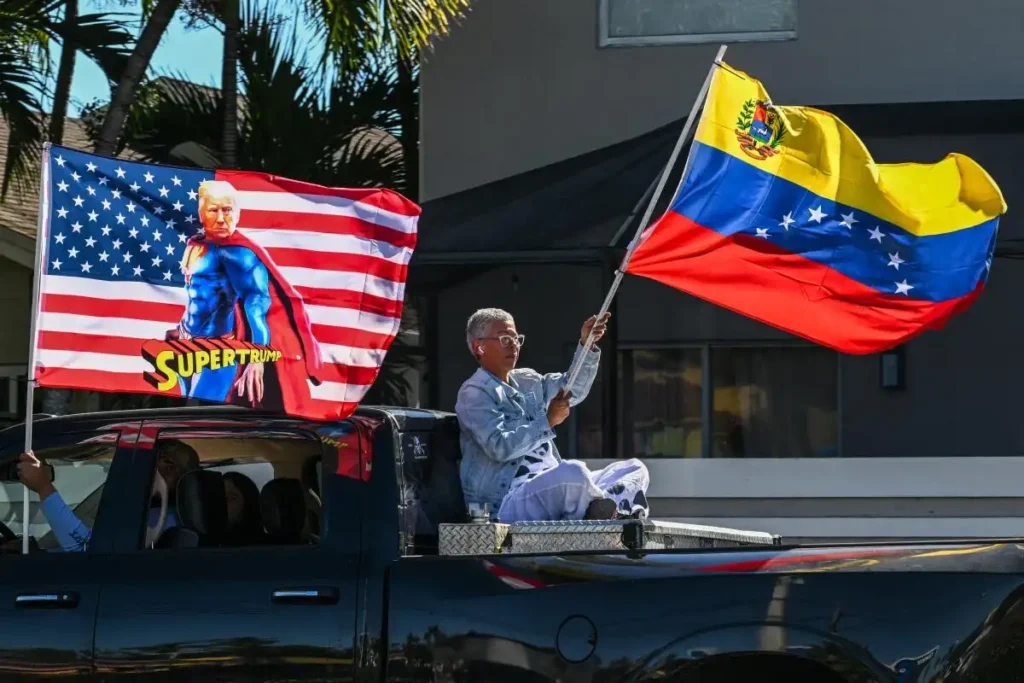
Why Many People Are Celebrating Maduro’s Arrest
1. Symbolic Victory Against Authoritarianism
Opposition leaders — notably Venezuelan opposition figure María Corina Machado — celebrated the capture as a turning point in Venezuela’s political crisis, calling it the beginning of “an hour of freedom” after decades of repression, economic collapse, and political purges.
Supporters view Maduro’s removal as justice against years of authoritarian consolidation, human rights abuses, and allegations of corruption tied to drug trafficking networks allegedly protected by the state.
2. A Blow Against Corruption and Crime
The U.S. Department of Justice had charged Maduro and others with leading a transnational criminal organization that trafficked cocaine into the United States and enriched members of the regime and allied networks.
For many Venezuelans and international advocates, his removal represents not just political turnover but accountability — long denied within Venezuela’s justice system.
3. Hope for a Transitional Government
U.S. allies in the Venezuelan opposition have begun to assert legitimacy, with figures recognized by the U.S. preparing to form a transitional government.
While immediate prospects remain chaotic, there is broad hope among opponents of the Maduro government that his removal could open pathways for democratic renewal.
Global Reaction: Celebration and Outrage
However, worldwide responses are sharply divided along geopolitical lines:
- Supporters — including right-leaning governments and some civil society voices — herald the action as a blow for democracy and justice.
- Critics — including China, Russia, France, Mexico, Brazil, and the United Nations — condemned the operation as an egregious breach of national sovereignty and international law.
North Korea’s reaction was particularly fierce. Pyongyang denounced the capture as a “serious encroachment of sovereignty” and “rogue and brutal,” calling for global protest against what it labeled U.S. imperialism.
Could Something Like Maduro’s Arrest Happen in North Korea?

Many observers — and some commentators — have asked this exact question, especially in light of wide U.S. legal justification for treating Maduro as a leader of a transnational criminal organization rather than a sovereign head of state.
1. The North Korean Case Is Fundamentally Different
North Korea differs dramatically from Venezuela in several key respects:
A. Nuclear Weapons and Strategic Deterrence
North Korea is widely recognized as a nuclear-armed state, with ballistic missiles and a declared deterrence doctrine. According to recent assessments, North Korea’s leadership uses its nuclear arsenal to prevent regime change and justify internal repression.
The U.S. or any coalition would face catastrophic risks in attempting a similar raid. Venezuelan forces have limited military capabilities; North Korea’s conventional and nuclear forces pose a significant deterrent.
B. State Structure and Isolation
North Korea’s political system is deeply centralized around Kim Jong Un and the Korean Workers’ Party, with near-total control of information, society, and the military.
Whereas Venezuela had a fractured political and economic system with significant domestic opposition, North Korea has no open political opposition and state capacity to repress dissent is nearly total.
C. Global Strategic Stakes
International consequences of removing North Korea’s leader would likely be far greater than in Venezuela. The Korean peninsula is one of the most militarized regions in the world. A foreign operation targeting Kim Jong Un could trigger full-scale conflict. Analysts say Pyongyang’s recent ballistic missile tests were partially meant to signal unease about external aggression after the Maduro operation.
2. International Legal and Geopolitical Constraints
Even in Venezuela, critics argue the Maduro capture violated international law and the UN Charter. Applying the same logic to North Korea would be even more diplomatically fraught.
Therefore — no, a Maduro-style operation in North Korea is virtually impossible in the current geopolitical climate.
Could Other Countries Be “Next”? (Hypothetical and Contextual)

While nothing in international affairs suggests a list of leaders targeted for arrest by foreign military force, some analysts frame this as a broader question about accountability for authoritarian abuse.
Here are some contexts and considerations:
1. Legal Instruments and International Courts
The International Criminal Court (ICC) and other tribunals can issue arrest warrants for leaders accused of war crimes and crimes against humanity.
However, these rely on state cooperation or international enforcement mechanisms that are rare without multinational consensus.
2. Regional Contexts With Weak Sovereignty and Strong External Pressure
Certain states with ongoing severe repression — such as Myanmar after its 2021 military coup — face international condemnation and sanctions, but enforcement remains primarily diplomatic and economic rather than military intervention.
International pressure is more common than regime abduction outside specific self-defense arguments.
3. U.S. and Western Policy Precedents
Historically, the U.S. targeted leaders like Saddam Hussein (Iraq, 2003) or supported regime change (Libya, 2011). But those were large military interventions with international coalitions, not isolated extraction missions like Venezuela in 2026.
That doesn’t form a neat “next country” list — rather, it underscores that regime change occurs within broader geopolitical conflict, not as routine enforcement of criminal indictments.
4. Domestic Movements Within Authoritarian States
Change is more likely to come from internal political forces, civil resistance, and domestic reforms supported by international pressure — not foreign military arrests.
Why the Celebration Matters — and Why It’s Complicated
1. It Reflects Longstanding Anger
For Venezuelans who have suffered economic collapse, hyperinflation, political imprisonment, and humanitarian crises, Maduro’s capture is a symbolic moment of accountability.
2. It Raises Questions About Sovereignty
Critics worry that sanctioning unilateral military actions erodes norms that prevent powerful states from infringing on weaker ones’ sovereignty.
3. It Highlights Global Divides
This event is a flashpoint between competing international visions — one that emphasizes accountability for wrongdoing versus one that insists on respecting territorial sovereignty and legal process.
4. It Sparks Debate on Global Justice
Could accountability ever extend to leaders accused of egregious crimes — even where they’re shielded by state power? The Venezuelan case could become a precedent in legal and political discussions but does not imply a new global standard.
Conclusion
Maduro’s arrest is a historic moment — celebrated by some as a victory for justice and reviled by others as an unlawful use of force. It underscores deep divisions in global politics and challenges traditional ideas of sovereignty.
As for North Korea or other authoritarian states, a similar arrest remains highly implausible given strategic, legal, and geopolitical realities. International justice in such cases is more likely to be pursued through courts, sanctions, and diplomacy than foreign military operations.

FAQs
Why is Maduro’s arrest being celebrated globally?
Maduro’s arrest is celebrated because it symbolizes rare accountability for an authoritarian regime accused of corruption, repression, and transnational crime. For many, it represents hope that powerful leaders are not immune from justice.
Could Maduro’s arrest happen to North Korea?
No. While Maduro’s arrest North Korea comparisons are common, North Korea’s nuclear weapons, military strength, and geopolitical risks make similar regime accountability actions extremely unlikely.
What makes North Korea different from Venezuela?
North Korea differs due to its nuclear deterrence, total state control, lack of internal opposition, and strategic importance. These factors prevent external enforcement actions seen in cases like Maduro’s arrest.
Which country could be next after Maduro’s arrest?
There is no confirmed “next country.” Global political arrests depend on international consensus, legal frameworks, and regional stability. Authoritarian regime accountability usually comes through sanctions or courts, not military capture.
Does Maduro’s arrest set a global precedent?
Maduro’s arrest raises debate but does not establish a global standard. Most experts agree it is an exceptional case rather than a model for handling North Korea or other authoritarian regimes.




 and then