








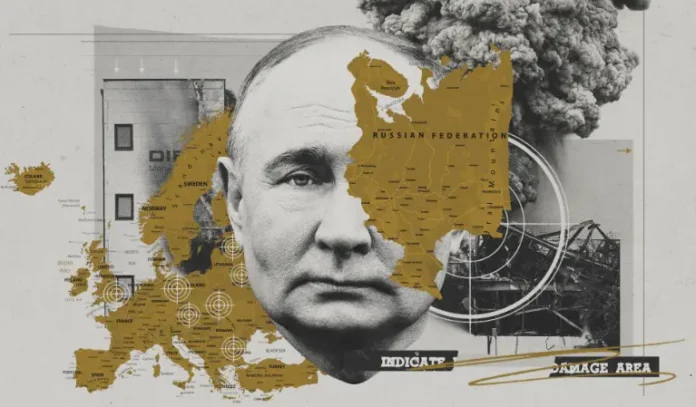
Russia hybrid war on Europe combines cyberattacks, disinformation, political interference, and covert operations to destabilize governments and societies. By exploiting vulnerabilities in infrastructure, politics, and public trust, these tactics undermine European unity and security while staying below the threshold of direct military conflict.
KumDi.com
Since 2022, Russia hybrid war on Europe has emerged as a multi-dimensional strategy targeting political systems, critical infrastructure, and public trust. Combining cyberattacks, disinformation campaigns, covert sabotage, and drone incursions, these operations aim to destabilize European nations, weaken alliances, and influence decision-making without triggering full-scale military conflict.
Since 2022, Russia has waged a hybrid war against Europe — combining military, cyber, informational, economic, and covert operations — to destabilize the continent without triggering a full-scale war. This strategy leverages ambiguity, technological vulnerabilities, and societal divisions to weaken European cohesion, disrupt critical infrastructure, and influence public perception.
Table of Contents

Understanding Hybrid Warfare
Definition:
Hybrid warfare is a strategic approach that blends conventional military force with non-traditional tactics. These tactics include cyberattacks, disinformation campaigns, espionage, economic coercion, and covert operations. The goal is to destabilize the target nation or alliance, exploit weaknesses, and achieve political objectives without provoking direct military retaliation.
In Europe, hybrid warfare involves both state actors and proxies, targeting infrastructure, democratic processes, and public trust to achieve strategic gains while maintaining plausible deniability.
How Russia Conducts Its Hybrid Campaign
Russia’s hybrid war is multi-dimensional, combining cyber, informational, physical, and political tactics.
1. Cyberattacks and Infrastructure Disruption
Russia frequently targets government networks, critical utilities, transportation, and private sectors. These operations often employ sophisticated hacking groups with links to intelligence services.
- Cyberattacks aim to disrupt public services, weaken economies, and create public insecurity.
- Attempts to infiltrate power grids, transportation systems, and government networks are common.
Impact: Disrupted essential services, economic strain, and reduced public confidence in national authorities.
2. Disinformation and Influence Campaigns
Disinformation is used to manipulate public perception, polarize societies, and undermine political cohesion.
- False narratives are spread to question government policies, sow distrust in alliances, and weaken support for sanctions or military aid.
- Social media and digital platforms are exploited to amplify divisive messages and erode public confidence in democratic institutions.
Outcome: Heightened societal polarization and challenges to unified policy responses.
3. Drone Incursions and Aerial Probes
Unmanned aerial systems are deployed to test defense systems and create uncertainty.
- Drone incursions into European airspace disrupt transportation and require military responses.
- These actions are often ambiguous, allowing Russia to claim non-involvement.
Purpose: Test national defenses, strain resources, and influence political debate.
4. Covert Sabotage
Sabotage operations target physical infrastructure like railways, utilities, and industrial facilities.
- Covert attacks aim to cause operational disruption without clear attribution.
- Criminal or proxy actors often carry out these operations to maintain plausible deniability.
Effect: Operational instability and increased public concern about safety.
5. Political Interference
Hybrid warfare extends into political influence and election manipulation.
- External actors support fringe candidates, fund protests, or spread misinformation to influence elections.
- The goal is to weaken public trust in democratic processes and reduce political consensus.
Consequence: Fragmentation within political systems and decreased alliance cohesion.
Why Europe Is Vulnerable
Hybrid warfare thrives in environments with structural vulnerabilities:
- Interconnected infrastructure: Modern digital networks are susceptible to cyber disruption.
- Open societies: Free flow of information can be exploited for misinformation campaigns.
- Complex decision-making: Alliances with multiple member states slow unified responses, creating openings for exploitation.
These vulnerabilities are magnified by strategies that remain below the threshold of traditional war, creating ambiguity and complicating defensive measures.
Real-World Examples (2022–2026)
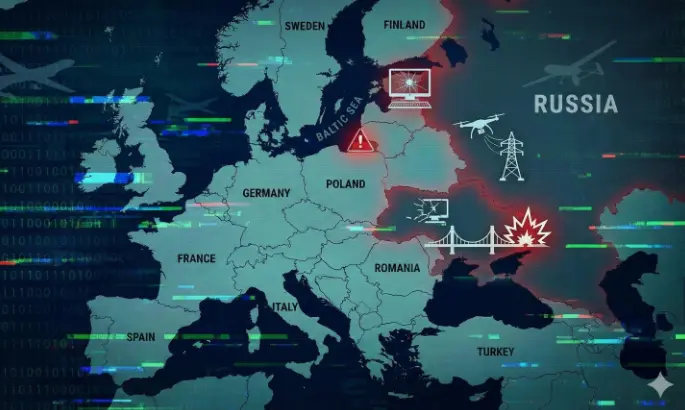
| Timeframe | Tactic | Effect |
|---|---|---|
| 2022–2025 | Cyberattacks on utilities and government networks | Public service disruptions and security alerts |
| 2024–2025 | Drone incursions into European airspace | Airport and airspace disruptions, military scramble |
| 2023–2025 | Disinformation campaigns around elections | Societal polarization and political uncertainty |
| 2024–2025 | Covert sabotage of transport and industrial infrastructure | Operational disruptions and public concern |
European and NATO Responses
1. Sanctions and Diplomatic Measures
Europe imposes sanctions and diplomatic pressure to deter hybrid actions and penalize malicious actors.
2. Strengthening Cyber Defenses
Investment in cybersecurity, public-private collaboration, and intelligence sharing improves resilience against cyber threats.
3. Strategic Communication
Governments educate the public on misinformation, implement counter-disinformation initiatives, and maintain rapid response teams to mitigate influence operations.
4. Military Preparedness
NATO and national militaries conduct exercises simulating hybrid attacks to enhance readiness and test response protocols.
Practical Recommendations
- Attribution: Accurate identification of hybrid attacks reduces ambiguity and increases political consequences for aggressors.
- Resilience: Strengthening public awareness, civic engagement, and infrastructure security limits hybrid campaigns’ effectiveness.
- Legal Frameworks: Updating laws to address cyberattacks, covert interference, and emerging domains of hybrid threats ensures Europe can respond effectively.
Future Outlook
Hybrid warfare is evolving. Russia continues to explore new domains, including space and advanced cyber capabilities, to extend influence without triggering direct conflict.
- Europe’s ongoing challenges include political fragmentation, uneven defenses, and the growing complexity of digital and physical infrastructure.
- Strengthened collaboration, intelligence sharing, and public resilience are critical to mitigating the impact of future hybrid operations.
Conclusion:
Russia’s hybrid war on Europe represents a sophisticated, multi-domain campaign designed to destabilize through ambiguity, disruption, and influence operations. Recognition, coordinated defense, and societal resilience are essential to safeguarding European security and democratic integrity.
FAQs
What is Russia’s hybrid war on Europe?
Russia’s hybrid war on Europe is a coordinated strategy using cyberattacks, disinformation, political interference, and covert operations to destabilize European governments and societies while avoiding direct military confrontation.
What tactics does Russia use in hybrid warfare?
Tactics include cyberattacks on infrastructure, disinformation campaigns, drone incursions, covert sabotage, and election interference, all designed to weaken European security and public trust.
How does Europe respond to Russia’s hybrid war?
European responses include sanctions, cyber defense initiatives, strategic communications to counter disinformation, and NATO military readiness programs to protect critical infrastructure and societal resilience.
Why is Europe vulnerable to hybrid warfare?
Europe’s open societies, interconnected infrastructure, and complex alliance decision-making make it susceptible to Russian hybrid warfare, as these factors are exploited to sow distrust and create operational disruption.
What are the future risks of Russia’s hybrid war on Europe?
Future risks include escalated cyberattacks, expanded influence operations, infrastructure sabotage, and potential use of new domains like space, making continuous intelligence, resilience, and coordinated defense critical for European security.




 and then