








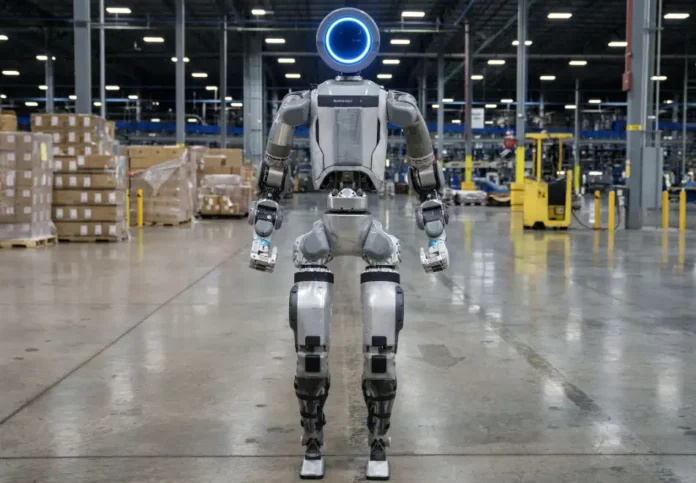
Hyundai Motor Group plans to deploy humanoid robots at its U.S. factory from 2028 to enhance productivity, safety, and efficiency. These AI-powered robots will assist human workers with physically demanding and repetitive tasks, marking a major step toward smart factory automation.
WomanlyZine.com
Hyundai Motor Group plans to deploy humanoid robots at a U.S. factory from 2028 as part of its long-term smart manufacturing strategy. By integrating AI-powered humanoid robots into automotive production, Hyundai aims to boost efficiency, reduce workplace strain, and redefine human-robot collaboration in modern factories.
Hyundai Motor Group is preparing for a transformative shift in automotive manufacturing by announcing plans to deploy humanoid robots at its U.S. production facilities starting in 2028. This move represents a bold step toward the future of human-robot collaboration, positioning Hyundai as a global leader in physical AI, robotics-powered manufacturing, and smart factories.
As labor shortages, workplace safety demands, and productivity pressures reshape the automotive industry, Hyundai’s strategy signals a new era where intelligent machines work alongside humans to enhance efficiency, precision, and sustainability.
Table of Contents

The Strategic Vision Behind Hyundai’s Humanoid Robot Deployment
Hyundai Motor Group’s robotics initiative is not a short-term automation experiment. It is part of a long-term strategy to integrate advanced AI-driven humanoid robots into real-world industrial environments.
Unlike traditional factory robots that operate in fixed positions, humanoid robots are designed to move, lift, and adapt in spaces built for humans. This allows Hyundai to modernize factories without completely redesigning existing infrastructure—a key advantage in scaling robotics globally.
The company envisions humanoid robots as assistive partners, capable of performing physically demanding, repetitive, or hazardous tasks while human workers focus on quality control, decision-making, and oversight.
Why 2028 Marks a Turning Point
The planned 2028 deployment reflects Hyundai’s belief that humanoid robotics technology will reach sufficient stability, intelligence, and economic viability by that time.
Between now and 2028, Hyundai is focusing on:
- AI training and real-world simulation
- Dexterity and mobility refinement
- Safety validation in human-shared environments
- Seamless integration with existing manufacturing systems
This deliberate timeline reduces risk and ensures that robots enter factories as productive contributors rather than experimental novelties.
What Humanoid Robots Will Do in Hyundai’s U.S. Factory
Initially, humanoid robots will support non-creative, physically intensive tasks that are common in automotive manufacturing.
Early Deployment Roles
- Parts sequencing and material handling
- Repetitive lifting and placement tasks
- Transporting components across production zones
- Operating in environments that strain human workers
Over time, their responsibilities may expand to include:
- Assisting in component assembly
- Supporting inspection and quality workflows
- Collaborating with humans on complex production steps
The gradual expansion ensures safety, reliability, and continuous improvement.
Human-Robot Collaboration, Not Replacement
One of the most critical aspects of Hyundai’s plan is its emphasis on collaboration rather than replacement.
Humanoid robots are intended to:
- Reduce workplace injuries
- Alleviate labor shortages
- Improve consistency and uptime
- Support aging workforces
Human employees will remain essential for:
- Supervising robotic systems
- Training and refining robot behavior
- Managing exceptions and creative problem-solving
- Maintaining ethical and safety standards
This approach aligns with a growing industrial philosophy that sees AI and robotics as augmentation tools, not workforce eliminators.
The Role of Physical AI in Manufacturing
Hyundai’s initiative is rooted in the concept of physical AI—artificial intelligence that interacts directly with the physical world.
Unlike software-only AI systems, physical AI must:
- Perceive complex environments
- Make real-time decisions
- Move safely among humans
- Adapt to unpredictable conditions
Humanoid robots represent one of the most challenging and impactful applications of physical AI, combining vision, reasoning, balance, and manipulation in a single system.
Why Humanoid Form Matters in Factories
The decision to use humanoid robots instead of specialized machines is strategic.
Advantages of Humanoid Design
- Can operate in spaces designed for humans
- Use existing tools, ladders, and workstations
- Navigate stairs, narrow passages, and uneven floors
- Adapt to changing factory layouts
This flexibility allows Hyundai to deploy robots across multiple facilities and tasks without costly reengineering.
Implications for the U.S. Manufacturing Landscape
Hyundai’s U.S. factory deployment sends a strong signal about the future of American manufacturing.
Key Impacts
- Reinforces the U.S. as a hub for advanced manufacturing
- Demonstrates how robotics can coexist with skilled labor
- Sets a precedent for other automakers and industries
- Encourages investment in AI and robotics education
As more manufacturers follow suit, humanoid robots could become a standard feature of next-generation factories.
Economic and Productivity Benefits
From an economic perspective, humanoid robots offer long-term advantages:
- Reduced downtime from worker fatigue
- Consistent performance across shifts
- Improved workplace safety metrics
- Enhanced production scalability
While initial investment costs are significant, Hyundai views robotics as a strategic infrastructure investment that will deliver returns through efficiency, quality, and resilience.
Addressing Workforce Concerns
Automation inevitably raises concerns about job displacement. Hyundai’s messaging emphasizes reskilling and role evolution rather than workforce reduction.
Expected workforce shifts include:
- More technical and supervisory roles
- Increased demand for robotics technicians
- Expanded training in AI-assisted manufacturing
- Greater focus on safety, quality, and innovation
This transition mirrors historical shifts during previous industrial revolutions, where technology changed job types rather than eliminating work altogether.
Competitive Positioning in Global Robotics

Hyundai’s robotics push places it among a select group of companies investing heavily in humanoid systems.
By combining:
- Automotive manufacturing expertise
- Advanced AI development
- Large-scale production capabilities
Hyundai is positioning itself not just as a carmaker, but as a mobility and robotics technology leader.
This diversification strengthens its long-term competitiveness as the automotive industry evolves toward electrification, autonomy, and intelligent systems.
Beyond 2028: What Comes Next
While the initial focus is manufacturing, Hyundai’s humanoid robot strategy has implications far beyond the factory floor.
Future applications may include:
- Logistics and warehousing
- Infrastructure maintenance
- Construction and heavy industry
- Smart cities and public services
As AI reasoning, dexterity, and energy efficiency improve, humanoid robots could transition from specialized tools to general-purpose industrial assistants.
Why This Matters for the Future of Work
Hyundai Motor Group’s plan to deploy humanoid robots at its U.S. factory from 2028 represents more than a technological upgrade—it reflects a fundamental rethinking of how humans and machines work together.
This initiative highlights:
- The maturation of humanoid robotics
- The rise of physical AI in real industries
- A pragmatic approach to automation
- A vision of shared productivity between humans and machines
As manufacturing enters its next chapter, Hyundai’s strategy offers a blueprint for responsible, human-centered automation in the age of intelligent machines.
Final Takeaway
Hyundai Motor Group’s decision to introduce humanoid robots into U.S. factories beginning in 2028 marks a defining moment in industrial history. By combining advanced AI, robotics, and human expertise, Hyundai is shaping a future where technology enhances work rather than replaces it.
This approach not only strengthens Hyundai’s manufacturing capabilities but also sets a global benchmark for how industries can responsibly integrate humanoid robots into everyday operations—ushering in a new era of smart, safe, and collaborative factories.
FAQs
Why is Hyundai Motor Group deploying humanoid robots in U.S. factories?
Hyundai humanoid robots are designed to improve efficiency, reduce labor strain, and support smart factory automation by handling repetitive and physically demanding manufacturing tasks.
When will Hyundai humanoid robots be introduced in the U.S.?
Hyundai plans to deploy humanoid robots at its U.S. factory starting in 2028, following extensive testing and AI system optimization.
What tasks will humanoid robots perform in Hyundai factories?
Humanoid robots in automotive plants will assist with material handling, parts transport, and repetitive tasks, supporting human workers rather than replacing them.
How do humanoid robots support smart factory automation?
AI manufacturing robots enhance smart factories by operating in human-designed spaces, adapting to real-time conditions, and improving workflow efficiency and safety.
Will Hyundai humanoid robots replace human workers?
No. Hyundai humanoid robots are intended to collaborate with humans, allowing workers to focus on supervision, quality control, and high-value decision-making roles.




 and then