









China’s hypergravity machine is a massive centrifuge that creates forces up to 2,000 times Earth’s gravity, allowing scientists to compress space and time in experiments. By scaling down distance and accelerating physical processes, it enables faster testing of infrastructure, materials, and environmental systems.
KumDi.com
China’s hypergravity machine represents a breakthrough in extreme gravity research, enabling scientists to compress space and time by recreating real-world forces at accelerated scales. Using intense centrifugal acceleration, the system allows small laboratory models to behave like full-scale structures, transforming how researchers study engineering safety, environmental change, and material performance.
China has taken a decisive leap in experimental science by unveiling the most powerful hypergravity machine ever constructed, a technological marvel capable of simulating gravitational forces nearly 2,000 times stronger than Earth’s gravity. This breakthrough machine is not about science fiction or bending spacetime in a relativistic sense—but about something equally transformative: compressing space and time for real-world scientific discovery.
By enabling researchers to reproduce large-scale, long-duration physical phenomena within a controlled laboratory environment, China’s hypergravity system fundamentally reshapes how humanity studies infrastructure safety, environmental change, materials science, and extreme physics. Processes that once took decades—or required massive real-world structures—can now be tested, observed, and refined in days.
This innovation marks a new chapter in how science accelerates reality itself.
Table of Contents
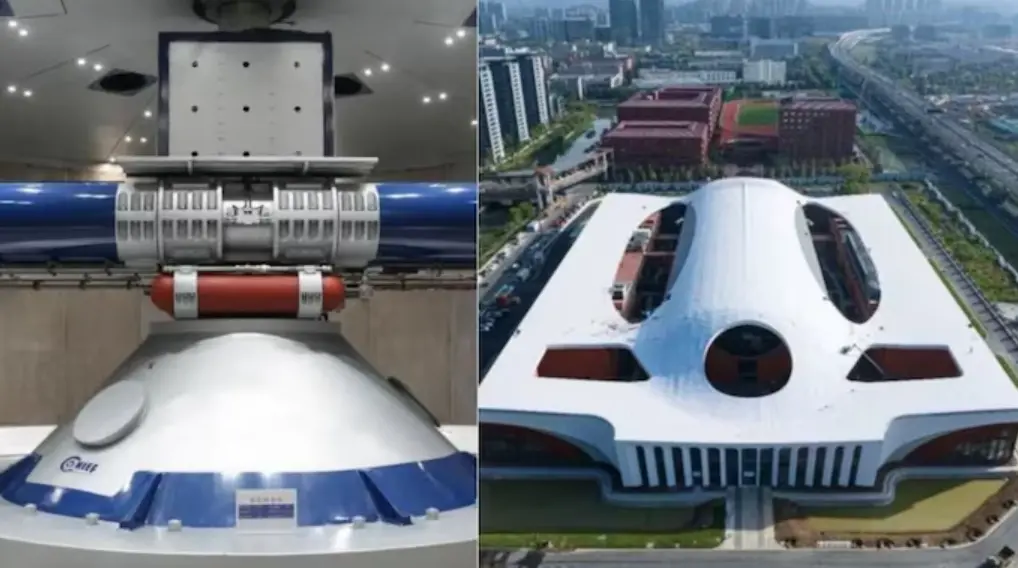
China’s Record-Breaking Hypergravity Machine Explained
China’s record-breaking hypergravity machine is a massive centrifuge designed to generate extreme gravitational forces approaching 2,000 times Earth’s gravity. By rotating experimental models at ultra-high speeds, the machine allows scientists to replicate large-scale physical conditions within a controlled laboratory environment, significantly accelerating scientific testing and discovery.
What Is a Hypergravity Machine and How Does It Work?
A hypergravity machine works by using centrifugal force to simulate gravity far stronger than natural Earth conditions. As the centrifuge spins, samples experience amplified gravitational acceleration, enabling small-scale models to behave like full-size structures. This method allows researchers to study stress, deformation, and long-term physical processes in compressed timeframes.
What Does “Compressing Space and Time” Actually Mean?
The phrase “compressing space and time” is metaphorical, yet scientifically precise in its intent. Hypergravity machines do not alter spacetime as described by Einstein’s relativity. Instead, they scale physical laws so that small models behave as if they were much larger, and short experiments replicate long-term outcomes.
Under hypergravity conditions:
- Distance is compressed: A small physical model behaves like a full-scale structure.
- Time is accelerated: Slow geological, structural, or material processes occur rapidly.
- Forces are amplified: Gravity-dependent stresses multiply without increasing size.
For example, a miniature dam placed under 100 times Earth’s gravity experiences the same stress conditions as a real dam 100 times larger. What normally takes decades of environmental exposure can be observed within hours.
This ability turns the laboratory into a time-accelerating lens, revealing future outcomes before they occur in reality.
How China Compresses Space and Time Using Extreme Gravity
China compresses space and time experimentally by increasing gravity rather than altering physics laws. Under hypergravity, physical distances are effectively scaled down, and time-dependent processes accelerate. This means decades of structural aging or geological change can be observed within hours or days, improving predictive accuracy across scientific fields.
The Science Behind Hypergravity and Extreme Gravity Simulation

Hypergravity simulation is grounded in classical physics and scaling laws. When gravitational force increases, mass, stress, and pressure effects intensify proportionally. By carefully calibrating gravity levels, scientists ensure that experimental results remain physically accurate, allowing reliable translation from laboratory models to real-world conditions.
Engineering Applications of China’s Hypergravity Machine
China’s hypergravity machine plays a crucial role in engineering applications such as dam safety, tunnel stability, earthquake resistance, and foundation design. Engineers use hypergravity testing to identify structural weaknesses early, optimize materials, and enhance safety standards without relying solely on costly real-world construction trials.
Inside China’s Record-Breaking Hypergravity Machine
At the heart of this advancement is a massive centrifuge system designed to generate 1,900 g-tonnes of hypergravity force, surpassing all existing machines worldwide. The machine operates by rotating experimental payloads at extreme speeds, creating immense centrifugal acceleration that mimics ultra-high gravity environments.
Key Technical Capabilities
- Hypergravity intensity approaching 2,000g
- Precision rotational control for stable long-duration experiments
- Massive load capacity for complex, multi-material models
- Advanced vibration isolation and thermal management systems
The facility housing this machine is built deep underground to ensure stability, safety, and accuracy—underscoring the level of engineering sophistication required to operate at such extremes.
Why Hypergravity Matters More Than Ever
Modern society depends on infrastructure and systems that must endure unpredictable and extreme conditions. Climate change, urban density, and technological complexity demand better predictive tools—and hypergravity delivers exactly that.
1. Infrastructure and Civil Engineering
Hypergravity testing allows engineers to:
- Simulate earthquakes, landslides, and structural fatigue
- Test dam stability, tunnel integrity, and foundation resilience
- Identify failure points before construction begins
This dramatically improves public safety while reducing cost and uncertainty.
2. Environmental and Earth Sciences
Environmental processes that evolve over centuries—such as soil compaction, erosion, or pollutant migration—can be studied in compressed timelines. This enables faster decision-making in environmental protection, land use planning, and disaster mitigation.
3. Materials Science and Advanced Manufacturing
Materials behave differently under extreme gravity. Hypergravity experiments reveal:
- Microstructural changes in metals and composites
- Stress responses in aerospace and automotive materials
- Performance limits of next-generation construction materials
The result is safer, stronger, and more efficient products across industries.
Engineering Challenges Behind the Machine
Constructing a hypergravity system at this scale is an extraordinary engineering challenge.
Extreme Rotational Stress
At high speeds, even microscopic imbalances can cause catastrophic failure. Engineers must achieve near-perfect symmetry and material integrity.
Heat and Energy Management
High rotational energy produces immense heat. Advanced cooling systems—combining vacuum environments, airflow control, and thermal dissipation—are essential to maintain safe operation.
Precision Control
Experiments require consistent gravitational conditions over time. This demands real-time monitoring, AI-assisted balancing systems, and ultra-high-precision sensors.
The success of this machine reflects not just scientific ambition, but industrial mastery.
Global Scientific Implications
This machine reshapes the global research landscape in several ways:
- Accelerated innovation cycles: Hypotheses can be tested faster than ever.
- Reduced reliance on costly real-world testing: Fewer full-scale failures.
- Cross-disciplinary collaboration: Physics, engineering, and environmental science converge.
By making extreme conditions experimentally accessible, hypergravity research becomes a catalyst for breakthroughs across domains previously limited by time, scale, or cost.
Debunking the Myths: This Is Not Time Travel

Popular headlines often exaggerate claims about “bending space and time.” In reality:
- The machine does not enable time travel
- It does not manipulate spacetime curvature
- It does accelerate physical processes through scaled gravity
The real achievement lies not in science fiction, but in predictive science—seeing future outcomes early enough to change them.
What Comes Next?
The future of hypergravity research is expansive:
- Integration with AI-driven simulation models
- Multi-physics experiments combining gravity, temperature, and pressure
- New insights into planetary science and space engineering
- Advanced disaster-prevention modeling
As hypergravity facilities evolve, they will increasingly function as time machines of probability—revealing what will happen unless humanity chooses differently.
Conclusion: A Machine That Accelerates Knowledge
China’s record-breaking hypergravity machine is more than a technological milestone—it is a new way of seeing the future. By compressing space and time within a laboratory, it allows scientists to observe outcomes before they unfold in the real world.
In an era defined by rapid change and growing risk, the ability to test reality ahead of time may be one of humanity’s most valuable tools. Hypergravity doesn’t bend the universe—but it bends the timeline of discovery.
And that may change everything.

FAQs
What is China’s hypergravity machine?
China’s hypergravity machine is a large-scale hypergravity centrifuge designed to generate extreme gravitational forces. It allows scientists to study infrastructure, materials, and environmental systems by compressing space and time through accelerated gravity-based experiments.
How does a hypergravity centrifuge compress space and time?
A hypergravity centrifuge compresses space and time by increasing gravity so that small models experience forces equivalent to much larger real-world systems. This accelerates physical processes that would normally take years into hours or days.
Why is extreme gravity research important?
Extreme gravity research helps scientists predict how materials, structures, and natural systems behave under stress. China’s hypergravity machine improves safety testing, disaster prevention, and engineering accuracy without relying on costly full-scale experiments.
What industries benefit from China’s hypergravity machine?
Industries such as civil engineering, environmental science, materials science, and energy benefit from the hypergravity machine. It enables advanced testing of dams, tunnels, buildings, and materials under simulated extreme gravity conditions.
Does China’s hypergravity machine really bend space and time?
No, China’s hypergravity machine does not bend spacetime physically. Instead, it compresses space and time experimentally by scaling gravity, allowing long-term and large-scale phenomena to be studied faster in a laboratory setting.




 and then