








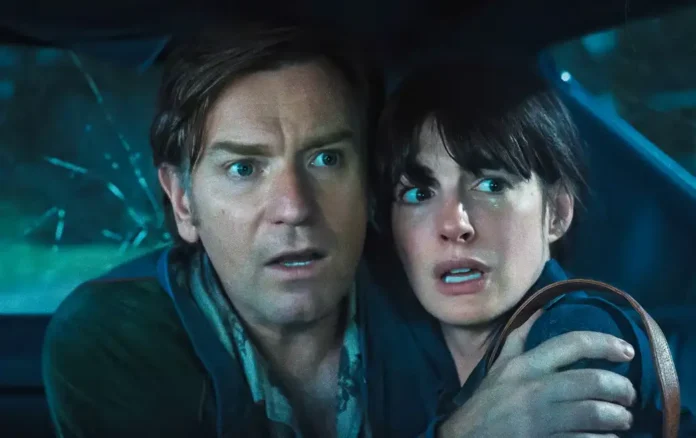

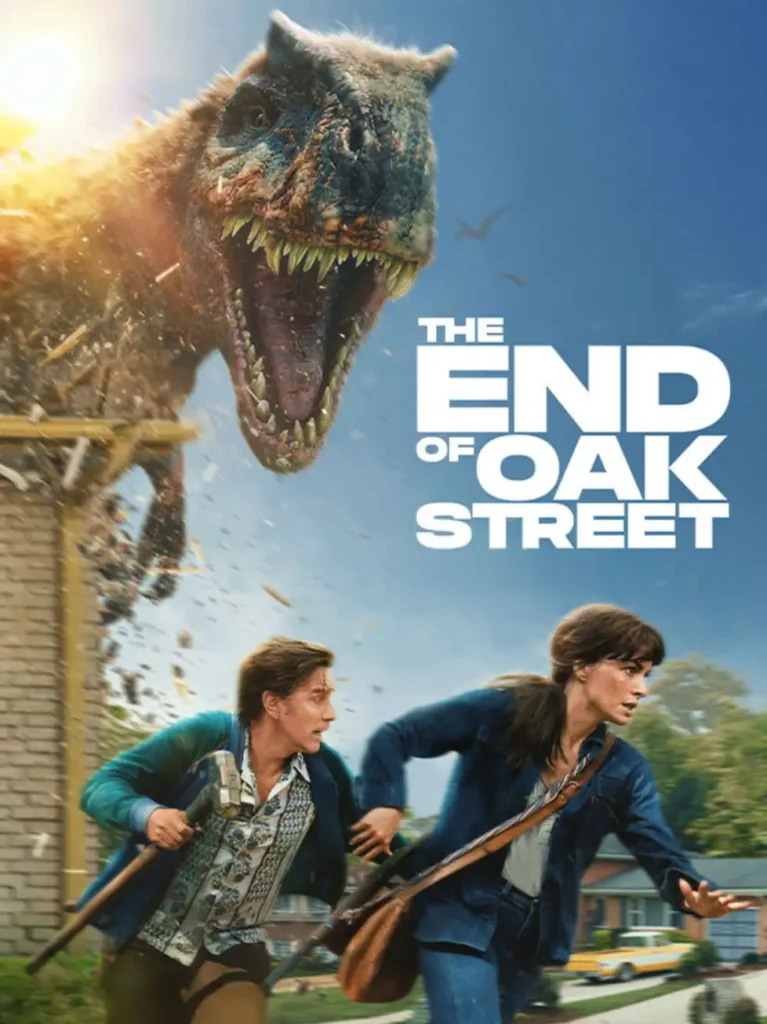
The End of Oak Street Review (2026): David Robert Mitchell’s sci-fi thriller blends suburban family drama with dinosaur survival and cosmic mystery. The film stands out for its atmosphere, visual ambition, and emotional themes, making it a worthwhile watch for fans of intelligent science-fiction and suspenseful adventure cinema.
KumDi.com
The End of Oak Street is one of the most unusual mainstream science-fiction releases of 2026, and the short answer to whether it is worth watching is yes—especially if you enjoy high-concept Spielberg-inspired adventure mixed with family drama and cosmic mystery. Directed by David Robert Mitchell (It Follows, Under the Silver Lake), the film turns a quiet 1980s suburban neighborhood into a prehistoric survival zone filled with dinosaurs, paradoxes, and emotional reckonings. Early critical responses have been notably divided: many reviewers praise its originality, visual ambition, and Anne Hathaway’s performance, while others argue that its emotional core is less convincing than its spectacular premise.
Table of Contents

What is The End of Oak Street about?
The film follows the Platt family, who live on a quiet suburban street during the early 1980s. Their already strained family relationships are interrupted by a mysterious cosmic event that transports their neighborhood into a prehistoric environment where dinosaurs roam freely. What begins as a suburban mystery gradually becomes a survival thriller and eventually a story about family identity, regret, and the possibility of rewriting the past.
| Category | Details |
|---|---|
| Film | The End of Oak Street (2026) |
| Rating | ★★★★☆ (4/5) |
| Director | David Robert Mitchell |
| Starring | Anne Hathaway, Ewan McGregor |
| Genre | Sci-fi survival / adventure thriller |
| Runtime | 99–100 minutes |
| Best for | Fans of Jurassic Park, Super 8, and cosmic mystery films |
The premise sounds intentionally absurd, but Mitchell approaches it with remarkable sincerity. Rather than treating the dinosaurs as mere spectacle, the film uses them as catalysts that expose emotional fractures within the family.
A bold Spielbergian experiment
The most obvious influence is Steven Spielberg’s 1980s adventure cinema, particularly E.T., Close Encounters of the Third Kind, and Jurassic Park. Yet The End of Oak Street is not simply an imitation. It is better understood as a postmodern Spielberg homage, filtered through Mitchell’s fascination with dreamlike spaces, temporal uncertainty, and suburban anxiety.
The film’s visual language reinforces this approach:
- split-diopter compositions,
- lingering suburban landscapes,
- practical-feeling creature encounters,
- and an atmosphere that oscillates between childhood wonder and cosmic dread.
Anne Hathaway carries the emotional weight
Anne Hathaway delivers the film’s strongest performance as Denise Platt, a mother whose private dissatisfaction becomes increasingly important as the story progresses. She gives the character a combination of vulnerability and determination that grounds the film’s more fantastical elements. Critics who were skeptical of the casting generally acknowledged that Hathaway ultimately becomes the emotional center of the movie.
Ewan McGregor is more divisive. His portrayal of Greg Platt captures insecurity and middle-aged disappointment, but some reviewers felt that the chemistry between the leads was inconsistent. The screenplay often gives Hathaway the more compelling emotional material.
The dinosaur sequences: spectacle with restraint
One of the film’s biggest surprises is that it does not overwhelm viewers with constant dinosaur action. Instead, the creatures are introduced gradually through environmental changes:
- unbearable heat,
- prehistoric vegetation,
- mysterious sounds,
- and fleeting glimpses behind suburban fences.
This slow escalation creates genuine suspense. When the major action sequences arrive, they are staged with impressive spatial clarity. Mitchell demonstrates a strong understanding of tension, particularly in scenes where ordinary suburban geography becomes terrifyingly unfamiliar.
The dinosaurs themselves are effective not because they are always visible, but because they feel integrated into the film’s altered ecosystem.
Why the ending is generating discussion
Without revealing major spoilers, the ending has become one of the film’s most discussed elements. It introduces time-travel implications, paradoxes, and alternate-timeline questions that significantly expand the story’s scope. For some viewers, this makes the film intellectually engaging; for others, it makes the narrative unnecessarily complicated.
The ending raises questions about:
- memory,
- personal identity,
- family relationships,
- and whether emotional growth retains meaning when timelines change.
These themes elevate the film beyond a straightforward monster adventure, although they may also frustrate viewers expecting a cleaner resolution.
The film’s biggest strengths
Original high-concept storytelling
In an era dominated by sequels and franchise extensions, The End of Oak Street offers a genuinely distinctive premise. The combination of suburban family drama and prehistoric survival feels refreshingly unpredictable.
Exceptional atmosphere
The production design deserves special recognition. The recreation of 1980s suburbia—BMX bikes, cassette tapes, neighborhood rituals, and domestic interiors—creates a convincing nostalgic environment that contrasts effectively with the prehistoric intrusion.
Strong pacing
At roughly 100 minutes, the film avoids the excessive length that affects many modern blockbusters. Its relatively compact runtime helps maintain momentum even when the narrative becomes increasingly strange.
Where the film falls short
The most consistent criticism concerns character development. While Denise receives substantial emotional attention, several supporting characters remain underdeveloped, and some relationship dynamics feel more symbolic than deeply lived-in.
The screenplay also occasionally prioritizes mystery over emotional clarity. Certain revelations are intriguing conceptually but less satisfying dramatically.
For viewers who value tight narrative logic, the film’s willingness to embrace ambiguity may feel like a weakness rather than a strength.
Themes: suburbia, family, and extinction
The dinosaurs function on multiple levels.
They represent:
- external danger,
- suppressed family conflict,
- environmental disruption,
- and the fragility of modern suburban security.
Mitchell has long been interested in spaces that feel simultaneously familiar and uncanny. Here, the American cul-de-sac becomes a liminal zone where domestic routines collapse under geological time.
The film suggests that catastrophe does not merely threaten families; it reveals who they actually are.
Is The End of Oak Street scary?
The film is more suspenseful than frightening. It contains several intense survival sequences and creature attacks, but it is not primarily a horror film. Viewers sensitive to:
- dinosaur violence,
- peril involving children,
- and some bloody imagery
should be aware that it carries a PG-13 rating for violent content and frightening scenes.
Comparison with Jurassic Park and Super 8
The most useful comparison is not that The End of Oak Street reaches the level of Jurassic Park, but that it attempts something different.
| Film | Primary focus |
|---|---|
| Jurassic Park | Scientific hubris and survival |
| Super 8 | Childhood adventure and mystery |
| The End of Oak Street | Family breakdown, suburbia, and temporal displacement |
Mitchell’s film is ultimately less interested in dinosaurs themselves than in what happens when ordinary lives are displaced from reality.
Who should watch this movie?
You are likely to enjoy The End of Oak Street if you appreciate:
- Spielberg-style adventure,
- cosmic mystery narratives,
- 1980s suburban settings,
- family-centered science fiction,
- and visually distinctive filmmaking.
You may be less satisfied if you prefer:
- straightforward action,
- tightly explained science-fiction mechanics,
- or deeply realistic character psychology.
FAQs
Is The End of Oak Street worth watching?
Yes. The End of Oak Street Review finds that the film is worth watching for its original concept, strong atmosphere, and emotional storytelling. Fans of David Robert Mitchell dinosaur movie projects and intelligent sci-fi thrillers will find plenty to appreciate.
What is The End of Oak Street about?
The End of Oak Street follows a suburban family trapped in a prehistoric environment after a mysterious cosmic event. The End of Oak Street 2026 review highlights its unique blend of dinosaur survival, family conflict, and science-fiction mystery.
Is The End of Oak Street a horror movie?
Not primarily. The End of Oak Street Review describes it as a sci-fi survival thriller with suspenseful dinosaur sequences rather than a traditional horror film. It focuses more on atmosphere, survival, and emotional tension than constant scares.
What makes David Robert Mitchell’s dinosaur movie different?
David Robert Mitchell dinosaur movie storytelling emphasizes mood, mystery, and suburban anxiety rather than nonstop action. The End of Oak Street Review shows how the film combines nostalgic suburbia, cosmic mystery, and prehistoric danger into a distinctive cinematic experience.
Does The End of Oak Street have a confusing ending?
The End of Oak Street ending explained discussions have become popular because the film explores time-travel implications, alternate timelines, and family identity. The ending is intentionally ambiguous, encouraging interpretation rather than providing a simple resolution.
Final review: a flawed but memorable sci-fi adventure
The End of Oak Street is not the perfect dinosaur movie that some early reactions suggested, nor is it the empty nostalgia exercise that its harshest critics describe. It is a rare studio film that feels driven by a filmmaker’s distinctive sensibility. David Robert Mitchell brings enough visual imagination and thematic ambition to make even its weaker moments interesting.
Anne Hathaway anchors the film with genuine emotional conviction, the dinosaur sequences are skillfully staged, and the suburban-prehistoric setting creates a uniquely haunting atmosphere. The narrative occasionally overcomplicates itself, and some characters remain underwritten, but the film leaves a stronger impression than most contemporary science-fiction blockbusters.
For audiences looking for a smart, visually inventive, and emotionally ambitious summer adventure, The End of Oak Street is well worth seeing in theaters. It may not become the next Jurassic Park, but it successfully reminds viewers that blockbuster cinema can still be strange, personal, and unexpectedly moving.




 and then