
HomeScienceHarvard’s Ultra-Thin Metasurface Quantum...

Harvard’s Ultra-Thin Metasurface Quantum Chip Sparks Global Next-Gen Military Tech Race

Free Subscribtion

The Ultra-Thin Metasurface Chip, developed by Harvard physicists, marks a major breakthrough in quantum optics. By collapsing complex optical systems onto a chip just nanometers thick, it paves the way for compact, next-gen quantum processors with military and communication applications, triggering a global race in quantum technology innovation.

KumDi.com

Harvard researchers have created an ultra-thin metasurface quantum chip capable of collapsing entire quantum-optical setups into a single flat device. Led by top scientists in quantum optics, the chip uses graph-theory-based nanoscale design to entangle photons and perform quantum operations at room temperature. This innovation dramatically enhances scalability, stability, and field deployment potential—ushering in a new era of quantum optics and advanced military applications.

Harvard Just Collapsed a Quantum Computer Onto a Chip

What is the Ultra-Thin Metasurface Quantum Chip?

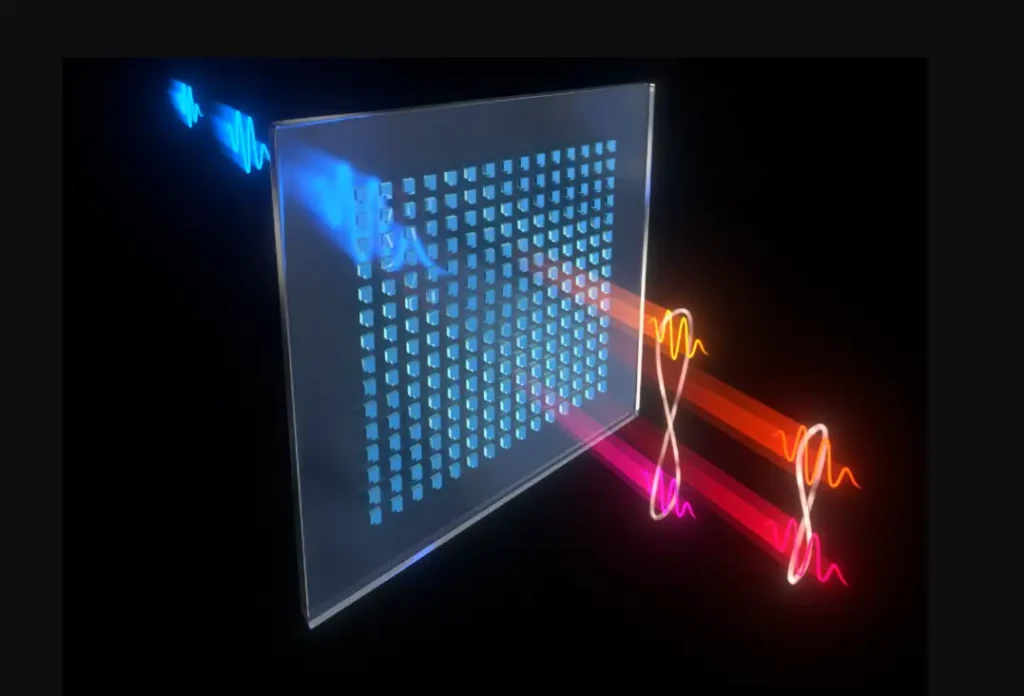
The chip is built from a nanostructured surface that mimics the function of waveguides, beam splitters, and lenses—all within a thin photonic platform. This metasurface can manipulate single photons to form entangled quantum states, enabling quantum computing and communication on a compact scale. Unlike traditional quantum systems, it operates at room temperature, making it highly adaptable for real-world use cases, especially in defense and aerospace.

Why This Matters for Military and Tech Industries

Scalability and Miniaturization

This chip replaces bulky quantum optics setups with a single, flat, scalable layer. Its compactness enables integration into drones, satellites, and mobile defense units.

Room-Temperature Quantum Operations

The chip supports quantum functions without the need for cryogenics, significantly reducing energy needs and improving system portability and maintenance.

Strategic Military Advantage

Defense agencies are interested in the chip’s potential to power unhackable communication systems, advanced quantum radar, and autonomous navigation powered by quantum AI.

How It Works: Graph Theory Meets Nanophotonics

The design leverages graph theory to precisely map photon paths and interactions into a physical surface pattern. These etched nanoscale features control how photons move, interact, and become entangled—all on a single chip. This approach collapses the entire optical quantum system into a reliable, compact platform, eliminating common sources of interference and instability.

- Advertisement -

Global Race Triggered by Breakthrough

With the announcement of this technology, a new wave of funding and defense interest has swept across the United States, China, and Europe. Government agencies and private contractors are racing to scale, adapt, and militarize the technology to gain strategic dominance in the emerging quantum battlefield. This innovation is expected to reshape both civilian and defense sectors over the coming decade.

Challenges and Future Directions

While promising, the chip faces challenges in scaling to handle more complex photon entanglement networks. Mass production and long-term coherence over time and in diverse environments are also areas of ongoing research. Nonetheless, this development represents a foundational step toward practical, portable quantum systems.
FAQs

What is the ultra-thin metasurface quantum chip by Harvard?

It is a nanoscale chip that combines the functions of optical components into a flat surface, enabling quantum photon manipulation and entanglement in a compact format.

How does the metasurface chip simplify quantum optics?

It replaces traditional bulk optics by integrating photon routing and entanglement into a single surface, enhancing stability and miniaturization.

Who developed this metasurface quantum chip?

Harvard scientists specializing in quantum optics and nanophotonics engineered the chip using graph-theory-based nanostructure design.

Why is this chip significant for military applications?

It enables portable, secure quantum systems for defense, including stealth detection, quantum radar, encrypted communication, and autonomous battlefield intelligence.

What are the challenges with metasurface quantum chips?

Scaling complexity, maintaining quantum coherence, and achieving high-yield manufacturing remain the primary hurdles before full deployment.


― ADVERTISEMENT ―

― YouTube Channel for Dog Owners ―

spot_img

Most Popular

Magazine for Dog Owners

Popular News

North Korea’s Ambitious Housing Project: A Tribute to Legacy

In a significant move that underscores both ambition and legacy, North...

Powering the AI Revolution: How the U.S. is Facing an Unprecedented Energy Challenge

The rapid growth of the artificial intelligence (AI) industry has been...

Revolutionary Health in ChatGPT: Transforming the Future of Healthcare in 2026

Health in ChatGPT is transforming healthcare in 2026 by helping healthcare...

― ADVERTISEMENT ―

Read Now

Toxic Fumes in Your Ride: The Hidden Health Risks of Car Interiors

Hopping into your car for the daily commute or weekend road trip may seem like a mundane routine, but unbeknownst to many drivers, the interior of your vehicle could be exposing you to a cocktail of carcinogenic chemicals. A series of recent studies have uncovered a disturbing...

3 “Toxic” Foods a Cardiologist Would Never Give His Kids: Heart Doctors’ Top Warnings for Parents in 2026

The 3 “toxic” foods a cardiologist would never regularly give his kids are sugar-sweetened beverages, processed meats, and ultra-processed snacks. These foods are linked to obesity, high blood pressure, insulin resistance, and increased cardiovascular risk. Heart specialists recommend replacing them with water, whole foods, fruits, vegetables, and...

Unlocking Dreams: New Experiment Links with Sleeping Minds

Imagine a world where the boundaries between dreams and reality blur, and the subconscious becomes a canvas for profound communication and exploration. This remarkable scenario, often relegated to the realm of science fiction, has now become a reality thanks to the pioneering efforts of researchers at REMspace,...

AI Made from Living Human Brain Cells: Revolutionizing Speech Recognition

Artificial intelligence (AI) has been a rapidly evolving field, constantly pushing the boundaries of what machines can achieve. In a groundbreaking experiment, researchers at Indiana University Bloomington have combined living brain cells with computer chips and AI algorithms to create a biocomputing system capable of performing speech...

The Mystery Illness Spreading Among Dogs: What You Need to Know

In recent months, reports of a mysterious respiratory illness affecting dogs have been causing concern among pet owners. With cases popping up in multiple states across the country, many are left wondering about the cause, symptoms, and potential risks associated with this illness. In this comprehensive guide,...

The Alien Ecosystem of Crystal-Clear Lagoons in the Atacama Desert

The Atacama Desert in Argentina's Puna de Atacama has revealed a stunning secret—an alien ecosystem of crystal-clear lagoons nestled amidst vast salt plains. This extraordinary discovery, unlike anything ever seen before, has left scientists astounded. The harsh conditions of this remote desert, known for its bone-dry environment...

Elon Musk’s Controversial Endorsement of Germany’s AfD

In recent weeks, Elon Musk, the billionaire entrepreneur and CEO of Tesla, has stirred up significant controversy by publicly endorsing Germany's far-right political party, the Alternative for Germany (AfD). This endorsement has raised eyebrows not only due to the party’s controversial stance on immigration and national identity...

The Rising U.S. National Debt: A Growing Concern for the Economy

The United States is facing a pressing economic issue as its national debt continues to rise at an alarming rate. In recent years, the debt has been increasing by $1 trillion approximately every 100 days. This concerning trend has caught the attention of economists and financial experts,...

Beetlejuice Beetlejuice: A Spirited Review of Tim Burton’s Sequel

Tim Burton's "Beetlejuice" has captivated audiences since its debut in 1988, blending horror and comedy in a uniquely ghoulish fashion. Now, after decades of anticipation, the ghostly bio-exorcist is set to return to the big screen in "Beetlejuice Beetlejuice." This new installment promises to bring back the...

Movie Trap Review: Josh Hartnett Shines in M. Night Shyamalan’s Twiste

For longtime fans of acclaimed director M. Night Shyamalan, the anticipation around each new release has become a bittersweet experience. Once hailed as the next Alfred Hitchcock for his ability to craft compelling thrillers with shocking twists, Shyamalan's career has been a rollercoaster ride, with both critical...

Why China’s Affordable AI Is a Worry for Silicon Valley: The 2026 Cost, Competition and Strategy Guide

China’s affordable AI is a concern for Silicon Valley because companies such as DeepSeek and Alibaba are delivering increasingly competitive AI models at lower costs. This could accelerate AI price competition, pressure profit margins, expand open-model adoption, and challenge the economics behind massive U.S. investments in AI...

Meta’s Threads App Launches Across EU, Posing a Challenge to Competitor X

Meta, the parent company of popular social media platforms Facebook and Instagram, has recently launched its Threads app in the European Union (EU). This move comes after a delay in the EU launch due to regulatory compliance. The introduction of Threads in the EU presents a potential...