










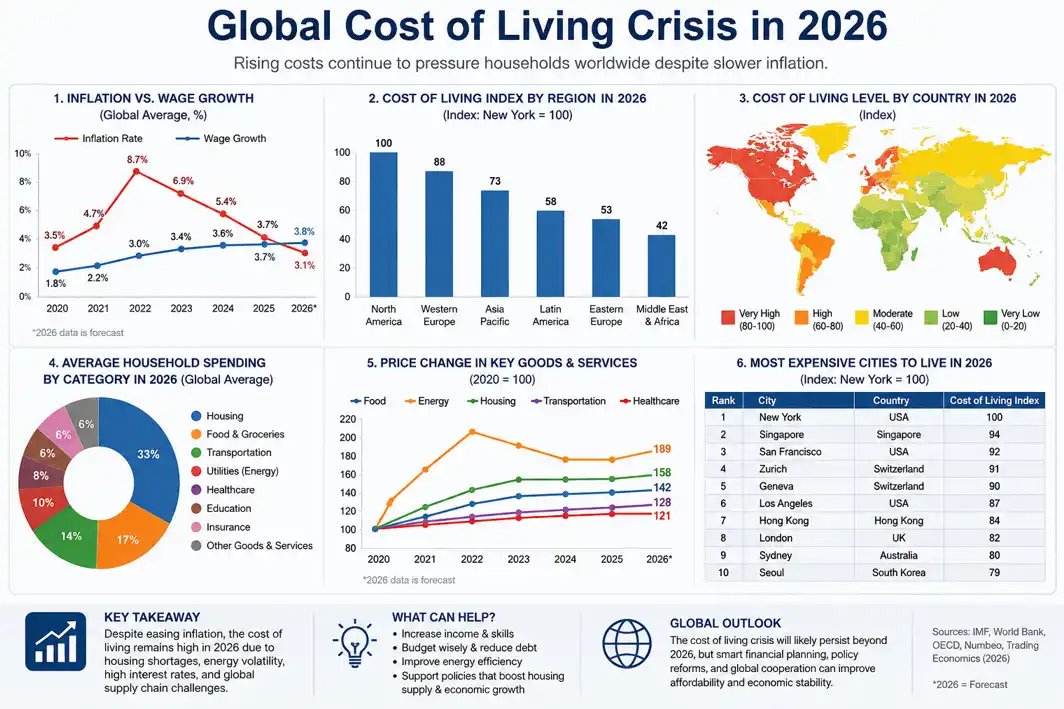
The Global Cost of Living Crisis in 2026 is the ongoing rise in housing, food, energy, healthcare, and transportation costs that continues to outpace income growth in many countries. Although inflation has eased in some regions, affordability remains a major global challenge due to high housing costs, interest rates, supply chain disruptions, and geopolitical uncertainty.
KumDi.com
The global cost of living crisis in 2026 refers to the sustained increase in the everyday expenses that households face, including housing, food, transportation, healthcare, education, and energy. Although inflation has moderated in some economies compared with the peak levels experienced after the COVID-19 pandemic, millions of families continue to struggle because wages have not always kept pace with rising costs, while housing shortages, geopolitical tensions, supply chain disruptions, and higher borrowing costs continue to affect household budgets.
Rather than being a temporary inflation spike, the 2026 cost of living crisis has evolved into a broader affordability challenge. Governments, businesses, and consumers are adapting to an economic environment characterized by higher structural costs, slower productivity growth in some sectors, changing labor markets, and increasing uncertainty surrounding global trade and energy security.
Table of Contents
What Is the Global Cost of Living Crisis?
The cost of living measures the amount of money required to maintain a certain standard of living within a particular city or country. It typically includes expenses such as:
- Housing and rent
- Mortgage payments
- Food and groceries
- Utilities
- Transportation
- Healthcare
- Childcare
- Education
- Insurance
- Taxes
- Entertainment
A cost of living crisis occurs when these expenses rise faster than household income, reducing purchasing power and making it increasingly difficult for people to afford essential goods and services.
Why Is the Cost of Living Still High in 2026?
Several interconnected factors continue to influence global prices.
1. Housing Remains the Largest Expense
Housing affordability remains one of the biggest challenges worldwide.
Many major cities continue experiencing:
- Limited housing supply
- High construction costs
- Rising property prices
- Increased mortgage interest rates
- Growing urban populations
Cities including New York, London, Sydney, Toronto, Seoul, Singapore, and Dublin continue to rank among the world’s most expensive housing markets.
2. Food Prices Continue to Increase
Although food inflation has slowed in some regions, grocery prices remain significantly above pre-pand9emic levels.
Major contributing factors include:
- Climate-related crop failures
- Higher fertilizer costs
- Increased transportation expenses
- Labor shortages
- Regional conflicts affecting agricultural exports
Staple foods such as wheat, rice, vegetable oils, dairy products, and meat continue experiencing price volatility depending on region and season.
3. Energy Markets Remain Volatile
Energy prices continue influencing almost every sector of the economy.
Contributing factors include:
- Geopolitical instability
- Natural gas market fluctuations
- Electricity demand from AI data centers
- Renewable energy transition costs
- Extreme weather events
Higher energy costs affect:
- Manufacturing
- Transportation
- Food production
- Heating and cooling
- Consumer goods
4. Higher Interest Rates Increase Household Costs
Many central banks maintained relatively high interest rates during 2025 and into 2026 to control inflation.
Higher rates directly increase:
- Mortgage payments
- Business loans
- Credit card interest
- Car loans
- Student loan repayments
Even if inflation slows, borrowing remains expensive for many households.
5. Global Supply Chains Are More Fragile
International supply chains have improved compared with previous years but remain vulnerable to disruptions caused by:
- Armed conflicts
- Shipping delays
- Trade restrictions
- Cybersecurity incidents
- Natural disasters
Businesses often pass these increased costs to consumers.
Which Countries Are Most Affected?
The severity of the cost of living crisis varies significantly across countries.
High-Income Economies
Countries including:
continue experiencing pressure from housing affordability and higher service costs despite relatively stable labor markets.
Emerging Economies
Many emerging economies face additional challenges including:
- Currency depreciation
- Higher import costs
- Food insecurity
- Limited wage growth
- Higher inflation volatility
How Does the Crisis Affect Everyday Life?
The effects extend beyond household budgets.
Reduced Consumer Spending
Families often postpone:
- Home purchases
- Vehicle upgrades
- Vacations
- Electronics
- Luxury goods
This reduced spending affects retail businesses and economic growth.
Increased Financial Stress
Financial pressure contributes to:
- Anxiety
- Delayed retirement planning
- Increased household debt
- Reduced savings
- Lower emergency preparedness
Financial well-being has become an important public health issue in many countries.
Declining Housing Affordability
Young adults increasingly face challenges purchasing homes because of:
- High down payment requirements
- Expensive mortgages
- Rising rents
- Limited housing inventory
Many delay homeownership for several years.
Changes in Consumer Behavior
Households increasingly:
- Compare prices online
- Buy store brands
- Reduce discretionary spending
- Use cashback programs
- Purchase second-hand products
- Delay large purchases
Industries Most Affected

Several industries have experienced major shifts.
Real Estate
Higher financing costs have slowed housing markets in some countries while rental demand continues increasing.
Retail
Consumers prioritize essential purchases over discretionary spending.
Travel
Travel demand remains strong, but travelers increasingly seek:
- Budget airlines
- Off-season travel
- Alternative accommodations
Healthcare
Healthcare costs continue rising because of:
- Aging populations
- Workforce shortages
- Medical technology investments
Why the Cost of Living Crisis Is Different From Inflation
Although often used interchangeably, inflation and cost of living are not identical.
| Inflation | Cost of Living |
|---|---|
| Measures average price increases | Measures total household expenses |
| Usually tracked using CPI | Includes lifestyle and local costs |
| May decline while prices remain high | Can remain elevated even after inflation slows |
This distinction explains why many households continue feeling financial pressure despite lower inflation rates.
Practical Strategies for Households
While no single solution fits everyone, several evidence-based strategies can improve financial resilience.
Build a Detailed Budget
Tracking spending often reveals unnecessary expenses and opportunities for savings.
Useful categories include:
- Housing
- Utilities
- Transportation
- Food
- Insurance
- Subscriptions
Strengthen Emergency Savings
Financial experts commonly recommend maintaining several months of essential living expenses in emergency savings whenever possible.
Reduce High-Interest Debt
Paying down high-interest debt can improve monthly cash flow and reduce long-term financial costs.
Improve Energy Efficiency
Simple improvements include:
- LED lighting
- Smart thermostats
- Home insulation
- Energy-efficient appliances
These measures may lower utility expenses over time.
Invest in Skills
Continuous learning remains one of the strongest long-term protections against economic uncertainty.
Growing fields include:
- Artificial intelligence
- Cybersecurity
- Healthcare
- Renewable energy
- Data analysis
What Governments Can Do
Public policy plays an important role in reducing affordability pressures.
Potential approaches include:
- Increasing housing supply
- Supporting affordable childcare
- Investing in public transportation
- Expanding workforce training
- Improving energy infrastructure
- Encouraging productivity growth
- Strengthening supply chain resilience
Each country’s policy response depends on its economic conditions, fiscal capacity, and labor market.
FAQs

What is the Global Cost of Living Crisis in 2026?
The Global Cost of Living Crisis in 2026 refers to the ongoing increase in everyday expenses such as housing, food, energy, transportation, and healthcare that continues to exceed income growth in many countries. Although global inflation 2026 has moderated in some regions, rising living costs remain a significant financial challenge for households worldwide.
What is causing the Global Cost of Living Crisis in 2026?
The main drivers of the Global Cost of Living Crisis in 2026 include persistent housing shortages, higher interest rates, energy market volatility, supply chain disruptions, climate-related impacts on food production, and geopolitical conflicts. Together, these factors contribute to higher cost of living 2026 across developed and emerging economies.
Which countries are most affected by the Global Cost of Living Crisis in 2026?
The Global Cost of Living Crisis in 2026 affects countries differently. High-income economies often struggle with expensive housing and services, while many emerging economies face higher global inflation 2026, weaker currencies, and increased food and energy costs. Affordability challenges are now a worldwide issue.
How can households adapt to the Global Cost of Living Crisis in 2026?
Households can adapt to the Global Cost of Living Crisis in 2026 by creating detailed budgets, reducing high-interest debt, improving home energy efficiency, increasing emergency savings, and investing in new skills. These strategies help reduce the impact of rising living costs and improve long-term financial resilience.
Will the Global Cost of Living Crisis improve after 2026?
Many economists expect global inflation 2026 to continue slowing, but the Global Cost of Living Crisis in 2026 may persist because housing shortages, demographic changes, energy transition costs, and geopolitical uncertainty continue to influence cost of living 2026 worldwide. Long-term affordability improvements will likely require sustained economic growth and effective public policies.
Future Outlook
Most economists expect inflation to remain more moderate than during the early 2020s, but the broader affordability challenge is likely to persist beyond 2026. Structural issues—including housing shortages, demographic changes, climate-related disruptions, geopolitical uncertainty, and the costs associated with the global energy transition—are expected to keep upward pressure on household expenses in many regions.
Future improvements will likely depend on sustained productivity growth, increased housing development, resilient supply chains, stable energy markets, and policies that help wages grow alongside living costs. While conditions vary by country, affordability is expected to remain a central economic and political issue for governments and households alike.
References
- International Monetary Fund (IMF). World Economic Outlook.
- World Bank. Global Economic Prospects.
- Organisation for Economic Co-operation and Development (OECD). Economic Outlook.
- International Labour Organization (ILO). Global Wage Report.
- Gallup. The World’s Most Important Problem Report 2026.
- S&P Global Market Intelligence. Midyear Economic Check-In: A World Diverging (2026).
- Forbes. Tracking 2026 Midyear Trends: Geopolitical, AI, Inflation, People Risk.




 and then