










A Penn State student has solved a 100-year-old mathematical problem that could drastically increase wind energy efficiency. This discovery may reshape how renewable energy is harnessed, optimized, and distributed across the globe.
KumDi.com
In a groundbreaking achievement, a Penn State student has cracked a century-old math problem, unlocking a new wind energy math breakthrough that experts believe could revolutionize the way we capture and optimize wind power. This discovery marks a pivotal moment in the future of renewable energy innovation, potentially increasing turbine efficiency and reshaping global energy strategy.
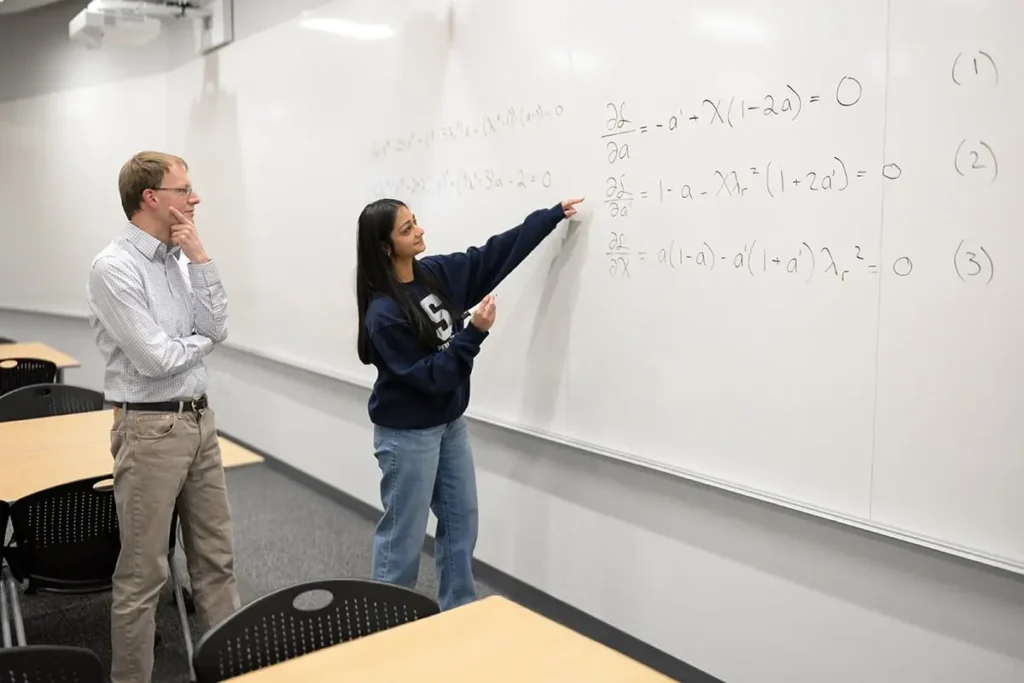
In a remarkable achievement that bridges the gap between historical mathematical theory and modern engineering, Divya Tyagi, a graduate student at Pennsylvania State University, has successfully refined a century-old equation originally proposed by British aerodynamicist Hermann Glauert. This breakthrough not only enhances our understanding of wind turbine efficiency but also opens new avenues for sustainable energy production.
Table of Contents
The Historical Context of Glauert’s Equation
Hermann Glauert introduced his mathematical framework over a hundred years ago, aiming to optimize the performance of wind turbines. His work laid the groundwork for understanding how turbines convert wind energy into electricity, focusing primarily on the maximum power coefficient. However, despite its significance, Glauert’s equation had notable limitations. It failed to account for critical physical forces that affect turbine performance, such as downwind thrust and root bending moments. These omissions hindered the practical application of his theories in real-world scenarios.
The Gaps in Glauert’s Work
- Downwind Thrust: This force acts on the rotor and is crucial for understanding how turbines interact with wind.
- Root Bending Moments: These moments occur due to the flexing of turbine blades under wind pressure, impacting their structural integrity.
By neglecting these factors, Glauert’s original model left engineers with an incomplete picture of turbine dynamics, limiting advancements in wind energy technology.
Divya Tyagi’s Innovative Approach
Divya Tyagi took on the challenge of revisiting Glauert’s equation during her undergraduate studies at Penn State’s Schreyer Honors College. Under the mentorship of Professor Sven Schmitz, she employed advanced mathematical techniques, specifically the calculus of variations, to refine the original model. This approach allowed her to create a more comprehensive and applicable formula for modern wind turbine design.
The Methodology Behind the Breakthrough
Tyagi’s research involved:
- Revisiting Glauert’s Theories: She analyzed the original equation to identify its shortcomings.
- Applying Calculus of Variations: This mathematical method enabled her to optimize the equation for better accuracy in predicting turbine performance.
- Incorporating Additional Variables: By including factors like downwind thrust and bending moments, Tyagi’s model offers a more holistic view of turbine dynamics.
Her work culminated in a refined equation that not only simplifies the calculations but also enhances the understanding of how turbines can be optimized for maximum efficiency.
The Impact of Tyagi’s Discovery
The implications of Tyagi’s refinement are profound. Even a modest improvement in the power coefficient of a wind turbine can lead to significant increases in energy output. Tyagi estimates that a mere 1% enhancement could potentially provide enough additional power to supply an entire neighborhood.
Real-World Applications
- Increased Energy Production: A small uptick in efficiency can translate to substantial energy savings and output.
- Cost Reduction: Improved turbine designs can lead to lower operational costs, making wind energy more competitive with other energy sources.
By addressing the previously overlooked factors in turbine performance, Tyagi’s work paves the way for the next generation of wind energy solutions.
Recognition and Awards
Tyagi’s groundbreaking research has not gone unnoticed. She was awarded the prestigious Anthony E. Wolk Award for her thesis, which recognizes the best senior thesis in aerospace engineering at Penn State. This accolade underscores the quality and potential impact of her work on the renewable energy sector.
The Significance of the Wolk Award
- Academic Excellence: The award highlights Tyagi’s dedication and innovative thinking in a challenging field.
- Future Influence: Her research is expected to inspire future engineers and researchers to explore similar avenues in wind energy optimization.
Future Directions in Wind Energy Research
As Tyagi continues her studies, she is now focusing on computational fluid dynamics (CFD) to analyze airflow around helicopter rotors. This research aims to improve pilot safety during deck landings by understanding how the air generated by ships interacts with helicopters.
Bridging Multiple Disciplines
Tyagi’s work exemplifies the interconnectedness of various engineering fields. By applying her findings from wind turbine optimization to aerospace applications, she is contributing to advancements in both sectors.
The Broader Implications for Renewable Energy
Tyagi’s mathematical breakthrough arrives at a crucial time when the demand for clean energy sources is escalating. As the world grapples with climate change and the need for sustainable solutions, improvements in wind turbine efficiency hold tremendous potential for addressing these challenges.
The Role of Wind Energy in Sustainability
- Renewable Resource: Wind energy is a clean, inexhaustible resource that can significantly reduce reliance on fossil fuels.
- Technological Advancements: Innovations like Tyagi’s refined equation can drive the development of more efficient wind turbines, making renewable energy more accessible and affordable.
The Path Forward
The wind energy sector stands on the brink of transformation, thanks to the contributions of researchers like Divya Tyagi. Her work not only enhances our understanding of turbine dynamics but also sets the stage for future innovations in renewable energy technology.
Encouraging Future Research
Tyagi’s success story serves as an inspiration for aspiring engineers and scientists. It highlights the importance of perseverance and creative problem-solving in tackling complex challenges. As the industry looks to the future, her findings may encourage similar revisitations of historical mathematical problems, potentially leading to a cascade of innovations across the sustainable energy sector.
Conclusion
Divya Tyagi’s refinement of Glauert’s century-old equation represents a significant milestone in the quest for improved wind energy efficiency. By addressing the gaps in the original model and applying modern mathematical techniques, she has opened new avenues for research and development in renewable energy. As the world continues to seek sustainable solutions to its energy needs, Tyagi’s work stands as a testament to the power of innovation and the importance of revisiting established theories with fresh perspectives.
The Future of Wind Energy
With Tyagi’s contributions, the future of wind energy looks promising. As engineers and researchers build upon her findings, we can expect to see advancements that not only enhance turbine performance but also contribute to a more sustainable energy landscape. The journey toward a cleaner, greener future is well underway, and it is driven by the innovative spirit of individuals like Divya Tyagi.

FAQs
What math problem did the Penn State student solve?
A Penn State student solved a century-old math problem involving complex equations that model wind turbulence, leading to a potential wind energy breakthrough.
How does this math discovery affect wind energy?
This mathematical insight improves the predictive modeling of wind patterns, boosting wind turbine efficiency and supporting broader renewable energy innovation.
Why is this wind energy math breakthrough important?
By solving this long-standing math challenge, energy systems can now be designed with greater accuracy, drastically enhancing wind power output and stability.
How was the Penn State student recognized for this discovery?
The student’s wind energy innovation has gained national recognition, placing Penn State at the forefront of clean energy mathematics and academic excellence.
Could this math solution impact other renewable energy fields?
Yes, similar models can be adapted for solar, hydro, and geothermal systems, making this math breakthrough a catalyst for multi-sector energy transformation.




 and then