








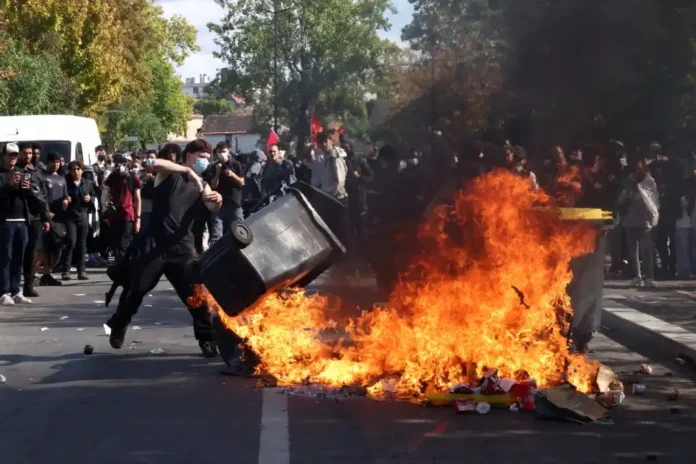

France high school protests in 2026 are driven by concerns over teacher shortages, overcrowded classrooms, deteriorating school facilities, educational inequality and government education policies. The demonstrations began around Paris before spreading nationwide, with some protests remaining peaceful while others involved school blockades, property damage and clashes with police.
KumDi.com
France’s high school protests have rapidly developed into one of the country’s most significant education-related demonstrations in 2026. The movement began in the Paris region in September, driven primarily by concerns about teacher shortages, overcrowded classrooms, deteriorating school buildings, long school days, inadequate resources, and inequality in education. By early October, the protests had spread nationwide, affecting hundreds of schools and, according to French authorities, more than 1,000 high schools at the movement’s peak.
The protests are important because they are not simply about one policy or one school. They reflect a broader conflict over the quality and accessibility of France’s public education system, government spending priorities, and how much influence young people should have over decisions affecting their education and future. At the same time, some demonstrations have involved fires, property damage and clashes with police, creating a second issue: how authorities should protect students and school staff while respecting the right to peaceful protest.
Table of Contents
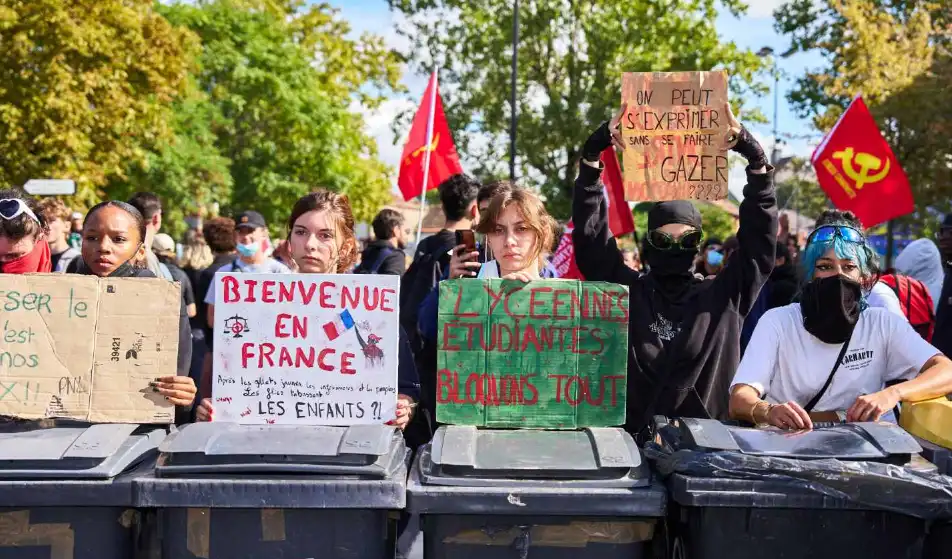
What Are France’s High School Protests About?
The current protests involve students at French lycées, the schools generally attended by teenagers aged approximately 15 to 18. In the American education system, a lycée is broadly comparable to high school.
The movement has several overlapping demands rather than one single manifesto. Students have reported problems including:
- Too few teachers and frequent teacher absences
- Overcrowded classrooms
- Aging or poorly maintained school buildings
- Long and demanding school schedules
- Insufficient educational and support staff
- Concerns about unequal access to educational resources
- Anxiety surrounding the transition from secondary school to higher education
- Frustration about government education and budget policies
These concerns are particularly visible in disadvantaged areas around Paris, including Seine-Saint-Denis, where students, parents and education workers have highlighted staffing shortages and inadequate facilities. However, the movement has expanded beyond the Paris suburbs to cities and towns across France.
French high school students are protesting mainly because they believe their schools are under-resourced and that deteriorating facilities, teacher shortages, overcrowding and educational inequality are undermining their ability to learn and prepare for their futures.
The demonstrations have also become connected to wider debates about government spending and public services.
How Did the Protests Start?
The latest wave of protests emerged in the Paris region in September 2026.
Early demonstrations were concentrated around individual schools, but student organizations subsequently called for wider mobilization. The movement gained momentum through social media, where students shared information about school-specific problems and coordinated blockades and demonstrations.
The timing was significant. France was already experiencing political pressure over government finances and proposed budget measures. A broader public-sector mobilization also brought teachers and other workers into the streets, creating an environment in which school-related grievances could quickly become part of a larger national protest movement.
By October 1, the Education Ministry said more than 1,020 high schools had been affected by strikes or protests, including 222 blockades. That represented roughly one-quarter of France’s high schools at that point.
The scale subsequently prompted school closures and increased police deployment.
7 Key Things to Know About the French High School Protests
1. The protests began with education-related grievances
At their core, the demonstrations concern students’ everyday experience at school.
Students have described classrooms without enough teachers, crowded learning environments and buildings requiring maintenance. In some locations, students say subjects have been canceled because schools cannot consistently provide teachers.
These complaints are particularly important because lost teaching time can have consequences beyond temporary inconvenience. For students preparing for the baccalauréat, France’s major secondary-school qualification, interruptions can affect preparation for examinations and subsequent higher-education applications.
The French Education Ministry reported that approximately 11.6 million students returned to school in September 2026, supported by about 851,500 teachers across roughly 57,700 schools, colleges and lycées. The ministry reported an average of 25.3 students per class in collèges and lycées.
Those national averages, however, do not necessarily describe conditions at individual schools.
2. Teacher shortages are one of the central complaints
One of the most frequently cited issues is the availability of teachers.
Students and parents have reported classes being canceled or taught without a permanent teacher. This is especially sensitive in disadvantaged areas, where education advocates argue that staffing problems can compound existing social inequalities.
The issue is not simply the number of teachers employed nationally. Teacher distribution, recruitment, replacement of absent staff and differences between schools and regions can all affect students’ actual classroom experience.
This distinction is important when evaluating the protests. A national staffing statistic may look relatively stable while a particular lycée can still experience repeated vacancies.
3. School inequality is a major underlying issue
The protests have highlighted longstanding concerns about differences between French schools.
A student’s educational experience can be influenced by the socioeconomic characteristics of the area in which they live, the resources available to their school, staffing stability and the condition of school facilities.
Seine-Saint-Denis, northeast of Paris, has become one of the most visible centers of the movement. Reports from the area describe chronic shortages involving teachers as well as other school personnel, including nurses and social workers.
This is why the protests cannot be understood solely as a dispute over classroom comfort.
For many participants, the issue is educational equality: whether students from less affluent communities have the same realistic opportunity to receive high-quality education as students in wealthier areas.
4. The protests have spread far beyond Paris
Although the movement began in the Paris region, demonstrations have appeared across France.
Cities including Lyon, Lille, Marseille, Strasbourg, Rennes and Nantes have seen protests or disruptions. Students have used blockades, demonstrations and other forms of direct action to draw attention to their demands.
The geographical expansion matters because it suggests that the movement is not solely a local dispute.
At the same time, demands vary between schools. Some students focus heavily on staffing and facilities, while others have raised concerns about schedules, food services, university admissions or specific government policies.
Therefore, it is more accurate to describe the protests as a national movement with multiple local grievances rather than a campaign built around one universally agreed demand.
5. Violence has changed the political debate
The most controversial aspect of the demonstrations has been the escalation from peaceful protests to incidents involving fires, vandalism, attacks and clashes with police.
The French government has emphasized that students have a legitimate right to express grievances but that violence and damage to schools or public property are unacceptable. Officials increasingly described some incidents as “urban violence” rather than ordinary student demonstrations.
French authorities have reported thousands of arrests during the escalation. AFP reported that more than 5,000 people had been arrested since Monday by October 4, while approximately 735 educational establishments had been affected on the Friday, according to the education minister.
These numbers should be interpreted carefully because the situation has been changing rapidly and government figures refer to different categories of incidents and time periods.
The distinction between peaceful student protest and criminal violence is essential. Treating the entire movement as violent would obscure the educational grievances expressed by many students. Conversely, treating every act committed during a protest as protected political expression would ignore legitimate concerns about safety and property damage.
Why Are Schools Being Closed?
School closures have become a major consequence of the protests.
When demonstrations occur directly outside school entrances, administrators may decide that allowing normal classes to continue creates unacceptable safety risks for students, teachers and other staff.
By October 2, reports indicated that approximately 400 of France’s roughly 3,700 high schools were closed, while hundreds more were experiencing protests or disruption.
Closures create a difficult policy dilemma:
If schools remain open: students and staff may face safety risks.
If schools close: students lose instructional time and the disruption can intensify the very educational problems protesters are highlighting.
This creates a feedback loop in which the protest itself can worsen educational disruption even while students are protesting against disruption.
What Role Does the French Government Play?
The government has attempted to balance two competing responsibilities:
- Address legitimate concerns about education.
- Maintain public safety and protect schools, students and staff.
Education Minister Édouard Geffray has acknowledged that some student grievances are legitimate while condemning violence.
The government has also attempted to engage with student organizations and parent representatives. Following the escalation, officials withdrew a proposal involving fees for certain post-secondary preparatory or vocational programs, in an effort to reduce tensions.
The Education Ministry’s broader 2026–27 strategy emphasizes three institutional priorities: educating, protecting and uniting students.
That creates a significant challenge for policymakers: responding to immediate protests while also addressing structural problems that cannot be solved within a few days.
How Does France’s Education Budget Fit Into the Protests?
Budget policy is an important part of the wider dispute.
The protests emerged alongside political controversy surrounding France’s public finances and proposed government spending reductions. Education has consequently become part of a broader national argument about which public services should receive funding and how France should control its deficit.
For students, the argument is relatively straightforward: if schools lack teachers, support personnel or adequate facilities, additional resources may be necessary.
For the government, the problem is more complicated because education spending must be considered alongside France’s broader fiscal constraints.
This tension explains why the protests have attracted support from trade unions and political organizations beyond the student movement itself.
Why Are Young People Especially Mobilized?
High school students have a direct stake in education policy because they experience its consequences every day.
A teenager dealing with a missing teacher, overcrowded class or deteriorating building does not experience those issues as abstract budget statistics. They experience them as lost lessons, additional stress and uncertainty about academic performance.
The timing is particularly significant for students approaching the baccalauréat or preparing for higher education.
France’s transition from secondary school to university and other forms of higher education can already be stressful. Students have also expressed frustration with the Parcoursup higher-education application system, adding another layer to concerns about their educational future.
Social media has also changed the speed at which school-level grievances can become national issues. Students can document problems, share protest information and see that similar concerns exist elsewhere almost immediately.
Are All French High School Students Supporting the Protests?
No.
It is important not to treat the entire French student population as a single political group.
The scale of participation has been substantial, but many students continue attending classes. Individual schools have experienced different levels of participation, and the reasons for joining demonstrations vary.
Some students participate because of staffing and educational conditions. Others may be responding to broader political or economic issues. Some participate in solidarity with students in disadvantaged schools.
This diversity is one reason why national descriptions of the movement should be treated carefully.
What Are the Main Risks of the Protests?
The protests create several distinct risks.
Educational disruption
School closures and canceled lessons can reduce instructional time, particularly concerning for students preparing for major examinations.
Safety risks
Clashes involving police, protesters, fires and thrown objects create risks for students, teachers, police officers and emergency personnel.
Property damage
Damage to schools can directly reduce the resources available to students and may impose additional costs on already pressured local authorities.
Political polarization
When education protests become associated with broader ideological conflicts, practical discussions about teachers, facilities and student welfare can become harder.
Unequal impact
Students in disadvantaged areas may experience a double burden: poorer educational conditions before the protests and greater disruption during them.
What Could Resolve the Crisis?
There is unlikely to be one quick solution.
A durable response would probably require several layers of action:
1. Improve teacher recruitment and replacement
Schools need reliable systems for filling vacancies and replacing absent teachers.
2. Target resources where needs are greatest
National averages can conceal major differences between schools. Funding should therefore account for socioeconomic conditions, staffing needs and infrastructure.
3. Repair deteriorating facilities
Building maintenance, heating, cooling, sanitation and classroom safety are basic conditions for effective learning.
4. Strengthen student representation
Students already have formal representative structures within French schools. The government itself emphasizes student participation and democratic engagement through bodies such as the Conseils de la vie lycéenne (CVL).
Giving students meaningful opportunities to communicate problems before they become crises could improve trust.
5. Separate peaceful protest from violence
A functioning democratic response should protect the right to peaceful expression while responding firmly and proportionately to violence, arson and attacks.
6. Measure outcomes rather than simply announcing funding
Additional money does not automatically produce better education. Policymakers should track whether investment actually results in more teachers, fewer canceled classes, safer buildings and improved student outcomes.
What Happens Next?
As of October 5, 2026, the situation remains fluid.
The weekend may temporarily reduce activity, but further demonstrations have been planned, including another major day of mobilization on Tuesday.
The next stage will depend on whether the government can convince students, teachers and parents that concrete improvements are possible.
The key question is therefore no longer simply “Why are French students protesting?”
It is increasingly:
Can France turn a rapidly escalating protest movement into a constructive debate about the future of public education?
That will require more than policing demonstrations. It will require measurable progress on staffing, school infrastructure, educational inequality and student participation.
France High School Protests: Key Facts at a Glance
| Question | Answer |
|---|---|
| Who is protesting? | Primarily French high school students, with support or participation from some university students, teachers and unions |
| Where did the movement begin? | The Paris region |
| When did it intensify? | September–October 2026 |
| Main complaints | Teacher shortages, overcrowding, poor facilities, long schedules and educational inequality |
| How widespread is it? | More than 1,000 high schools were affected at one point, according to Education Ministry figures |
| Why are schools closing? | Safety concerns and disruption around school entrances |
| Has the movement become violent? | Some demonstrations have involved fires, vandalism and clashes with police |
| What is the government’s position? | Officials acknowledge legitimate educational grievances while condemning violence |
| What is the broader issue? | The quality, funding and equality of France’s public education system |
| What happens next? | Further demonstrations and negotiations are expected |
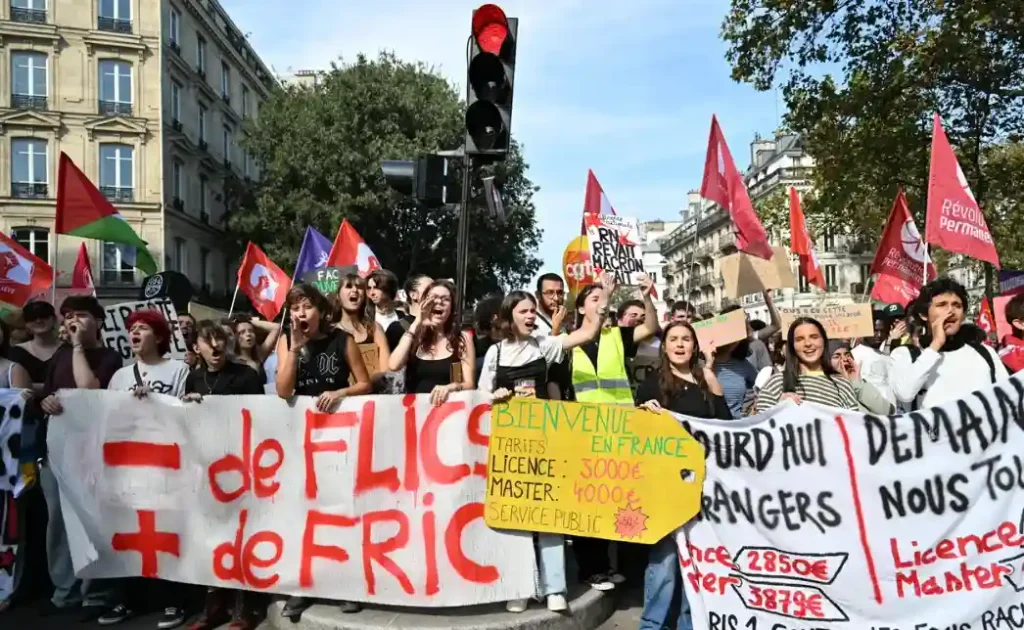
The Bigger Picture
France’s 2026 high school protests are best understood as both an education crisis and a broader debate about public services, inequality and youth participation in democracy.
The immediate grievances are concrete: students want teachers in classrooms, functioning buildings, manageable schedules and a fair opportunity to succeed.
The escalation into violence has complicated those demands, forcing the government to address public safety at the same time that it responds to educational concerns.
The most important lesson is that the size of a protest does not by itself explain its significance. The underlying question is whether the educational problems identified by students can be addressed through sustained policy changes.
France already has formal mechanisms for student participation, including student representative bodies and school-level democratic institutions. The government has emphasized these mechanisms as part of school life.
The current protests demonstrate why those channels matter.
If policymakers can translate student complaints into measurable improvements in staffing, infrastructure and educational equality, the protests could ultimately become a catalyst for reform. If the underlying problems remain unresolved, however, the demonstrations may continue to reappear in different forms.
As of October 5, 2026, the situation remains unresolved, and developments are changing quickly. Any assessment of the protests should therefore distinguish confirmed government statistics from claims made by individual protesters or political groups, and should rely on updated reporting as new information emerges.




 and then