








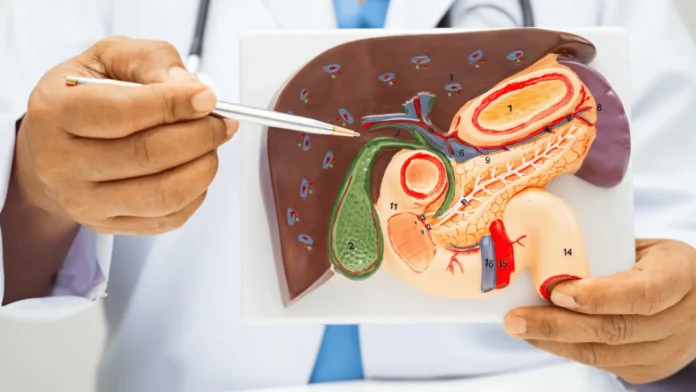

What is early-onset cirrhosis from fatty liver disease?
KumDi.com
Early-onset cirrhosis from fatty liver disease is advanced liver scarring caused by metabolic dysfunction-associated steatotic liver disease (MASLD), occurring before age 50. Recent research suggests that type 2 diabetes, metabolic dysfunction and genetic susceptibility may increase the risk of earlier progression to cirrhosis.
Early-onset cirrhosis caused by fatty liver disease is emerging as an important clinical problem, particularly among adults who develop advanced liver scarring before age 50. A new 2026 study from researchers at the University of California San Diego found that people with cirrhosis related to metabolic dysfunction-associated steatotic liver disease (MASLD) before age 50 have a distinct combination of genetic susceptibility and metabolic risk—especially type 2 diabetes.
The study analyzed approximately 2,400 adults with biopsy-confirmed MASLD from the U.S. NASH Clinical Research Network. About one-quarter of cirrhosis cases occurred before age 50, leading researchers to define this group as having early-onset MASLD cirrhosis. Importantly, nearly one-third of these younger patients had fibrosis scores that might not normally trigger additional evaluation under commonly used age-dependent screening approaches.
The findings do not mean that every person with fatty liver will develop cirrhosis at a young age. Instead, they highlight an important clinical message: age alone should not be used to underestimate liver-disease risk when metabolic and genetic risk factors are present.
Table of Contents
What Is Early-Onset Cirrhosis From Fatty Liver Disease?
Early-onset MASLD cirrhosis refers to advanced, permanent liver scarring caused by MASLD that develops before the age of 50.
MASLD is the modern medical term for what was previously called nonalcoholic fatty liver disease (NAFLD). Its inflammatory form, formerly called nonalcoholic steatohepatitis (NASH), is now known as metabolic dysfunction-associated steatohepatitis (MASH).
MASLD occurs when excess fat accumulates in the liver in association with metabolic dysfunction. Common associated factors include:
- Overweight or obesity
- Abdominal obesity
- Insulin resistance
- Prediabetes
- Type 2 diabetes
- High triglycerides or other abnormal lipids
- High blood pressure
- Metabolic syndrome
For some people, liver fat remains relatively stable. For others, persistent metabolic stress causes inflammation and hepatocyte injury, followed by progressive fibrosis. Advanced fibrosis can eventually develop into cirrhosis.
The disease can be silent
One of the major difficulties with MASLD is that a person may have substantial liver damage without obvious symptoms.
Fatty liver disease may produce few or no symptoms, and even cirrhosis can remain clinically silent until complications develop.
That makes early identification of people at higher risk particularly important.
What Did the New 2026 Study Discover?
The September 2026 study from UC San Diego is significant because researchers specifically examined MASLD-related cirrhosis occurring before age 50 rather than treating younger patients simply as an earlier version of typical cirrhosis.
Investigators found approximately:
2,400
adults with biopsy-confirmed MASLD
~25%
of cirrhosis cases occurred before age 50
Nearly 1 in 3
younger patients with cirrhosis had screening scores that might not normally trigger further assessment
The study identified two particularly important components of early-onset disease:
- Inherited genetic susceptibility
- Metabolic disease, particularly type 2 diabetes
Researchers concluded that younger adults developing MASLD-related cirrhosis may have a distinctive risk profile rather than simply developing the conventional form of the disease at an earlier age.
This distinction matters because conventional fibrosis algorithms often incorporate age. A younger person’s age can therefore contribute to a deceptively reassuring risk score even when other factors indicate significant liver disease.
Why Can Fatty Liver Progress to Cirrhosis So Early?
MASLD progression is not determined by liver fat alone.
The process is better understood as an interaction between metabolic stress, inflammation, fibrosis, genetics, and duration of exposure.
A simplified progression is:
Metabolic dysfunction → liver fat accumulation → hepatocyte injury → inflammation → fibrosis → advanced fibrosis → cirrhosis
Not everyone moves through every stage, and progression rates vary substantially between individuals.
1. Type 2 diabetes
Type 2 diabetes is one of the most important risk factors for progressive MASLD.
Current European guidelines identify type 2 diabetes and obesity—particularly abdominal obesity—as major factors influencing progression toward advanced fibrosis, cirrhosis and hepatocellular carcinoma.
The relationship is particularly important because insulin resistance can promote abnormal lipid storage and metabolic stress in the liver.
The longer diabetes persists and the more difficult it is to control metabolic risk, the greater the concern for progressive liver fibrosis.
2. Abdominal obesity
Body weight alone does not tell the complete story.
Visceral or abdominal fat is metabolically active and is strongly associated with insulin resistance and other metabolic abnormalities.
For this reason, clinicians generally consider the broader metabolic picture rather than relying solely on body mass index.
A person with substantial abdominal obesity, abnormal glucose metabolism, hypertension and dyslipidemia may have considerably more liver risk than body weight alone suggests.
3. Genetic susceptibility
The new research also reinforces the role of inherited factors.
Genes including PNPLA3 and TM6SF2 have been associated with progressive MASLD and cirrhosis. Other variants, including those involving MBOAT7, GCKR and HSD17B13, have also been studied for their effects on disease progression.
Importantly, having a genetic risk variant does not mean that cirrhosis is inevitable.
Genetic susceptibility interacts with environmental and metabolic factors.
This is better described as:
Genetic susceptibility + metabolic stress + time = potentially accelerated liver disease
rather than a simple genetic cause-and-effect relationship.
Why Standard Screening Can Miss Younger Patients
One of the most important findings from the 2026 study concerns fibrosis screening.
Tools such as the FIB-4 index use routinely available laboratory measurements and age to estimate the likelihood of advanced fibrosis.
They are useful, but they are not perfect.
Because age is incorporated into some scoring systems, younger adults may receive relatively low scores even when significant liver fibrosis is present.
In the UC San Diego study, nearly one-third of people with early-onset MASLD cirrhosis had scores that would not normally prompt additional evaluation using standard thresholds.
This does not mean that FIB-4 should be abandoned.
Instead, it suggests that clinicians should interpret noninvasive scores within the patient’s broader clinical context.
A younger patient with:
- Type 2 diabetes
- Significant obesity
- Abdominal obesity
- Elevated liver enzymes
- Imaging showing fatty liver
- Strong family history of severe liver disease
- Multiple metabolic risk factors
may warrant further evaluation even when an age-dependent screening score appears reassuring.
How Is Early Liver Fibrosis Detected?
The modern approach increasingly uses noninvasive testing before considering liver biopsy.
A typical evaluation may include:
Step 1: Medical history
Doctors evaluate:
- Weight and weight history
- Diabetes or prediabetes
- Blood pressure
- Cholesterol and triglycerides
- Alcohol intake
- Medications and supplements
- Viral hepatitis risk
- Family history of liver disease
Step 2: Blood tests
Testing may include:
- AST
- ALT
- Platelet count
- Bilirubin
- Albumin
- INR when appropriate
- Glucose
- HbA1c
- Lipid profile
These measurements can be combined into noninvasive fibrosis scores.
Step 3: Calculate fibrosis risk
FIB-4 is commonly used as an initial risk-stratification tool.
However, the 2026 findings reinforce the importance of understanding its limitations in younger people.
Step 4: Liver stiffness measurement
If additional assessment is appropriate, clinicians may use:
- Transient elastography
- Vibration-controlled transient elastography
- Magnetic resonance elastography
These methods estimate liver stiffness and can provide additional information about fibrosis.
AASLD maintains dedicated guidance for both blood-based and imaging-based noninvasive assessment of liver fibrosis and steatosis.
Step 5: Specialist evaluation
Patients with evidence of advanced fibrosis or cirrhosis may require evaluation by a gastroenterologist or hepatologist.
Liver biopsy is not required for every person with MASLD, but it may be appropriate in selected cases when the diagnosis or disease stage remains uncertain.
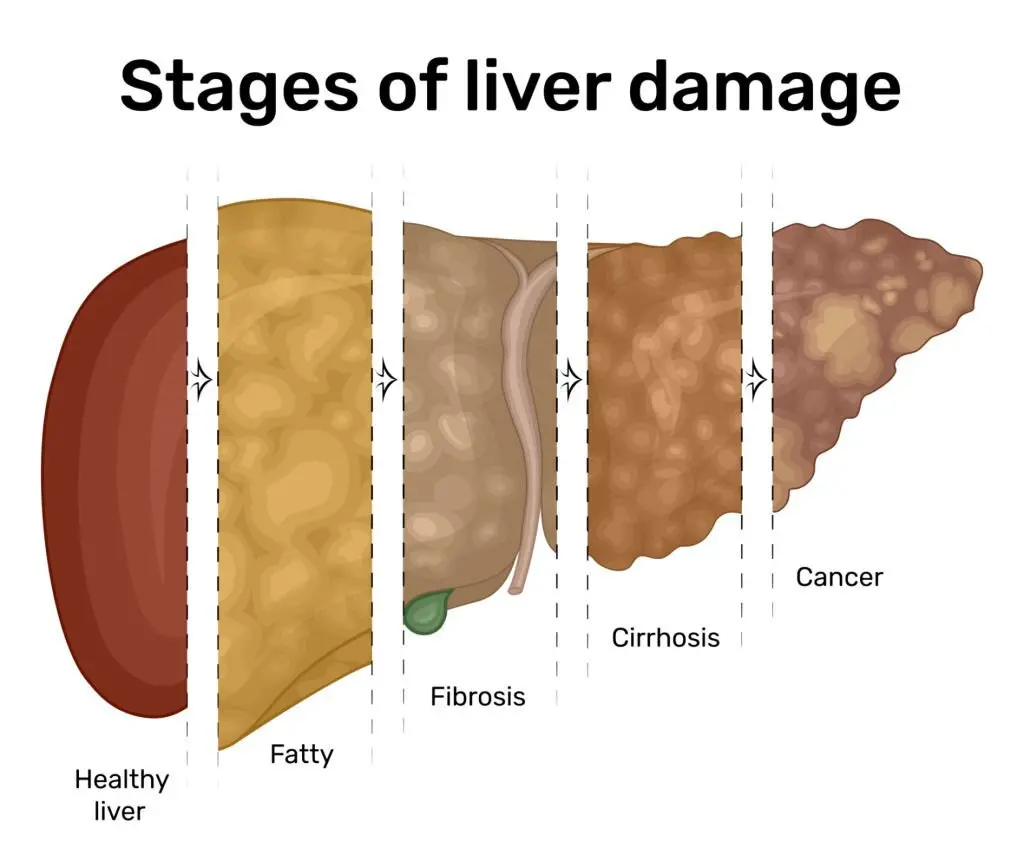
What Are the Stages of Fatty Liver Disease?
The progression can be summarized as follows:
| Stage | What happens |
|---|---|
| MASLD / fatty liver | Excess fat accumulates in liver cells |
| MASH | Fat accumulation is accompanied by inflammation and liver injury |
| Fibrosis | Scar tissue develops in response to chronic injury |
| Advanced fibrosis | Extensive scar tissue disrupts normal liver architecture |
| Cirrhosis | Extensive permanent scarring changes liver structure and function |
| Decompensated cirrhosis | Complications such as ascites, hepatic encephalopathy or variceal bleeding develop |
NIDDK describes cirrhosis as permanent liver damage in which scar tissue replaces healthy liver tissue and interferes with normal liver function.
An important distinction is that fatty liver itself is not the same thing as cirrhosis.
Many people with MASLD do not progress to advanced fibrosis.
The clinical priority is therefore identifying the subgroup at elevated risk of progression.
What Are the Risks of Early-Onset Cirrhosis?
Once cirrhosis develops, the concern extends beyond liver fat.
Potential complications include:
- Portal hypertension
- Ascites
- Esophageal or gastric varices
- Gastrointestinal bleeding
- Hepatic encephalopathy
- Liver failure
- Hepatocellular carcinoma
- Increased risk of death from liver-related complications
AASLD defines decompensated cirrhosis clinically by complications such as ascites, hepatic encephalopathy or variceal bleeding.
Cirrhosis is also an important risk factor for hepatocellular carcinoma (HCC), the most common primary liver cancer.
This is why recognizing advanced fibrosis or cirrhosis before symptoms develop can change clinical management.
Can Early MASLD Be Reversed?
The answer depends strongly on the stage of disease.
Liver fat and metabolic dysfunction can often improve substantially with effective lifestyle and medical treatment.
Fibrosis may also improve in some patients when the underlying disease is successfully treated.
However, established cirrhosis represents advanced structural damage and should not be described as simply reversible through dieting or exercise.
For people with overweight or obesity and fatty liver disease, gradual weight reduction, improved diet and regular physical activity are important components of treatment. NIDDK notes that weight loss can reduce liver fat, inflammation and scarring.
The treatment strategy should therefore be based on the patient’s fibrosis stage and overall metabolic health, not simply whether an ultrasound shows fatty liver.
What Treatments Are Available in 2026?
Treatment has evolved rapidly.
Lifestyle treatment
Core measures include:
- Gradual weight reduction when appropriate
- Regular physical activity
- Reduced intake of highly processed foods
- Limiting excess saturated fat
- Emphasizing vegetables, whole grains and other minimally processed foods
- Managing diabetes
- Controlling blood pressure
- Managing cholesterol
- Avoiding excessive alcohol
NIDDK recommends healthy dietary patterns, appropriate portion sizes and weight management for people with MASLD.
Metabolic disease management
Controlling diabetes, obesity, hypertension and dyslipidemia is not merely treatment of unrelated conditions.
These factors are directly connected with the progression of MASLD.
Pharmacologic treatment
The therapeutic landscape is changing quickly.
The American Association for the Study of Liver Diseases updated its guidance in 2025 regarding semaglutide therapy for MASH, reflecting emerging evidence and evolving regulatory approvals. The guidance focuses on appropriate patient selection, safety monitoring and effectiveness, particularly in patients with moderate-to-advanced fibrosis.
Treatment decisions should be individualized by a physician because medications may have different indications depending on fibrosis stage, diabetes status, obesity and other medical conditions.
Does Everyone With Fatty Liver Need Genetic Testing?
Not necessarily.
Routine genetic testing is not currently recommended for every person with MASLD.
However, genetic evaluation may become more relevant when there is:
- Very early disease
- Severe disease at an unusually young age
- A strong family history of advanced liver disease
- Advanced disease without obvious metabolic triggers
- Severe liver disease in a person with normal body weight
The EASL-EASD-EASO guidelines specifically note that people with early presentation, strong family history or an otherwise unusual severe phenotype may benefit from evaluation for genetic causes of liver disease.
The new 2026 findings may further support research into personalized risk assessment for younger patients.
A Practical Example: Why Age Alone Can Be Misleading
Consider two hypothetical patients.
Patient A
A 32-year-old has:
- Normal body weight
- No diabetes
- Normal blood pressure
- No abnormal liver imaging
- No family history of severe liver disease
Their baseline risk profile is different from a younger person with multiple metabolic risk factors.
Patient B
A 38-year-old has:
- Abdominal obesity
- Type 2 diabetes
- Fatty liver on imaging
- Elevated triglycerides
- Abnormal liver enzymes
- A parent who developed advanced liver disease
Even though Patient B is young, the overall clinical picture may justify substantially more attention to fibrosis risk.
This illustrates the central lesson of the new research:
A young age does not automatically equal low liver risk.
Risk assessment should combine age with metabolic disease, family history, laboratory findings, imaging and, when appropriate, genetic information.
What Should Younger Adults With Fatty Liver Do?
A diagnosis of fatty liver at age 30, 40 or even younger should not automatically be interpreted as a prediction of cirrhosis.
Instead, it is an opportunity to determine whether there is evidence of liver injury or fibrosis.
A practical checklist is:
- Confirm the cause of liver fat.
- Check for diabetes or prediabetes.
- Measure blood pressure and cardiovascular risk.
- Assess cholesterol and triglycerides.
- Calculate an appropriate fibrosis risk score.
- Consider elastography when clinically indicated.
- Review family history.
- Discuss specialist referral if fibrosis risk is elevated.
- Address obesity and metabolic dysfunction.
- Continue long-term monitoring when risk factors persist.
The goal is not simply to detect fatty liver.
The more important question is:
Does this person have, or are they developing, significant liver fibrosis?
The Bigger Meaning of the 2026 Findings
The new research changes the way early-onset MASLD cirrhosis should be understood.
Historically, cirrhosis was often viewed as a disease that developed after decades of liver injury. MASLD challenges that assumption because metabolic disease can begin much earlier in life.
At the same time, the evidence does not support the idea that all young people with fatty liver are destined to develop cirrhosis.
Instead, the emerging model is more individualized:
Metabolic exposure + genetic susceptibility + disease duration + lifestyle + other liver conditions → individual progression risk
This is consistent with modern MASLD guidelines, which recognize that metabolic and genetic factors influence fibrosis progression and that patients do not all follow the same disease trajectory.
FAQs

What is early-onset cirrhosis from fatty liver disease?
Early-onset cirrhosis from fatty liver disease refers to advanced and permanent liver scarring caused by MASLD that develops before age 50. It can occur when fatty liver progresses through inflammation and fibrosis to cirrhosis, particularly in people with metabolic risk factors such as type 2 diabetes, obesity and insulin resistance.
Can fatty liver disease cause cirrhosis before age 50?
Yes. Early-onset MASLD cirrhosis can occur before age 50. Although not everyone with fatty liver develops advanced liver disease, younger adults with type 2 diabetes, obesity, metabolic syndrome or genetic susceptibility may have an increased risk of progressive fatty liver disease fibrosis.
What increases the risk of early-onset MASLD cirrhosis?
Important risk factors for early-onset MASLD cirrhosis include type 2 diabetes, obesity, abdominal obesity, insulin resistance, abnormal blood lipids and certain genetic factors. The combination of metabolic disease and genetic susceptibility may contribute to faster progression from fatty liver to significant fibrosis and cirrhosis.
How is fatty liver disease fibrosis detected?
Fatty liver disease fibrosis can be assessed using blood-based fibrosis scores such as FIB-4 and imaging techniques such as transient elastography or magnetic resonance elastography. Because age can affect some fibrosis scores, younger patients with significant metabolic risk may require additional assessment even when an initial score appears reassuring.
Can early-onset cirrhosis from fatty liver disease be prevented?
The risk of early-onset cirrhosis from fatty liver disease may be reduced by addressing metabolic risk factors early. Weight management, regular physical activity, diabetes control, healthy dietary patterns, appropriate medical treatment and regular liver assessment can help reduce the risk of progressive liver damage.
Conclusion: Early Detection Matters More Than Age
The 2026 research on early-onset MASLD cirrhosis provides an important refinement to how fatty liver disease is evaluated.
Cirrhosis can develop before age 50, and younger patients may have a distinctive combination of genetic susceptibility and metabolic risk, particularly type 2 diabetes. The new findings also show why age-dependent screening approaches may fail to identify some younger patients with advanced disease.
The practical lesson is not that every young person with fatty liver needs extensive testing. Rather, people with early-onset fatty liver, diabetes, obesity, strong family history, abnormal liver tests or other signs of metabolic dysfunction should have their fibrosis risk assessed appropriately.
Modern MASLD care is moving away from asking only, “Does this person have fatty liver?”
The more clinically meaningful question is:
“How much liver fibrosis does this person have, and what is driving its progression?”
That shift—from detecting liver fat to identifying fibrosis risk—may be one of the most important developments in the modern management of fatty liver disease.
References and Evidence
- University of California San Diego Health — September 16, 2026: Study defining early-onset MASLD cirrhosis and identifying genetic and type 2 diabetes associations.
- American Association for the Study of Liver Diseases (AASLD): Clinical guidance on MASLD and noninvasive liver disease assessment.
- EASL–EASD–EASO Clinical Practice Guidelines: Evidence on metabolic and genetic risk factors, fibrosis assessment and MASLD progression.
- National Institute of Diabetes and Digestive and Kidney Diseases (NIDDK): Information on MASLD/NAFLD, cirrhosis, nutrition and treatment.
- npj Gut and Liver, 2026: Research framework addressing young-onset MASLD and age-specific diagnostic and therapeutic gaps.




 and then