








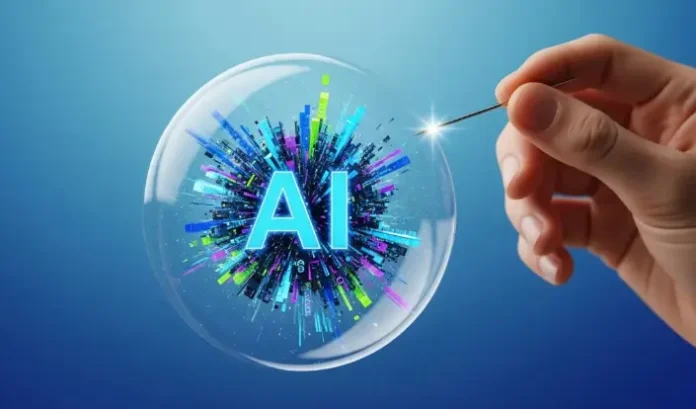

The AI bubble is unlikely to fully pop in 2026, but a significant market correction is expected. Overvalued AI startups may fail, while profitable, real-world artificial intelligence applications continue to grow. This shift reflects market maturation, not collapse.
KumDi.com
The question “Is the AI bubble going to pop in 2026?” reflects growing concern about artificial intelligence investment risk amid rapid market expansion. While speculative valuations are under pressure, evidence shows AI adoption is accelerating across healthcare, finance, and enterprise operations, signaling a correction rather than a systemic crash.
The AI bubble is unlikely to “pop” in 2026 in the traditional dot-com crash sense, but the market will undergo a sharp correction and consolidation. Overvalued AI startups, speculative infrastructure plays, and weak business-model deployments are expected to fail, while practical, revenue-generating AI systems will survive and grow.
This distinction matters. What many call an “AI bubble pop” is more accurately a market maturation phase—where hype-driven valuations collapse, but real AI adoption accelerates. Understanding the difference is critical for businesses, investors, and professionals making 2026–2030 decisions.
Table of Contents
What People Mean by an “AI Bubble” (And Why the Term Is Often Misused)
An economic bubble occurs when asset prices rise far beyond their intrinsic value, driven by speculation rather than fundamentals, followed by a rapid collapse. In AI, the term is often applied loosely to describe:
- Sky-high startup valuations
- Massive capital inflows into AI infrastructure
- Overpromising AI vendors with underdelivering products
- Fear of mass job displacement narratives
However, AI is not a single asset class. It is a general-purpose technology, similar to electricity, the internet, or cloud computing. Bubbles form around implementations and expectations, not around the underlying capability.
Key distinction:
AI itself is not the bubble. Certain AI business models are.
Why the “AI Bubble” Narrative Accelerated After 2024–2025

Several converging forces fueled bubble concerns:
1. Explosive Capital Allocation Without Profitability
From 2023 to 2025, trillions of dollars flowed into:
- Foundation models
- GPU and data-center infrastructure
- AI-branded SaaS tools
- Healthcare, legal, and finance automation startups
Many of these companies:
- Had no sustainable revenue
- Relied on subsidized compute
- Could not clearly articulate long-term margins
This mirrors early cloud and internet cycles.
2. Overestimation of Short-Term Capabilities
Real-world deployments exposed limitations:
- Hallucinations in regulated environments
- Poor integration with legacy systems
- Data governance and privacy barriers
- High inference costs at scale
Executives expecting “plug-and-play AGI” were forced to recalibrate.
3. Infrastructure Overbuild Risk
Massive GPU and data-center expansion raised a legitimate concern:
What happens if AI demand growth slows faster than capacity expansion?
This fear—more than AI capability—drives bubble rhetoric.
Will the AI Bubble Pop in 2026? A Stage-Based View
Instead of a binary “pop,” AI markets are entering a four-stage correction cycle.
Stage 1 (Already Occurring): Expectation Reset
- Enterprises shift from pilots to ROI-validated deployments
- Boards demand measurable productivity gains
- “AI for everything” pitches lose credibility
Stage 2 (2026): Valuation Compression
This is where many confuse correction with collapse.
Likely outcomes:
- Down rounds for AI startups
- M&A consolidation
- Fewer mega-funding announcements
- Infrastructure pricing pressure
Importantly: usage continues to grow even as valuations fall.
Stage 3 (2026–2027): Survivorship & Standardization
- Proven vendors dominate
- AI becomes embedded, not marketed
- Vertical-specific models outperform general tools
Stage 4 (Post-2027): Quiet Expansion
Similar to cloud computing today:
- Essential
- Profitable
- No longer hyped
Lessons from Real-World AI Deployment
From enterprise and healthcare AI implementation experience, several patterns are clear:
Where AI Delivers Real Value
- Clinical decision support (triage, radiology pre-reads)
- Revenue cycle optimization in healthcare
- Fraud detection in financial services
- Customer support augmentation, not replacement
- Developer productivity tools with clear benchmarks
These systems:
- Reduce time, not responsibility
- Operate under human oversight
- Integrate with existing workflows
Where AI Fails Commercially
- Fully autonomous decision systems in regulated fields
- “Replace humans” positioning
- Generic AI tools with no domain specialization
- Products dependent on perpetual investor subsidies
These failures fuel bubble narratives—but do not invalidate AI itself.
Why This Is Not Another Dot-Com Crash
The dot-com crash wiped out companies because:
- Infrastructure was immature
- Internet usage was limited
- Monetization paths were unclear
In contrast, AI in 2026 has:
- Massive enterprise adoption
- Immediate productivity gains
- Clear monetization models
- Cross-industry integration
Historical parallel:
This moment is closer to the 2010–2012 mobile app shakeout than 2000.
Who Is Most at Risk If the AI Market Corrects in 2026?
High-Risk Groups
- Startups with no proprietary data
- Companies reselling API access without differentiation
- Firms dependent on hype-driven fundraising
- Overleveraged infrastructure providers
Lower-Risk Groups
- Domain-specific AI vendors
- AI embedded in healthcare, logistics, manufacturing
- Companies reducing costs, not just increasing novelty
- Organizations treating AI as operational infrastructure
High-Risk vs. Durable AI Business Models (2026 Outlook)
| Category | High-Risk AI Business Models | Durable AI Business Models |
|---|---|---|
| Core Value Proposition | Vague “AI-powered” claims without measurable outcomes | Clear, problem-specific AI solutions with proven ROI |
| Revenue Model | Freemium or usage-based models without path to profitability | Subscription or enterprise contracts tied to business outcomes |
| Data Advantage | No proprietary data; reliant on public or licensed datasets | Proprietary, high-quality, domain-specific datasets |
| Model Differentiation | Thin wrappers around third-party AI APIs | Customized models optimized for specific industries or workflows |
| Cost Structure | High inference and compute costs with weak margin control | Optimized inference, cost-aware deployment, scalable margins |
| Customer Type | General consumers with low switching costs | Enterprises with long-term contracts and integration depth |
| Regulatory Readiness | No compliance strategy for healthcare, finance, or privacy laws | Built-in governance, auditability, and regulatory alignment |
| Human Oversight | Fully autonomous positioning with liability risk | Human-in-the-loop systems for accountability and trust |
| Go-to-Market Strategy | Hype-driven growth and aggressive fundraising | Evidence-based sales focused on efficiency and productivity |
| Resilience to AI Market Correction | Highly vulnerable during AI bubble correction | Positioned to grow during and after market consolidation |
| Long-Term Outlook (2026–2030) | High probability of shutdown or forced acquisition | Sustainable growth as AI becomes core infrastructure |
What Smart Organizations Are Doing Right Now

1. Measuring AI ROI Rigorously
Successful companies track:
- Cost per inference
- Error reduction rates
- Time saved per workflow
- Compliance impact
2. Shifting from “AI Projects” to “AI Systems”
AI is no longer experimental—it is operational.
3. Investing in Human-AI Collaboration
The highest returns come from:
- Augmented professionals
- Clear accountability
- Training and governance
Common Myths About the AI Bubble
Myth 1: AI demand will collapse in 2026
→ Demand continues; spending becomes disciplined.
Myth 2: AI can’t deliver ROI
→ Poor implementations can’t; good ones already do.
Myth 3: Regulation will kill AI growth
→ Regulation favors serious players and raises trust.
What This Means for Investors, Businesses, and Professionals
For Investors
- Expect fewer unicorns, stronger fundamentals
- Focus on cash flow and defensibility
For Businesses
- AI is no longer optional
- Poor strategy is more dangerous than non-adoption
For Professionals
- AI literacy becomes a baseline skill
- Domain expertise + AI fluency wins
Final Verdict: Will the AI Bubble Pop in 2026?
No—AI will not collapse.
But the illusion that every AI company deserves extreme valuation will end.
2026 marks:
- The end of indiscriminate hype
- The beginning of disciplined AI economics
- A transition from speculation to infrastructure
For those prepared, this is not a crash—it is the most important opportunity window since the early cloud era.

FAQs
Is the AI bubble going to pop in 2026?
The AI bubble in 2026 is more likely to experience a market correction than a full collapse. While speculative AI investments may decline, sustainable artificial intelligence business models are expected to grow long term.
What causes concern about an AI market correction in 2026?
Concerns stem from inflated valuations, high infrastructure costs, and unproven AI business models. These artificial intelligence investment risks are driving expectations of consolidation rather than widespread failure.
How will an AI bubble correction affect investors?
Investors may see reduced returns from speculative AI startups, but stronger opportunities in proven sectors. A disciplined approach to AI market correction improves long-term investment stability.
Which industries are safest if the AI bubble deflates?
Healthcare, finance, manufacturing, and enterprise automation remain resilient. These sectors rely on practical artificial intelligence applications rather than hype-driven AI investment trends.
What is the AI industry outlook for 2026 and beyond?
The AI industry outlook for 2026 points toward slower valuation growth but deeper adoption. Market correction strengthens trustworthy artificial intelligence solutions and reduces unsustainable speculation.




 and then