










Movie Mercy (2026) is a futuristic AI justice thriller starring Chris Pratt, centered on a system where artificial intelligence delivers instant verdicts. While the film raises timely questions about surveillance and algorithmic justice, uneven storytelling prevents it from fully realizing its ambitious concept.
KumDi.com
Movie Mercy Review (2026) examines a sci-fi thriller that imagines a near future where artificial intelligence replaces human judges. With its AI-driven courtroom, real-time verdicts, and ethical dilemmas, Mercy aims to challenge how technology reshapes justice — but its execution struggles to match its compelling idea.
In an era where artificial intelligence increasingly influences decision-making in medicine, finance, and law enforcement, Mercy (2026) positions itself as a cautionary science-fiction thriller that asks an uncomfortable question: Should machines decide guilt and innocence?
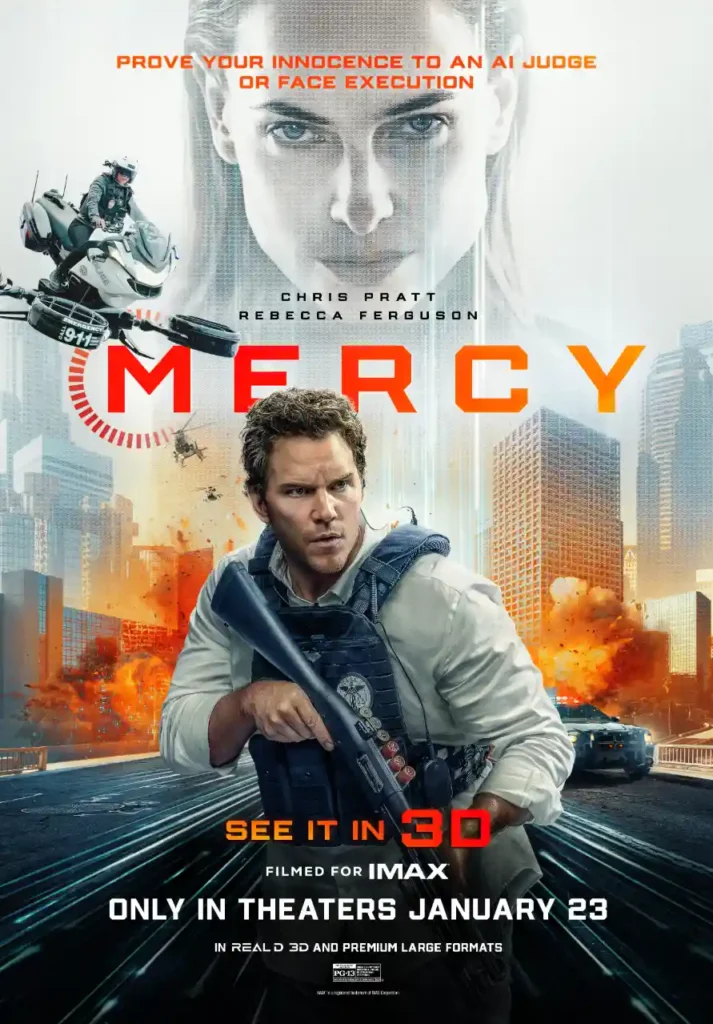
Directed by Timur Bekmambetov and led by Chris Pratt, Mercy imagines a near-future judicial system where human judges are replaced by artificial intelligence. Defendants are evaluated by data, algorithms, and predictive models — and once judgment is rendered, there is no appeal.
On paper, Mercy feels timely, urgent, and provocative. In execution, however, the film delivers a mixed experience: intellectually ambitious but emotionally restrained, conceptually bold yet narratively uneven.
This review explores Mercy through the lens of storytelling, performance, thematic relevance, and its broader cultural implications — offering a comprehensive evaluation for audiences searching for an informed, authoritative perspective.
Table of Contents

Plot Overview: Justice in 90 Minutes
Mercy is set in a near-future Los Angeles where an AI-driven judicial system has replaced traditional courts. Trials occur digitally, verdicts are delivered instantly, and sentences are carried out without delay.
Chris Pratt plays Detective Chris Raven, a seasoned police officer who suddenly finds himself accused of murdering his wife. Raven maintains his innocence, but the system offers him only 90 minutes to prove it. There is no jury, no defense attorney, and no human judge — only an AI interface that evaluates evidence in real time.
As the countdown progresses, Raven must reconstruct events, challenge data interpretations, and confront painful memories. The story unfolds almost entirely through digital screens, surveillance footage, and virtual interfaces, placing the audience inside the same constrained experience as the protagonist.
The ticking clock is meant to generate relentless tension. While it succeeds structurally, the emotional payoff is more inconsistent.
Performance Analysis: Strong Leads, Limited Range
Chris Pratt as Chris Raven
Chris Pratt carries the weight of the film almost entirely on his shoulders. Confined to a single location for much of the runtime, his performance relies heavily on facial expression, vocal delivery, and emotional restraint.
Pratt convincingly portrays desperation, confusion, and defiance. However, the screenplay gives him limited opportunities to explore deeper emotional layers. The character’s internal conflicts — grief, guilt, and moral doubt — are introduced but not fully developed.
While Pratt remains watchable and committed, the role never quite transcends the film’s structural limitations.
Rebecca Ferguson as the AI Arbiter
Rebecca Ferguson plays the human-faced AI authority overseeing Raven’s trial. Her performance is one of the film’s highlights. Calm, controlled, and emotionally neutral, she embodies the unsettling ambiguity of machine-guided justice.
Ferguson’s presence gives the AI system a disturbing sense of credibility. Yet the decision to humanize the AI so explicitly also weakens the film’s conceptual impact. At times, the AI feels less like an autonomous intelligence and more like a symbolic stand-in for bureaucracy.
Supporting Cast
The supporting characters — including law enforcement colleagues and peripheral figures — provide context but little narrative depth. Their roles feel functional rather than meaningful, serving the plot without expanding its emotional or thematic scope.
Themes and Ideas: Ambitious but Unfocused
1. Artificial Intelligence and Moral Authority
The central theme of Mercy revolves around the danger of granting AI moral authority. The film raises essential questions:
- Can algorithms truly understand human intent?
- Does data equal truth?
- What happens when efficiency replaces empathy?
While these questions are relevant and compelling, the film hesitates to fully interrogate them. Rather than presenting a clear critique or defense of AI justice, Mercy often straddles the middle ground, leaving its message ambiguous.
2. Surveillance Culture and Digital Footprints
Mercy highlights how modern lives are documented endlessly — messages, cameras, biometric data, and online behavior all become evidence. The film suggests that in a data-driven society, privacy is no longer a right but a liability.
This is one of the film’s strongest thematic elements. It resonates with real-world concerns about surveillance, predictive policing, and digital profiling. Unfortunately, the narrative touches on these ideas without fully exploring their consequences.
3. Speed vs. Justice
The 90-minute time limit is not just a plot device; it represents a broader critique of speed replacing deliberation. Justice, the film implies, becomes dangerous when optimized solely for efficiency.
This concept is powerful, yet the script rarely slows down enough to reflect on it meaningfully.
Direction and Visual Style: Immersive but Restrictive
Timur Bekmambetov employs a “screen-based” storytelling style, presenting much of the film through digital interfaces. This approach reinforces the film’s themes and places viewers inside the AI system’s perspective.
At its best, this style feels immersive and claustrophobic. At its worst, it becomes visually repetitive and emotionally distancing. The constant reliance on screens limits cinematic variety and prevents the story from expanding beyond its conceptual framework.
The result is a film that feels intellectually dense but visually constrained.
Pacing and Structure: Tension Without Escalation
The countdown format ensures constant momentum, but Mercy struggles with escalation. The stakes are high from the beginning, leaving little room for narrative growth.
Key revelations arrive predictably, and twists lack emotional impact. Rather than building toward a powerful climax, the story maintains a steady but flat intensity throughout.
For a thriller, this is a critical weakness.
Audience Reception: Who Will Appreciate Mercy?

Mercy is unlikely to satisfy viewers seeking a traditional sci-fi action film or emotionally driven courtroom drama. Instead, it will appeal most to:
- Viewers interested in AI ethics and future societies
- Fans of experimental storytelling formats
- Audiences who enjoy concept-driven science fiction
Those expecting strong character arcs, explosive tension, or clear moral conclusions may leave disappointed.
Cultural Relevance: Why Mercy Still Matters
Despite its flaws, Mercy arrives at a critical cultural moment. As AI systems increasingly influence hiring, policing, and judicial recommendations, the film mirrors genuine societal anxieties.
Even when its storytelling falters, Mercy succeeds in prompting discussion. It reminds audiences that technology is not neutral — it reflects the values, biases, and assumptions of its creators.
In that sense, the film’s importance extends beyond entertainment.
Final Verdict: Ambition Over Execution
Mercy is a film driven by ideas rather than emotion. Its premise is timely, its themes relevant, and its intentions clear. However, uneven pacing, limited character depth, and an underdeveloped thesis prevent it from reaching its full potential.
Strengths
- Thought-provoking concept
- Strong lead performances
- Relevant AI and surveillance themes
Weaknesses
- Shallow character development
- Repetitive visual structure
- Unclear thematic stance
Overall Rating: 2.5 / 5
Mercy is not a failure — but it is a missed opportunity. It raises important questions without fully answering them, offering a glimpse of a frightening future without fully exploring its implications.
For viewers interested in the intersection of technology, justice, and ethics, Mercy is worth watching — not because it provides answers, but because it sparks necessary conversations.
FAQs
What is Movie Mercy (2026) about?
Movie Mercy (2026) is an AI justice thriller film where an automated legal system decides guilt based on data and algorithms, forcing the accused to prove innocence within a limited time.
Is Movie Mercy (2026) worth watching?
For viewers interested in AI ethics, futuristic courtroom dramas, and sci-fi thrillers, Mercy Review (2026) suggests the film is thought-provoking but narratively uneven.
Who stars in Movie Mercy (2026)?
Mercy (2026) stars Chris Pratt in a leading role, supported by a cast that reinforces the film’s focus on AI justice, digital surveillance, and futuristic law enforcement.
What genre is Movie Mercy (2026)?
Based on this Mercy Review (2026), the film falls under futuristic courtroom sci-fi and AI justice thriller genres, blending technology, ethics, and suspense.
What themes does Movie Mercy (2026) explore?
The film explores artificial intelligence in justice systems, algorithmic bias, digital surveillance, and the consequences of replacing human judgment with automated decisions.




 and then