








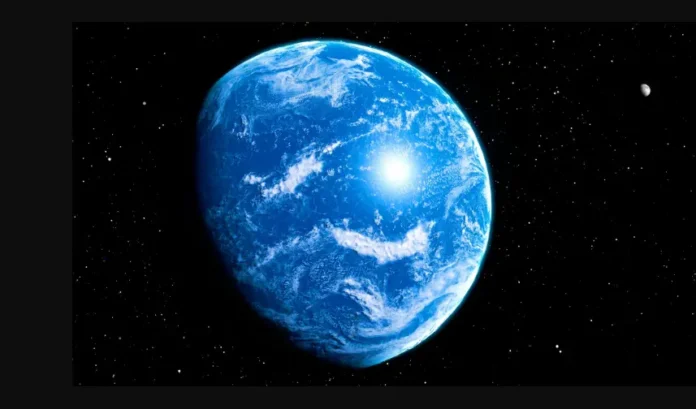
How did Earth become a planet covered in oceans? Scientists now believe Earth formed with hydrogen-rich building materials that allowed water to form internally as the planet cooled. A meteorite discovery suggests oceans were not delivered later, but emerged naturally during Earth’s early formation.
KumDi.com
How did Earth become a planet covered in oceans? For decades, scientists believed Earth formed dry and only gained water later through asteroid and comet impacts. New evidence from a rare meteorite now suggests Earth may have possessed the ingredients for water from the very beginning, rewriting the story of our planet’s oceans.
Earth is unique in the known universe for one defining reason: it is a rocky planet covered in vast, deep oceans. More than 70 percent of its surface is blanketed by water, shaping climate, geology, and the emergence of life itself. Yet one of the most fundamental scientific questions has remained unsettled for decades — how did all that water get here?
For much of modern planetary science, researchers believed they had the answer. Earth, they thought, formed hot and dry, acquiring its water later through impacts from icy asteroids and comets. But a recent breakthrough involving a rare meteorite recovered in Alaska is forcing scientists to reconsider that long-standing assumption. The new evidence suggests Earth may not have needed water delivered from space at all. Instead, the planet may have been born with the essential ingredients for oceans already locked inside its earliest building blocks.
This discovery reshapes not only our understanding of Earth’s past, but also how common water-rich worlds may be throughout the universe.
Table of Contents

A Violent Beginning: Why Earth Was Thought to Be Dry
The early Earth formed approximately 4.5 billion years ago from a swirling disk of gas and dust surrounding the young Sun. As material collided and accumulated, the growing planet became intensely hot. Energy from constant impacts, radioactive decay, and gravitational compression melted the surface into a global magma ocean.
Under these extreme conditions, liquid water could not exist. Any hydrogen or water vapor present would have escaped into space or remained trapped in superheated gases. Because of this, scientists long assumed Earth’s original material lacked water entirely. The planet, according to this view, only became wet after it cooled.
That assumption gave rise to the “late delivery” model — the idea that water arrived after Earth formed.
The Traditional Explanation: Water Delivered by Asteroids and Comets
For decades, planetary scientists believed Earth’s oceans came from space. The culprits were thought to be water-rich asteroids and comets that bombarded the planet during its early history.
Certain primitive meteorites contain hydrated minerals and chemically bound water. These meteorites, known as carbonaceous chondrites, originate from the outer regions of the solar system and were believed to have delivered water during repeated impacts. Comets, composed largely of ice, were also considered potential contributors.
This theory gained traction because chemical measurements of hydrogen in some meteorites closely resemble the isotopic composition of Earth’s ocean water. The match suggested a shared origin, reinforcing the idea that Earth’s water was imported rather than native.
Yet this explanation always carried unresolved problems. Models showed that comet impacts alone could not easily supply enough water. Some meteorites showed incompatible chemical signatures. And crucially, the theory depended on a key assumption: that Earth’s original building materials were dry.
That assumption is now being challenged.
The Alaska Meteorite That Changed the Story
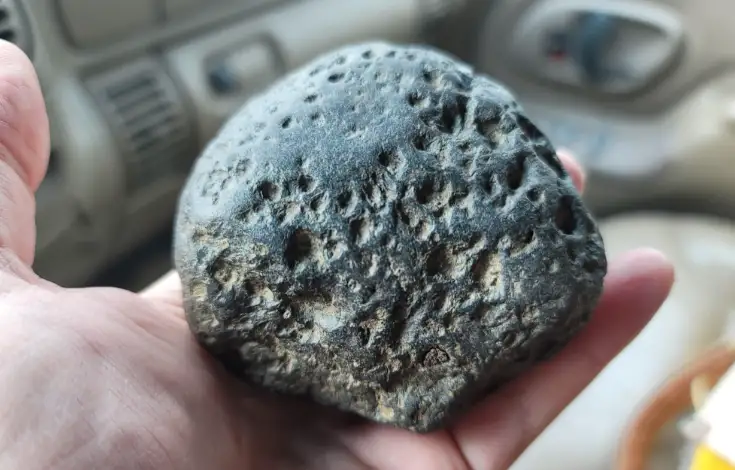
A rare meteorite recovered in Alaska provided scientists with an opportunity to test a different possibility. This meteorite belongs to a class known as enstatite chondrites — unusual space rocks formed in the inner solar system under extremely dry, oxygen-poor conditions.
What makes enstatite chondrites special is their chemical similarity to Earth. Their isotopic makeup closely matches that of our planet, making them one of the best available analogues for the materials that formed Earth itself.
When researchers examined this meteorite using advanced analytical techniques, they made a surprising discovery. Embedded within its mineral structure was a significant amount of hydrogen — not from contamination after landing on Earth, but chemically bound within the rock since its formation.
Hydrogen is the essential ingredient for water. If Earth’s building blocks contained hydrogen from the beginning, then water may not have needed to arrive later at all.
Earth May Have Been Born With Water-Making Ingredients
The implications of this discovery are profound. If the material that formed Earth was already hydrogen-rich, then the planet possessed the raw ingredients needed to generate water internally as it cooled.
As Earth’s magma ocean gradually solidified, hydrogen trapped within minerals could have reacted with oxygen to form water. Volcanic activity would have released water vapor into the atmosphere. As surface temperatures dropped, that vapor would have condensed into rain, filling basins and forming the earliest oceans.
In this scenario, Earth did not rely on lucky asteroid strikes to become wet. Water was not an external gift. It was a natural outcome of the planet’s formation.
This overturns decades of thinking about planetary water origins.
Rethinking the Role of Asteroids and Comets
The new findings do not mean that asteroids and comets played no role at all. Instead, they suggest a more nuanced picture.
Impacts likely contributed additional water and other volatile compounds, enriching Earth’s inventory over time. But rather than being the primary source, these impacts may have supplemented an already water-capable planet.
This resolves several long-standing contradictions. It explains why Earth’s water chemistry does not perfectly match any single class of meteorite. It also reduces the need for improbable impact scenarios to account for the sheer volume of Earth’s oceans.
Earth may have started wet — and simply became wetter.
Why This Discovery Matters Beyond Earth
This shift in thinking has far-reaching implications for planetary science and the search for life beyond our solar system.
If Earth formed with intrinsic water-forming materials, then other rocky planets may do the same. Water may not require rare, finely tuned conditions or precise impact histories. Instead, it could be a natural byproduct of how planets assemble.
This dramatically increases the likelihood of water-bearing worlds elsewhere in the galaxy. Planets orbiting distant stars may develop oceans simply by forming from similar materials — even without comet bombardments or external delivery systems.
In short, water-rich planets may be common, not exceptional.
A New Model for Earth’s Oceans
The emerging picture of Earth’s water origin combines both old and new ideas:
- Earth’s building materials contained intrinsic hydrogen.
- Internal chemical reactions generated water as the planet cooled.
- Volcanic outgassing released water vapor into the atmosphere.
- Cooling temperatures allowed water to condense and accumulate.
- Later asteroid and comet impacts added smaller contributions.
Rather than a single dramatic event, Earth’s oceans formed through a gradual, inevitable process rooted in planetary chemistry.
What Comes Next
This discovery opens new avenues for research. Scientists are now re-examining other meteorites, planetary formation models, and geochemical data to refine estimates of how much water Earth could have produced internally.
Future space missions that analyze asteroids, lunar samples, and planetary materials will help test whether hydrogen-rich building blocks are common across the inner solar system.
Each new finding brings us closer to understanding not just Earth’s past, but the broader question of how habitable worlds emerge.
Conclusion: Earth’s Water Was Not an Accident
For generations, scientists believed Earth became a water world through cosmic chance — a fortunate barrage of icy impacts. The Alaska meteorite tells a different story.
Earth may have been destined to host oceans from the moment it began forming. The ingredients for water were present from the start, woven into the planet’s very foundation.
This revelation transforms our understanding of Earth’s history and suggests that water — and perhaps life itself — may be a far more common outcome of planetary formation than we ever imagined.
FAQs
How did Earth become a planet covered in oceans?
Earth became a planet covered in oceans because hydrogen trapped in its original building materials combined with oxygen as the planet cooled, forming water internally rather than relying solely on asteroid or comet impacts.
Where did Earth’s water come from originally?
The origin of Earth’s oceans likely includes hydrogen-rich minerals present during Earth’s formation, with additional contributions from meteorites, challenging the idea that all water came from space later.
What role did meteorites play in Earth’s ocean formation?
Meteorites, especially those similar to Earth’s building materials, reveal that hydrogen was already present, supporting the idea that Earth could generate water internally before later impacts added more.
Why is the meteorite water discovery important?
This meteorite water discovery is important because it shows Earth may not have needed external delivery of water, changing how scientists understand planetary habitability and ocean formation.
Does this discovery affect the search for life on other planets?
Yes. If Earth’s oceans formed naturally from its building blocks, other rocky planets may also develop water easily, increasing the likelihood of habitable worlds across the universe.




 and then