








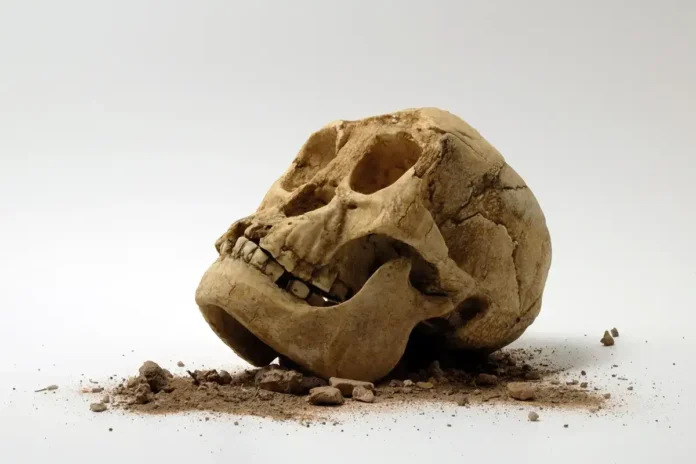
The human chin evolution mystery refers to the unanswered question of why modern humans have a projecting chin while other primates do not. Most researchers believe it resulted from facial reduction and jaw restructuring rather than direct natural selection for survival or chewing strength.
KumDi.com
The human chin—technically known as the mental prominence—is a small but distinctive anatomical feature found only in Homo sapiens. No other living primate, including chimpanzees, gorillas, or orangutans, has a true projecting chin. Even extinct human relatives such as Neanderthals lacked the prominent forward-pointing structure seen in modern humans.
Despite decades of research in paleoanthropology, evolutionary biology, and craniofacial anatomy, scientists still do not have a single, universally accepted explanation for why the human chin evolved. Several strong hypotheses exist—ranging from structural reinforcement to sexual selection and facial size reduction—but none fully accounts for all anatomical and fossil evidence. That is why the human chin remains one of evolution’s most intriguing unresolved anatomical questions.
Table of Contents
Definition: What Is the Human Chin?
The chin refers to the forward projection of bone at the lower front of the mandible (lower jaw). In anatomical terminology, it is called the mental protuberance or mental eminence.
Key Characteristics of the Human Chin
- Forward-projecting bony prominence
- Located at the anterior mandible
- Unique to modern humans (Homo sapiens)
- Absent in other primates and most extinct hominins
- Appears in the fossil record approximately 200,000–300,000 years ago
In contrast, other primates have a receding lower jaw or a flat mandibular profile without forward projection.
Why Evolution Struggles to Explain the Chin
Most evolutionary traits serve a clear functional advantage—improved locomotion, feeding efficiency, protection, or reproductive success. However, the chin does not have an obvious survival function.
Unlike:
- Opposable thumbs (tool use)
- Bipedal locomotion (energy-efficient walking)
- Enlarged brain size (cognition and language)
The chin’s adaptive value is not immediately evident.
This has led researchers to explore multiple hypotheses.
Major Scientific Theories Explaining the Human Chin
1. Structural Reinforcement Hypothesis
One early theory proposed that the chin evolved to strengthen the mandible against mechanical stress from chewing.
Argument:
As human diets changed—particularly with cooking and food processing—the shape of the jaw changed. The chin may have acted as reinforcement against bending forces.
Scientific Assessment (2026 consensus):
Biomechanical modeling studies show that the chin does not significantly improve resistance to chewing stress. In fact, comparative stress analyses suggest the chin may not function as structural reinforcement at all.
This weakens the structural explanation.
2. Facial Reduction Theory (Most Supported Hypothesis)
Currently, the most widely accepted explanation involves evolutionary facial reduction.
Over the past 500,000 years:
- Human faces became flatter
- Teeth became smaller
- Jaw size decreased
- Brow ridges diminished
As the face retracted beneath the braincase, the lower jaw reorganized structurally. The chin may be a byproduct of this retraction process, not a directly selected trait.
Step-by-Step Logic
- Brain size expanded.
- Facial projection reduced.
- Mandibular geometry shifted.
- Bone deposition patterns created a forward projection.
- The chin emerged as a structural consequence—not a primary adaptation.
In this model, the chin is an evolutionary side effect, not a selected trait.
3. Sexual Selection Hypothesis
Another theory suggests the chin may function in mate selection.
Research in evolutionary psychology and craniofacial morphology indicates:
- More prominent chins in males are associated with perceived dominance.
- Facial symmetry influences attractiveness.
- Secondary sexual characteristics often evolve through mate preference.
However:
- Females also have chins.
- Chin size variation does not consistently correlate with reproductive success.
- Fossil data do not strongly support sexual selection as the sole driver.
Thus, while sexual selection may influence chin variation, it likely does not explain its origin.
4. Developmental Byproduct Theory
Some researchers argue the chin emerges due to developmental growth patterns in the mandible.
During childhood and adolescence:
- The lower jaw grows forward and downward.
- Bone resorption and deposition occur in distinct patterns.
- The chin forms due to differential growth rates.
This aligns with modern imaging studies in craniofacial development and orthodontics.
In clinical practice, orthodontists observe that chin projection is heavily influenced by growth timing rather than functional necessity.
This supports the idea that the chin is a developmental consequence of craniofacal restructuring rather than a direct adaptation.
Fossil Evidence: When Did the Chin Appear?
The earliest clear evidence of a true chin appears in early Homo sapiens fossils from Africa roughly 200,000 years ago.
Notably:
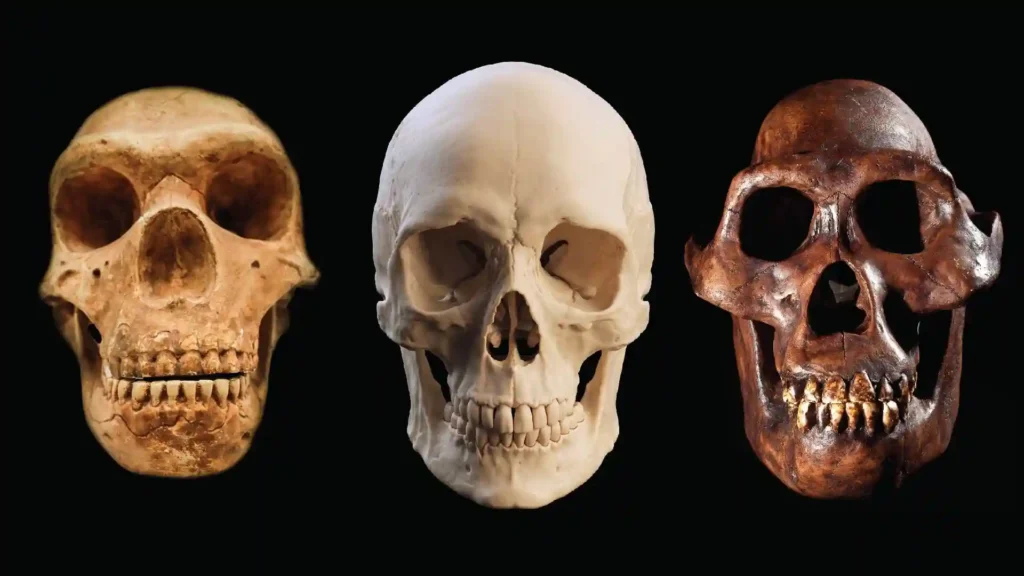
- Neanderthals had large jaws but lacked a projecting chin.
- Earlier species like Homo erectus also lacked a chin.
The presence of a chin is one of the defining features paleoanthropologists use to classify fossils as modern human.
Functional Role Today: Does the Chin Do Anything?
Although its evolutionary origin is debated, the chin does play roles in modern human anatomy.
1. Speech Support
Some linguists and anatomists propose that jaw reshaping—including chin formation—may have indirectly supported the development of complex speech by altering oral cavity structure.
However, this remains secondary and not strongly evidenced as a primary cause.
2. Muscle Attachment and Soft Tissue Support
The chin provides attachment points for:
- Mentalis muscle
- Lower lip stabilizers
In reconstructive surgery and maxillofacial practice, chin structure influences:
- Facial balance
- Airway alignment
- Occlusion
- Orthodontic planning
From a clinical standpoint, chin morphology affects facial harmony and airway function more than survival mechanics.
Clinical Perspective: Real-World Applications
As observed in orthodontic and maxillofacial surgery practice:
Example Scenario
A patient with mandibular retrusion (receding jaw) may experience:
- Obstructive sleep apnea
- Bite misalignment
- Facial disproportionality
Chin advancement procedures (genioplasty) can improve:
- Airway space
- Facial symmetry
- Jaw alignment
This demonstrates that while the chin may not have evolved for a clear survival reason, it now has functional and medical significance.
Why This Matters in Evolutionary Biology
The chin challenges a simplistic understanding of evolution.
Not every anatomical trait must:
- Increase survival directly
- Improve reproductive fitness clearly
- Serve an obvious mechanical function
Some traits may emerge as:
- Developmental byproducts
- Structural consequences of other changes
- Neutral variations that persisted
The chin is a powerful example of how evolutionary biology includes complexity, trade-offs, and indirect outcomes.
Comparison: Humans vs Other Primates
| Feature | Humans | Chimpanzees | Neanderthals |
|---|---|---|---|
| True projecting chin | Yes | No | No |
| Reduced facial projection | Yes | No | Partial |
| Smaller teeth | Yes | No | No |
| Flatter midface | Yes | No | No |
This contrast highlights how the chin is tightly linked to overall facial reorganization unique to Homo sapiens.
What Evolutionary Biologists Agree On (2026 Evidence Summary)
✔ The human chin is unique to modern humans.
✔ It appears relatively late in the fossil record.
✔ It is not strongly supported as a chewing adaptation.
✔ It likely emerged due to facial reduction and mandibular restructuring.
✔ No single explanation fully accounts for its origin.
Is the Chin Truly “Unexplainable”?
It would be inaccurate to say evolution cannot explain the chin at all. Rather:
Evolutionary science has multiple plausible explanations—but no definitive consensus.
This distinction is critical.
Science progresses by refining hypotheses as new fossil discoveries, 3D modeling technologies, and genetic research emerge. As of 2026, the facial reduction and developmental byproduct models hold the strongest support.
Final Evidence-Based Conclusion
The human chin remains one of the most unique and puzzling anatomical traits in evolutionary biology. It is:
- Exclusive to Homo sapiens
- Absent in all other primates
- Not clearly linked to survival advantage
- Most likely a byproduct of facial shortening and mandibular restructuring
Rather than being an evolutionary “mistake,” the chin appears to be an indirect consequence of the dramatic craniofacial transformations that occurred as humans developed larger brains, flatter faces, and smaller teeth.
Its existence reminds us that evolution is not always a story of direct functional optimization. Sometimes, traits emerge from complex structural shifts—leaving behind fascinating biological signatures that continue to challenge scientific understanding.

FAQs
Why do humans have chins if other primates do not?
The human chin evolution mystery arises because only modern humans have a true projecting chin. Most experts believe it formed as facial size reduced over time rather than as a direct survival advantage, supporting current chin evolutionary theory research.
What is the function of the human chin?
The primary human chin function today relates to facial structure and muscle attachment rather than chewing strength. While it may support speech mechanics and lower lip stability, evidence does not show it evolved specifically for these purposes.
Is the human chin an evolutionary adaptation?
Current research suggests the human chin evolution mystery is likely not a classic adaptation. Instead, it may be a structural byproduct of skull reshaping as humans developed flatter faces and smaller jaws.
Did Neanderthals have chins?
No, Neanderthals lacked a true projecting chin. This difference is one of the defining features separating modern humans from extinct hominins and supports ongoing debate in chin evolutionary theory discussions.
Could sexual selection explain the human chin evolution mystery?
Some researchers propose mate preference may have influenced chin prominence. However, scientific evidence indicates sexual selection alone does not fully explain the human chin evolution mystery or why do humans have chins uniquely.




 and then