








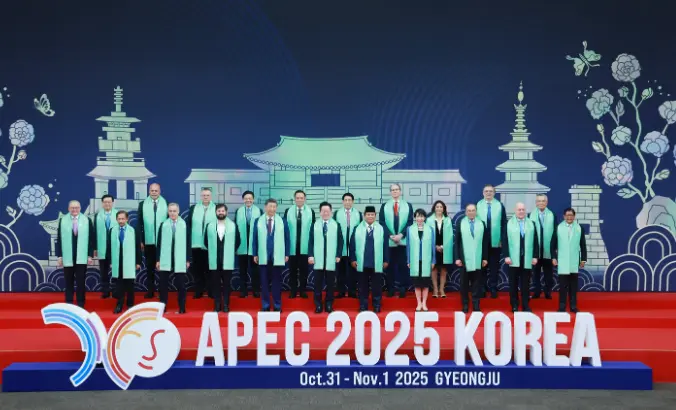

The APEC 2025 Gyeongju Declaration adopted the theme “Building a Sustainable Tomorrow,” centered on AI cooperation and resilient trade. Key outcomes included an agreement to establish an Asia-Pacific AI Center, a Framework on Demographic Change, and a strong affirmation of free trade despite excluding the customary WTO reference, underscoring new regional priorities.
KumDi.com
The 2025 Asia-Pacific Economic Cooperation (APEC) Economic Leaders’ Meeting, hosted by South Korea in the historic city of Gyeongju, concluded with a powerful affirmation of global cooperation, ushering in a new chapter for the Asia-Pacific. The landmark APEC 2025 Gyeongju Declaration successfully forged unprecedented consensus on crucial future-oriented issues, placing AI and resilient trade at the core of the region’s shared vision for sustainable growth, defying the complex geopolitical landscape.
Table of Contents

APEC 2025: A New Chapter for the Asia-Pacific in Gyeongju
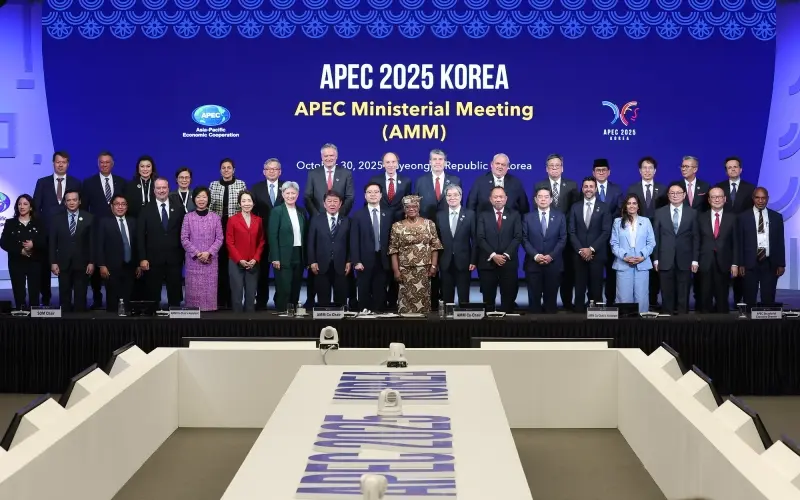
The Gyeongju Declaration, adopted by the 21 APEC member economies, reaffirms their shared commitment to realizing the Putrajaya Vision 2040—a goal of achieving an open, dynamic, resilient, and peaceful Asia-Pacific community. South Korea’s leadership ensured the declaration was structured around three core priorities: Connect, Innovate, and Prosper.
1. Connect: Reaffirming Trade and Resilience
In a period of rising protectionism and geopolitical tension, the declaration achieved a significant diplomatic breakthrough by explicitly including language that reaffirmed the commitment to free trade.
- Free Trade Consensus: The leaders agreed to “advance economic integration in the Asia-Pacific region in a manner that is market-driven, including through the work on the Free Trade Area of the Asia-Pacific (FTAAP) agenda.” This collective reaffirmation of free trade principles was a strong signal against isolationism.
- Trade Omissions: Notably, a point of contention among members, the declaration omitted the traditional reference to maintaining the multilateral trading system under the World Trade Organization (WTO). This reflects the widening policy differences and new trade dynamics among major economies.
- Supply Chain Focus: The declaration underscored the necessity of building an inclusive trade and investment environment that promotes resilience in global supply chains.
2. Innovate: AI and Digital Transformation at the Core
South Korea successfully placed Artificial Intelligence (AI) and Digital Transformation at the forefront of the APEC agenda—a major differentiator from previous summits.
- AI Cooperation Framework: The declaration reflected Korea’s proposals to establish an “Asia-Pacific AI Center” and promote “AI for an inclusive society.” The members agreed to explore collaborative approaches to ensure the benefits of the AI transformation are accessible to all, laying the foundation for an AI-driven economy that enhances well-being.
- Bridging the Digital Divide: Commitments were made to improve digital connectivity, enhance digital literacy, and address the digital divide through capacity-building and public-private sector partnerships, as outlined in the APEC Internet and Digital Economy Roadmap (AIDER).
- Culture as a Growth Engine: In a historic first for an APEC Leaders’ Statement, the declaration explicitly recognized the Cultural and Creative Industries (CCIs), including K-culture, as a new driver of growth for the Asia-Pacific region. This signals a new area for regional economic and cultural cooperation.
3. Prosper: Addressing Demographic and Social Resilience
The summit introduced a forward-looking cooperative initiative to tackle long-term structural and social challenges facing the region.
- Framework on Demographic Change: A comprehensive “Framework on Demographic Change” was endorsed, establishing a foundation for collaboration to turn challenges stemming from low birthrates and aging populations into new opportunities. Key areas of cooperation include:
- Building resilient social systems.
- Modernizing human capital development.
- Advancing tech-based healthcare and care services.
- Inclusive Growth: The leaders emphasized expanding the economic participation of vulnerable groups, including women, youth, and SMEs, to ensure that growth is not just measured in numbers, but in who benefits from it.
- Anti-Corruption Efforts: The declaration reaffirmed the need for more innovative, coordinated, and effective anti-corruption efforts to protect economic integrity.
High-Stakes Bilateral Meetings on the Sidelines
While the multilateral forum provided the stage for economic cooperation, the summit was equally defined by the flurry of high-level bilateral and trilateral meetings held on its sidelines, particularly among the world’s most influential economies. The ancient capital of Gyeongju briefly transformed into a crucial hub of 21st-century diplomacy.
The US-China Meeting: A Trade Truce
The most anticipated side event was the meeting between U.S. President Donald Trump and Chinese President Xi Jinping. This was their first face-to-face meeting in over six years and successfully signaled a pause in the ongoing trade war.
- Trade Tension Eased: The leaders agreed on a one-year trade truce to lower tensions, which had recently flared up over China’s export curbs on rare earth minerals.
- Tariff Adjustments: Following their talks, President Trump announced that the U.S. would lower its tariff on certain Chinese goods from 20% to 10%.
- Diplomatic Significance: Although President Trump did not attend the main APEC Leaders’ Summit, his engagement with President Xi provided a rare space for dialogue between the world’s two largest economies, a crucial stabilizing factor for the global market.
The South Korea-China Summit: Navigating Geopolitics
South Korean President Lee Jae Myung held a critical summit with Chinese President Xi Jinping, marking President Xi’s first state visit to South Korea in 11 years.
- North Korea Dialogue: President Lee urged President Xi to use China’s improved high-level ties with Pyongyang to help bring North Korea back to the negotiating table for denuclearization talks, emphasizing the need for stronger “strategic communication” on the Korean Peninsula issue.
- Economic Ties: Both leaders called for advancing the partnership to a “more mature stage,” agreeing to speed up negotiations for upgrading the China-South Korea free trade agreement and deepening cooperation in key sectors like AI and biopharmaceuticals.
The South Korea-US Dialogue: Investment and Security
President Lee and President Trump held discussions focusing on trade, investment, and the bilateral security alliance.
- Investment Pledge: The talks addressed the structure of South Korea’s previously pledged $350 billion in new investments into the United States, which had faced a deadlock over implementation details. Both sides played down the prospect of a full breakthrough during the APEC talks but expressed commitment to finding a workable solution.
- Defense Partnership: Security issues and the defense cost-sharing arrangement were also on the agenda, as President Trump has previously pressed allies like South Korea to increase their defense contributions.
South Korea’s Legacy as Host
The successful adoption of the Gyeongju Declaration and the role played by South Korea’s pragmatic diplomacy in facilitating crucial high-level dialogue underscored its burgeoning diplomatic stature as a global connector in an increasingly fragmented world. By successfully elevating new agendas like AI and demographic change, South Korea positioned APEC as a forum that is both future-oriented and capable of delivering tangible results. The event is estimated to generate a total of 7.4 trillion won ($5.3 billion) in economic impact, solidifying its place as a significant turning point for both the host nation and the Asia-Pacific region.
FAQs
What were the main priorities of the APEC 2025 Gyeongju Declaration?
The main priorities of the APEC 2025 Gyeongju Declaration were “Connect, Innovate, and Prosper,” with a strong emphasis on advancing APEC AI cooperation, strengthening supply chain resilience, and achieving sustainable, inclusive growth across the Asia-Pacific region.
Did the APEC 2025 Gyeongju Declaration achieve a consensus on free trade?
Yes, the APEC 2025 Gyeongju Declaration included a strong commitment to free trade, specifically agreeing to advance the Free Trade Area of the Asia-Pacific (FTAAP) agenda, although specific Gyeongju trade outcomes noted the omission of the customary WTO reference.
What was the significance of AI in the APEC 2025 Gyeongju Declaration?
The APEC 2025 Gyeongju Declaration made history by establishing a framework for APEC AI cooperation, including a proposal for an Asia-Pacific AI Center, reflecting AI’s crucial role in the region’s future economic growth and social well-being.
What were the key results from the US-China APEC meeting on the sidelines?
The US-China APEC meeting during the summit provided a crucial diplomatic moment, resulting in a one-year trade truce and an agreement to reduce certain U.S. tariffs on Chinese goods, which helped stabilize the global trade outlook amid the APEC 2025 Gyeongju Declaration talks.
How does the APEC 2025 Gyeongju Declaration address demographic shifts?
The APEC 2025 Gyeongju Declaration addressed demographic shifts by adopting a comprehensive Framework on Demographic Change, outlining cooperation on modernizing human capital development and using technology to advance healthcare, turning population challenges into opportunities for future growth.




 and then