








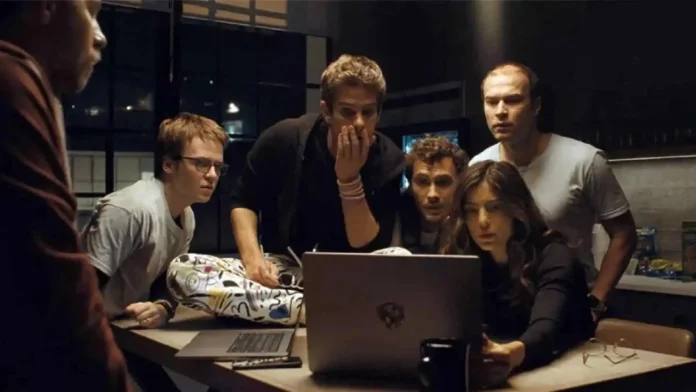
Is Artificial by Andrew Garfield worth watching?
KumDi.com
Yes. Artificial is a sharp, unsettling AI drama about Sam Altman, OpenAI, ambition, technology and AI governance. Andrew Garfield delivers a compelling performance, while Luca Guadagnino combines corporate drama, dark comedy and technological anxiety to examine who controls the future of artificial intelligence.
Luca Guadagnino’s Artificial is one of the most timely films of 2026, using Andrew Garfield’s unsettling performance as Sam Altman to turn the rise of OpenAI into a dark comedy about ambition, power, money, and the risks of artificial intelligence. The film premiered at the 2026 New York Film Festival and has already generated strong critical discussion, with many reviewers comparing its technology-industry drama to The Social Network.
My assessment: Artificial is worth watching, particularly for viewers interested in AI, Silicon Valley, technology ethics, or Andrew Garfield’s acting. It is stylish, provocative and frequently funny, but its broad satire and uneven tone sometimes prevent it from becoming the definitive AI movie it clearly wants to be.
Artificial Review: Quick Verdict
| Category | Assessment |
|---|---|
| Film | Artificial |
| Director | Luca Guadagnino |
| Screenwriter | Simon Rich |
| Andrew Garfield | Sam Altman |
| Yura Borisov | Ilya Sutskever |
| Mark Rylance | Geoffrey Hinton |
| Monica Barbaro | Mira Murati |
| Genre | Drama / Dark Comedy / Tech Satire |
| Runtime | Approximately 139 minutes |
| World Premiere | New York Film Festival 2026 |
| US Release | December 25, 2026 |
| Overall verdict | Recommended |
| Best reason to watch | Andrew Garfield and the film’s provocative examination of AI power |
Runtime and release information are based on current 2026 reporting and may vary by territory.
Table of Contents

What Is Artificial About?
Artificial dramatizes the rise of OpenAI and the people surrounding the development of modern artificial intelligence. Rather than treating AI as an abstract technological subject, Luca Guadagnino’s film focuses on the humans behind it—particularly Sam Altman, Ilya Sutskever and Geoffrey Hinton.
Andrew Garfield plays Sam Altman, while Yura Borisov portrays Ilya Sutskever and Mark Rylance plays AI researcher Geoffrey Hinton. Monica Barbaro also appears as Mira Murati.
The story spans years of AI development but gives particular dramatic weight to the extraordinary events surrounding Altman’s removal as OpenAI CEO in November 2023 and his rapid return to the company.
That real-world episode provides the movie with its central question:
What happens when people building technology capable of transforming humanity begin fighting over who should control it?
The answer offered by Artificial is deliberately uncomfortable: the biggest danger may not simply be the technology itself, but human ambition, institutional power and the incentives surrounding it.
Andrew Garfield as Sam Altman
Andrew Garfield is arguably the strongest reason to see Artificial.
His interpretation does not attempt to present Sam Altman as a conventional heroic technology visionary. Instead, Garfield emphasizes contradictions: charm alongside calculation, vulnerability alongside confidence, and apparent idealism alongside an intense desire for control.
That approach has attracted considerable critical attention.
The Guardian described Garfield’s performance as particularly effective at portraying Altman’s transformation, while Variety‘s early reactions highlighted the actor’s ability to combine charm with something considerably more unsettling.
This is important because Artificial is not structured as a conventional biopic.
Garfield isn’t simply asked to reproduce Altman’s mannerisms. He is playing a cinematic interpretation of a contemporary public figure.
That distinction matters.
The movie is dramatized entertainment, not a documentary record. Audiences should therefore distinguish between:
- documented historical events,
- publicly reported facts,
- fictionalized conversations,
- composite dramatic situations,
- and Guadagnino’s artistic interpretation.
That is one of the most important considerations when evaluating the movie.
Is Andrew Garfield’s Performance Good?
Yes. Garfield is one of the film’s biggest strengths.
His performance works because he avoids making Altman completely monstrous from the beginning. Instead, the character becomes progressively more difficult to read.
That creates an interesting dramatic mechanism.
At first, Altman’s confidence can appear entrepreneurial. Later, the same behavior can look manipulative. Eventually, his determination to maintain control becomes part of the movie’s broader anxiety about technological power.
Several early reviews have singled out Garfield’s performance as a major achievement. Variety reported reactions describing his portrayal as one of his most unsettling and transformative performances, while Screen Daily praised his depiction of Altman as a particularly compelling element of the film.
For viewers who remember Garfield from The Social Network, there is an additional layer of irony.
In that 2010 film, Garfield played Eduardo Saverin, a character caught on the losing side of a technology company’s internal power struggle.
In Artificial, he is effectively on the other side of that equation.
That makes the casting particularly clever.
Yura Borisov as Ilya Sutskever
Yura Borisov provides the film’s other major dramatic anchor as Ilya Sutskever.
Where Garfield’s Altman represents ambition and organizational power, Borisov’s Sutskever represents the scientific and ethical questions surrounding AI development.
The relationship between the two characters becomes the film’s emotional engine.
Sutskever begins with an idealistic vision of artificial intelligence and its potential benefits. As the technology becomes increasingly powerful—and the organization surrounding it becomes increasingly complicated—his relationship with Altman deteriorates.
This creates an important contrast:
Altman asks, “How far can we go?”
Sutskever increasingly asks, “Should we go that far?”
That conflict gives Artificial considerably more substance than a simple technology-industry satire.
What Does Artificial Say About AI?
The movie’s central argument isn’t really about whether AI is inherently good or bad.
Instead, it explores who controls powerful AI systems and what incentives guide their decisions.
That distinction is significant.
Artificial intelligence can be discussed through several different dimensions:
- Technical capability — What can AI systems actually do?
- Commercial incentives — Who profits from their development?
- Institutional governance — Who gets to make decisions?
- Safety — How are potentially harmful outcomes controlled?
- Social impact — What happens when AI changes employment, information and creativity?
- Concentration of power — What happens when a small number of organizations control increasingly capable systems?
Artificial focuses heavily on the last three.
The film portrays AI development almost like the creation of a monster. But the monster metaphor is less interesting than the people responsible for creating and controlling it.
That is where the film becomes genuinely relevant in 2026.
Is Artificial a Sequel to The Social Network?
No, but the comparison is understandable.
The Social Network examined Facebook’s origins through the lens of ambition, betrayal, friendship and technological disruption.
Artificial similarly examines a technology company whose influence has expanded far beyond its original founders.
The difference is that the stakes have changed.
Facebook transformed communication.
Generative AI potentially transforms how humans create, search, program, communicate and make decisions.
That gives Artificial a much larger existential framework.
Several critics have explicitly described the movie as a spiritual successor to The Social Network.
But there is an important limitation to the comparison.
David Fincher’s The Social Network was tightly constructed around a specific interpersonal conflict. Artificial attempts to cover a much broader historical and technological landscape.
That makes it more ambitious—but also less focused.
Luca Guadagnino’s Direction
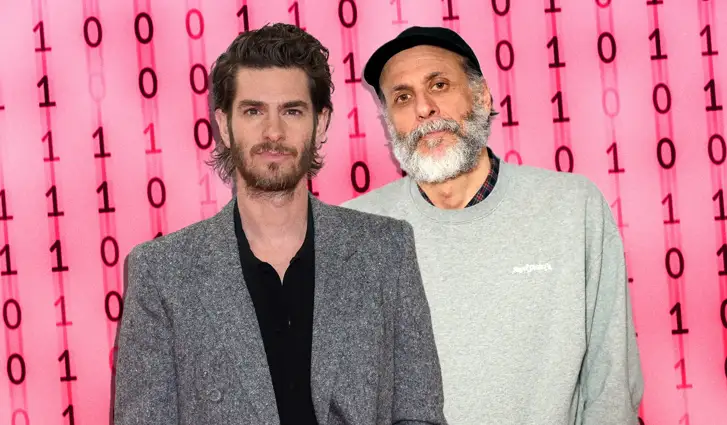
Luca Guadagnino is perhaps the least obvious director for a movie about Silicon Valley.
Known for films including Call Me by Your Name and Challengers, Guadagnino brings a highly stylized visual sensibility to a story that could easily have been presented as a conventional corporate drama.
The result is deliberately strange.
The movie uses:
- stylized camera movement,
- electronic music,
- exaggerated performances,
- dark comedy,
- unsettling imagery,
- and deliberately theatrical sequences.
Damon Albarn’s score is another important component. Screen Daily notes that the electronic score incorporates sounds reminiscent of computer games, helping create the film’s uneasy technological atmosphere.
The style makes Artificial visually distinctive.
However, it also contributes to one of the movie’s weaknesses.
Sometimes the filmmaking calls attention to itself more than the story requires.
The Biggest Weakness: Tone
This is where the critical response becomes divided.
Some reviewers have praised Artificial as a provocative dark comedy. Others have criticized its tonal inconsistency and broad humor.
The Guardian, for example, gave the film three stars and described it as a muddled tech satire.
Screen Daily similarly praised Garfield while arguing that the screenplay does not always provide enough depth behind its larger ideas.
That criticism is fair.
The film moves between:
comedy → corporate drama → satire → horror → technological thriller
without always transitioning smoothly.
One moment can be intentionally absurd; the next asks the audience to contemplate potentially catastrophic consequences of AI.
For some viewers, that combination will make the movie more interesting.
For others, it will feel inconsistent.
Is Artificial Based on a True Story?
Yes, but it should be understood as a dramatization rather than a documentary.
The film draws from real people and real events surrounding AI development and OpenAI.
That includes figures such as:
- Sam Altman
- Ilya Sutskever
- Geoffrey Hinton
- Mira Murati
- Elon Musk
and the events surrounding OpenAI’s leadership crisis in 2023.
However, filmmakers inevitably reconstruct private conversations, motivations and events for dramatic purposes.
Therefore, viewers should not assume that every conversation or scene represents a historically verified event.
This distinction is particularly important with contemporary biographical films because many of the people depicted are still alive and continue to shape the technology industry.
Why the 2023 OpenAI Crisis Matters to the Movie
One of the most dramatic real-world elements surrounding Artificial is Altman’s removal and return as OpenAI CEO.
In November 2023, OpenAI’s board announced Altman’s removal. After several days of intense negotiations and pressure from employees and stakeholders, Altman returned to the company.
That extraordinary episode gives Artificial a naturally cinematic structure.
It contains:
- corporate conflict,
- competing visions,
- boardroom politics,
- personal relationships,
- questions about AI safety,
- enormous financial stakes,
- and a dramatic reversal.
For a screenwriter, it is almost impossible to invent a better corporate crisis.
The movie uses that episode to explore something larger: whether technological leadership can be separated from personal power.
Does Artificial Accurately Explain AI?
Not completely—and that isn’t necessarily its purpose.
The film uses real AI concepts and historical developments, but it is primarily a drama.
Some viewers unfamiliar with artificial intelligence may find the terminology challenging. Screen Daily specifically notes that jargon-heavy sections involving concepts such as natural language processing can be demanding for audiences.
If you want a technically accurate explanation of how modern AI systems work, Artificial should not be treated as a textbook.
Instead, it works better as an introduction to the human and institutional problems surrounding AI.
The movie asks questions such as:
- Who decides how AI should develop?
- What happens when commercial incentives conflict with safety?
- Can organizations control technologies that evolve rapidly?
- Should a small group of executives make decisions affecting billions of people?
- What happens when scientific idealism encounters enormous financial incentives?
Those are much more central to the film than technical explanations of machine learning.
Artificial vs. The Social Network
| Feature | The Social Network | Artificial |
|---|---|---|
| Technology | Social media | Artificial intelligence |
| Central company | OpenAI | |
| Core conflict | Ownership and ambition | Power, AI safety and control |
| Style | Legal/corporate drama | Dark comedy / satire / thriller |
| Central figure | Mark Zuckerberg | Sam Altman |
| Main question | Who owns the future of social connection? | Who controls the future of intelligence? |
| Historical scope | More focused | Broader |
| Tone | Consistent and dramatic | More deliberately chaotic |
The comparison is useful, but Artificial ultimately wants to do something different.
The Social Network is fundamentally about the creation of a company.
Artificial is increasingly about the consequences of creating a technology.
What Critics Are Saying
The early critical response is broadly positive but far from unanimous.
Several critics praised the movie’s relevance, performances and ambition. Variety reported particularly enthusiastic reactions following the New York premiere, with critics describing it as provocative, frightening and highly timely.
Other reviews were more reserved.
The Guardian criticized the movie’s muddled satire, while Screen Daily argued that its strong performances and visual style cannot completely overcome limitations in characterization and screenplay depth.
That divergence is useful for prospective viewers.
It suggests that Artificial is not simply a universally acclaimed masterpiece. Rather, it is an ambitious movie generating strong reactions because its subject matter is unusually current.
Who Should Watch Artificial?
You should watch it if you:
- Follow artificial intelligence and OpenAI.
- Are interested in Sam Altman or Silicon Valley.
- Enjoy technology-focused dramas.
- Liked The Social Network.
- Enjoy dark comedy and satire.
- Want to see Andrew Garfield in a radically different role.
- Are interested in the ethics and governance of AI.
You may want to skip it if you:
- Want a conventional biographical movie.
- Expect a technically rigorous explanation of AI.
- Prefer realistic corporate dramas.
- Dislike exaggerated or theatrical performances.
- Want a straightforward narrative without stylistic experimentation.
Final Review: Is Artificial Worth Watching?
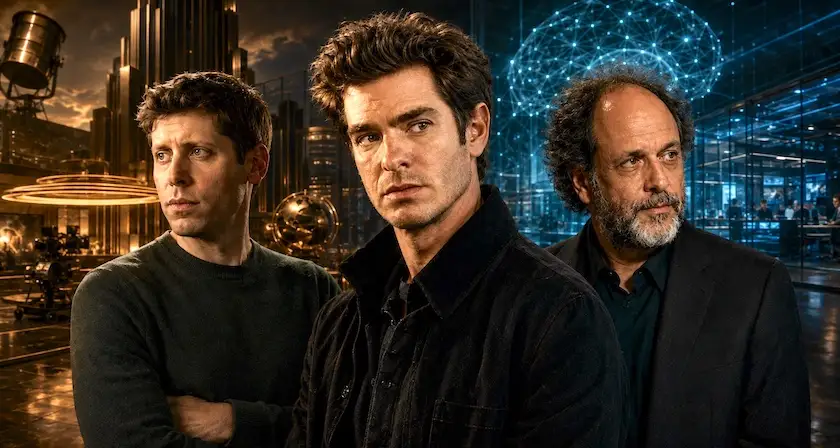
Yes.
Artificial is not perfect, but it is one of the more culturally relevant films of 2026 because it arrives at a moment when artificial intelligence is no longer simply a science-fiction concept.
AI is already influencing search, education, programming, media, business, entertainment and everyday communication.
That makes the movie’s central conflict unusually immediate.
The strongest element is Andrew Garfield’s Sam Altman. Garfield gives the character enough charm and unpredictability to keep the audience watching even when the screenplay becomes deliberately exaggerated.
Yura Borisov provides the film with its moral counterweight, while Guadagnino’s visual direction prevents the movie from becoming a conventional corporate biopic.
The weakness is the screenplay’s tendency to overplay its satire. At times, the characters become symbols rather than fully developed human beings. The film also struggles to balance comedy with its darker warnings about AI.
Nevertheless, those flaws do not erase its value.
Final Rating: 8/10
Best feature: Andrew Garfield’s performance
Best thematic element: AI power versus human responsibility
Biggest weakness: Uneven tone and occasionally broad characterization
Best comparison: The Social Network meets dark Silicon Valley satire
Worth watching? Yes—especially for AI, technology and Andrew Garfield fans.
Ultimately, Artificial isn’t really asking whether artificial intelligence will destroy humanity.
It is asking a more uncomfortable question:
What happens when human beings build something extraordinarily powerful—and then have to decide who gets to control it?
That question makes Artificial more than a movie about OpenAI. It makes it a film about the defining technological power struggle of the 2020s.




 and then