








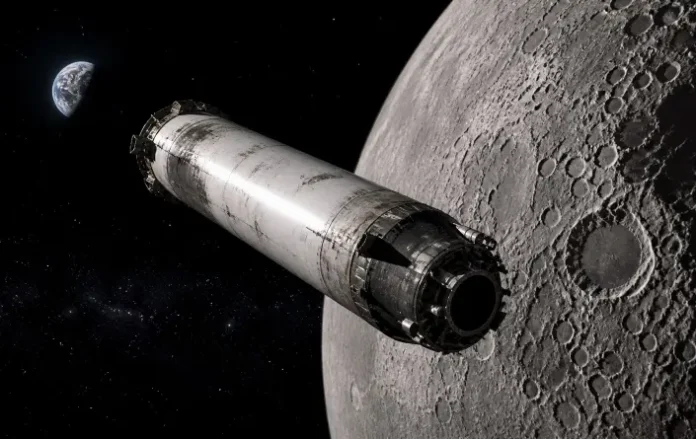

A discarded SpaceX Falcon 9 upper stage is expected to collide with the Moon after completing its mission and drifting through cislunar space. The impact is accidental, caused by the combined gravitational pull of Earth and the Moon altering its orbit over time. Scientists say the event poses no threat to Earth and provides a valuable opportunity to study lunar impacts and space debris.
KumDi.com
A discarded SpaceX Falcon 9 upper stage is expected to collide with the Moon this week after spending more than a year drifting through cislunar space. The impact is unintentional—the rocket was never designed to return to Earth or enter stable lunar orbit after completing its mission. Instead, the combined gravitational forces of Earth and the Moon gradually altered its trajectory until a collision became inevitable.
Although headlines may sound alarming, there is no danger to Earth. Scientists view the event as a rare scientific opportunity to study impact physics, lunar dust behavior, and the growing challenge of managing space debris beyond Earth’s orbit. As human activity around the Moon increases through NASA’s Artemis program and commercial missions, this incident also highlights why better space traffic management is becoming increasingly important.
Quick Answer
| Question | Answer |
|---|---|
| What will hit the Moon? | A discarded SpaceX Falcon 9 upper stage. |
| Was the crash intentional? | No. It is an accidental orbital evolution. |
| Is Earth at risk? | No. |
| Expected impact speed | About 5,400 mph (8,700 km/h). |
| Expected impact date | August 5, 2026 (UTC). |
| Scientific value | High—researchers can study lunar impacts, ejecta, and space debris. |
Table of Contents

What Exactly Is Crashing into the Moon?
The object is not an active spacecraft, nor is it a complete Falcon 9 rocket.
Instead, it is the upper stage of a Falcon 9 launch vehicle—the section responsible for delivering payloads beyond Earth’s orbit.
After launching two commercial lunar landers during a 2025 mission, the stage completed its job but retained enough momentum to continue traveling through Earth-Moon space. Because it had no remaining fuel for controlled disposal, it became another piece of deep-space debris.
Unlike rockets operating in low Earth orbit, objects traveling toward the Moon cannot always be safely deorbited.
Why Is the Rocket on a Collision Course?
The answer lies in orbital mechanics, not equipment failure.
Several factors gradually pushed the rocket toward the lunar surface.
1. Mission Completed
Once the payloads separated successfully, the upper stage became inactive.
Its engines shut down permanently.
2. No Fuel for Disposal
Many Earth-orbiting rockets perform a controlled reentry.
This particular upper stage did not have sufficient fuel to safely dispose of itself after entering cislunar space.
3. Gravitational Perturbations
The Earth and Moon constantly influence nearby objects.
Small gravitational changes accumulate over months, eventually altering an object’s orbit.
This process slowly transformed the rocket’s path into one intersecting the Moon.
4. No Atmospheric Drag
Earth’s atmosphere naturally removes much orbital debris.
The Moon has essentially no atmosphere.
Without drag to slow it down, the rocket continued traveling until impact became unavoidable.
Why Didn’t SpaceX Simply Bring It Back?
This is one of the most common public questions.
The answer is largely technical and economic.
Deep-space missions operate with extremely tight fuel margins.
Every kilogram of fuel reserved for disposal reduces the payload capacity available for scientific instruments or commercial spacecraft.
Historically, many lunar missions—from government agencies as well as private companies—have left upper stages in space after mission completion.
As lunar traffic increases, however, this practice is receiving greater scrutiny from scientists and policymakers.
What Will Happen During the Impact?
Scientists estimate the Falcon 9 stage will strike the Moon at approximately:
- 8,700 km/h
- 5,400 mph
- 2.4 km per second
The impact is expected to:
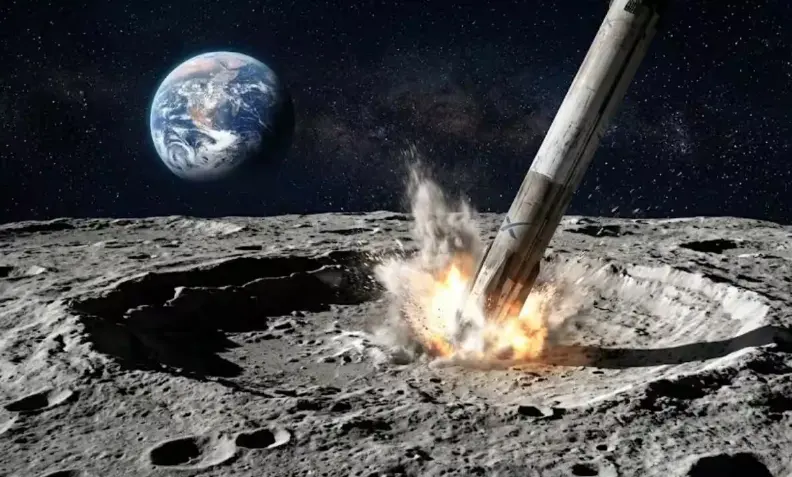
- produce a new crater roughly 27 meters (90 feet) wide
- eject large amounts of lunar dust and rock
- briefly create a visible debris plume under favorable observing conditions
- provide valuable before-and-after observations for lunar orbiters.
Unlike Earth, the Moon lacks wind and weather.
As a result, the crater may remain essentially unchanged for millions of years.
Will Anyone Be Able to See It?
Possibly—but not with the naked eye.
Visibility depends on:
- telescope size
- viewing location
- weather
- the brightness of the impact plume
- the exact impact geometry.
Professional observatories and experienced amateur astronomers are expected to attempt observations. Spacecraft already orbiting the Moon may also photograph the impact site before and after the event.
Why Are Scientists Excited?
Although accidental, this impact creates a rare controlled experiment.
Researchers can compare:
- predicted crater size
- actual crater dimensions
- dust plume behavior
- ejecta velocity
- impact energy calculations
- lunar surface composition.
Normally, meteorite impacts occur without advance warning.
Here, scientists know:
- what object is striking,
- approximately how fast it is traveling,
- where it will hit,
- and when observations should begin.
That makes this an unusually valuable research opportunity.
Does This Damage the Moon?
Practically speaking, no.
The Moon experiences thousands of natural impacts every year.
Most are caused by meteoroids traveling much faster than this Falcon 9 stage.
Compared with the Moon’s diameter of 3,474 kilometers, a crater only a few dozen meters wide is insignificant.
There is no realistic possibility that the impact could:
- alter the Moon’s orbit
- affect Earth’s tides
- trigger moonquakes dangerous to Earth
- break apart the Moon.
The Bigger Issue: Space Debris Beyond Earth
The event highlights an increasingly important challenge.
For decades, attention focused mainly on debris in low Earth orbit.
Now humanity is expanding toward:
- lunar orbit
- lunar landings
- cislunar transport
- commercial Moon missions
- permanent lunar infrastructure.
Every discarded rocket stage becomes another object that must eventually be tracked or safely disposed of.
Experts increasingly argue that international standards should extend beyond Earth orbit to include lunar space traffic management.
Could Future Lunar Bases Be at Risk?
Today, the answer is essentially no.
The predicted impact location is far from existing spacecraft.
However, the long-term concern is different.
NASA’s Artemis program, commercial companies, and several national space agencies all plan to establish sustained operations on or around the Moon over the coming decade.
As lunar activity increases, unmanaged debris could eventually threaten:
- habitats
- communication satellites
- landing zones
- scientific instruments
- astronauts performing surface operations.
This is why researchers increasingly consider debris management part of future lunar safety planning.
Have Similar Moon Impacts Happened Before?
Yes.
Several spacecraft have intentionally impacted the Moon for scientific purposes.
Examples include:
- NASA’s LCROSS mission (2009), which deliberately struck the Moon to search for water ice.
- Multiple Apollo mission stages that were intentionally crashed to generate seismic data.
- Other retired spacecraft that ended their missions with controlled lunar impacts.
The major difference here is that the Falcon 9 impact is uncontrolled, even though its trajectory has been accurately predicted.
FAQs
Why is a SpaceX rocket crashing into the Moon?
The Falcon 9 upper stage completed its mission but lacked enough fuel for a controlled disposal. Over time, gravitational forces from the Earth and Moon gradually changed its trajectory, placing it on an unavoidable collision course with the lunar surface.
Is the Moon collision dangerous for Earth?
No. The impact poses no risk to Earth. The rocket will strike only the Moon, and its mass is far too small to affect the Moon’s orbit, Earth’s tides, or any other planetary systems.
What part of the SpaceX rocket will hit the Moon?
It is not the entire Falcon 9 rocket. The object is the upper stage, the section that carried payloads toward the Moon before becoming inactive after mission completion.
Why are scientists interested in the impact?
Researchers will use the event to study crater formation, impact energy, lunar dust behavior, and ejecta patterns. Because the object’s size, speed, and impact location are known in advance, it offers a rare opportunity to validate lunar impact models.
What does this event mean for future Moon missions?
The collision highlights the growing need for space debris management around the Moon. As NASA’s Artemis program and commercial lunar missions increase, experts say international guidelines for spacecraft disposal and cislunar traffic management will become increasingly important.
Conclusion
The impending collision between a discarded SpaceX Falcon 9 upper stage and the Moon is not a planetary threat, but it is an important milestone in the era of expanding lunar exploration. The impact illustrates how the growing number of government and commercial missions beyond Earth is creating new challenges in managing space debris.
For scientists, the event offers a unique chance to validate impact models, observe crater formation in real time, and refine our understanding of the lunar environment. For policymakers and space agencies, it underscores the need for international standards governing spacecraft disposal and traffic management around the Moon. As humanity prepares for sustained lunar operations, incidents like this serve as valuable lessons for building a safer and more sustainable future in deep space.




 and then