








Elon Musk work optional money irrelevant is his prediction that within 10–20 years, AI and robotics will produce abundant goods and services without human labor. In this future, people would not need jobs to survive and could choose work only for creativity, meaning, or enjoyment.
KumDi.com
Elon Musk work optional money irrelevant is a bold vision of the future where artificial intelligence and robotics replace most human labor. Musk believes that within 10–20 years, machines will create enough abundance that traditional jobs and income are no longer necessary for survival, fundamentally reshaping human life.
Elon Musk has never been known for modest predictions. From colonizing Mars to creating self-driving cars and artificial general intelligence, his forecasts often sit at the intersection of bold optimism and disruptive realism. One of his most provocative claims yet is this: within the next 10 to 20 years, work will become optional, and money may lose much of its relevance, driven by rapid advances in artificial intelligence and robotics.
This statement challenges the very foundation of modern civilization. Work and money have shaped human societies for thousands of years — defining status, survival, purpose, and power. Musk’s vision suggests that humanity may be approaching a historic turning point, one where technology fundamentally alters how people live, earn, and find meaning.
This article explores what Musk means by this prediction, why he believes it is possible, what such a future might look like, and the serious challenges that stand between today’s economy and a post-work world.
Table of Contents
Understanding Musk’s Claim: What Does “Work Will Be Optional” Really Mean?
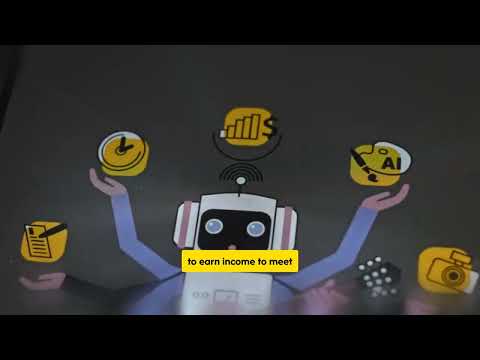
When Elon Musk says work will be optional, he is not suggesting that people will be forbidden from working. Instead, he envisions a future where human labor is no longer required for survival.
In this scenario:
- Machines perform nearly all necessary physical labor
- AI systems handle most cognitive, analytical, and creative tasks
- Goods and services are produced at extremely low cost
- Humans are free to work only if they want to, not because they must
Work becomes a choice rather than a requirement, similar to how people today choose hobbies, sports, or artistic pursuits. Some may still work out of passion, ambition, or curiosity, but the threat of poverty or deprivation disappears.
Why Musk Believes AI and Robotics Will Make This Possible
1. Exponential AI Intelligence Growth
Modern AI systems are already capable of:
- Writing code
- Creating art and music
- Analyzing legal and medical data
- Running businesses and optimizing logistics
- Teaching, tutoring, and advising humans
Musk believes this trend will continue toward artificial general intelligence (AGI) — AI that can perform any intellectual task a human can, but faster, cheaper, and at scale.
Once intelligence itself becomes abundant, the economic value of human cognitive labor drops dramatically.
2. Robotics Eliminating Physical Labor
While AI replaces mental tasks, robots replace physical ones.
Humanoid robots, automated factories, autonomous delivery systems, robotic surgeons, agricultural robots, and construction machines are already emerging. Musk argues that once robots can perform most physical work more efficiently than humans, the need for human labor across industries collapses.
Together, AI and robotics form a complete replacement for human productivity.
3. Near-Unlimited Production Capacity
When machines can build machines, production scales rapidly. Musk envisions a world where:
- Food production is fully automated
- Housing is built by robotic systems
- Manufacturing requires minimal human oversight
- Energy is abundant through advanced renewables and storage
In such a system, scarcity — the reason money exists — begins to fade.
Why Money Could Become “Irrelevant”
Money exists to allocate scarce resources. If AI and robots can produce more than enough for everyone, money loses much of its function.
Musk does not necessarily mean money will vanish overnight. Instead, he suggests that:
- Basic needs may no longer require payment
- Access to essentials becomes universal
- Economic survival no longer depends on income
Money may still exist for luxury goods, status items, or personalized experiences, but it no longer determines whether someone can live with dignity.
This represents a shift from a scarcity-based economy to a post-scarcity or abundance-based society.
The Role of Universal Income in Musk’s Vision
Musk has frequently discussed the idea of universal income, often expanding it into what he calls a “universal high income.”
In this model:
- Every person receives enough resources to live comfortably
- Income is decoupled from employment
- People are free to pursue education, creativity, caregiving, or exploration
Unlike traditional welfare, this system would not be based on need or unemployment. Instead, it would reflect the reality that machines produce the value, while humans share in the benefits.
Is the 10–20 Year Timeline Realistic?
This is where debate intensifies.
Arguments Supporting Musk’s Timeline
- AI capability is improving exponentially
- Automation is accelerating faster than past industrial revolutions
- Entire job categories are already disappearing
- Technological adoption cycles are shrinking
From this perspective, 10–20 years may be enough for a radical transformation.
Arguments Against the Timeline
- Robotics hardware scales slower than software
- Physical infrastructure takes decades to replace
- Political systems adapt far more slowly than technology
- Economic power may remain concentrated among AI owners
Critics argue that while AI may eliminate many jobs, social and political systems may prevent the benefits from reaching everyone within Musk’s timeframe.
What Would Humans Do If Work Is Optional?
This question reveals the deepest implications of Musk’s prediction.
Positive Possibilities
- Explosion of creativity and art
- Lifelong learning without financial pressure
- Stronger families and communities
- Scientific and philosophical exploration
- More focus on health, well-being, and purpose
In this view, humanity enters a new renaissance.
Psychological and Social Challenges
Work provides:
- Identity
- Structure
- Social status
- Purpose
If work disappears suddenly, societies may face:
- Loss of meaning for many individuals
- Mental health challenges
- Cultural confusion about success and value
Musk himself has acknowledged that meaning will become the central challenge in a post-work world.
The Biggest Risk: Inequality

Technology alone does not guarantee fairness.
If AI and robots are owned by a small group:
- Wealth concentration could increase dramatically
- Social unrest could rise
- Optional work becomes a privilege, not a reality
For Musk’s vision to succeed, societies must address:
- Ownership of AI systems
- Redistribution of productivity gains
- Fair access to technology
Without this, automation could deepen inequality instead of eliminating it.
Will Money Truly Disappear — or Just Change?
Rather than vanishing, money may evolve.
Possible future systems include:
- Energy-based credits
- Compute-usage credits
- Resource access tokens
- Reputation or contribution systems
The key shift is not the elimination of value exchange, but the removal of survival pressure from economic participation.
A Civilization-Level Transition
If Musk’s prediction becomes reality, it would represent:
- The end of labor-based economics
- The largest social transformation since agriculture
- A complete rewrite of human purpose
This transition would not be purely technological — it would be philosophical, cultural, and ethical.
Conclusion: Visionary Forecast or Overconfident Prediction?
Elon Musk’s claim that work will be optional and money irrelevant within 10 to 20 years is one of the most radical economic predictions of the AI era.
It rests on three core assumptions:
- AI will surpass human intelligence across domains
- Robotics will replace nearly all physical labor
- Societies will successfully redistribute abundance
Whether or not his timeline proves accurate, one conclusion is unavoidable:
AI and robotics are fundamentally changing the meaning of work, value, and human purpose.
The future Musk describes may not arrive exactly as predicted — but the direction of change is already underway. Humanity now faces a critical question:
If machines can do everything for us, what does it mean to be human?

FAQs
Why does Elon Musk believe work will be optional in the future?
Elon Musk believes work will be optional because AI and robotics will replace most human jobs, allowing machines to produce goods and services efficiently without human labor.
How could AI make money irrelevant according to Elon Musk?
Elon Musk says money could become irrelevant if AI creates abundant resources, reducing scarcity and eliminating the need to earn income to meet basic human needs.
When does Elon Musk predict work will no longer be necessary?
Elon Musk predicts that within 10–20 years, work could become optional as AI replacing jobs accelerates across industries worldwide.
What role do robotics play in a post-work society?
Robotics enable a post-work society by performing physical labor such as manufacturing, construction, and logistics, supporting an AI-driven abundance economy.
Will humans still work if AI replaces jobs?
Yes, humans may still work in a future where AI replaces jobs, but work would be voluntary, focused on creativity, purpose, and personal fulfillment rather than survival.


 and then