








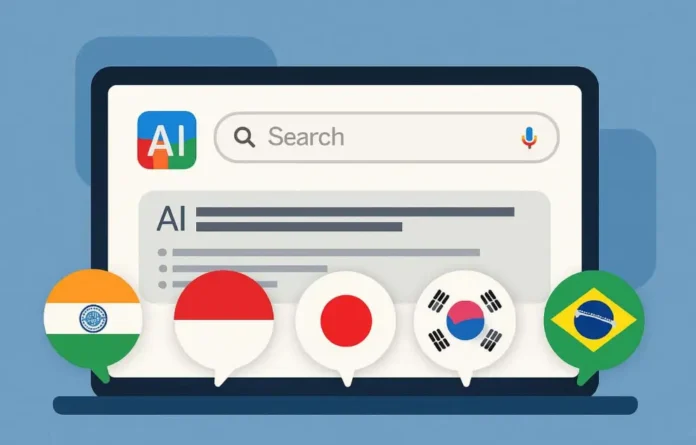

Google AI Mode new languages now include Hindi, Japanese, Korean, Indonesian, and Brazilian Portuguese. This global expansion allows billions of users to access smarter, conversational AI-powered search in their native language, offering more natural, localized, and culturally relevant results beyond English.
KumDi.com
Google has officially expanded AI Mode to five new languages worldwide, bringing its advanced AI-powered search experience to speakers of Hindi, Japanese, Korean, Indonesian, and Brazilian Portuguese. This update allows billions of users to enjoy smarter, more natural, and localized search results in their native language, marking a major milestone in Google’s global AI strategy.
Table of Contents

Major Step Toward Truly Global Search
Google has taken another bold step in its mission to create a search experience that works for everyone, everywhere. Its experimental AI Mode, which reimagines the way people interact with search, is no longer limited to English. The company has officially rolled out support for five new languages: Hindi, Indonesian, Japanese, Korean, and Brazilian Portuguese.
This expansion marks a turning point in Google’s strategy to ensure that the benefits of advanced artificial intelligence are accessible across cultures and regions, not just English-speaking markets. With this update, millions of new users can now engage with AI Mode in their native language, allowing for a more natural, intuitive, and context-aware search experience.
What Is Google AI Mode?
AI Mode is Google’s most ambitious rethinking of search in decades. Rather than simply displaying a list of blue links, it uses large-scale generative AI to understand questions in depth and provide conversational, context-rich answers.
Here’s how it works:
- Conversational queries: Instead of typing rigid keywords, users can ask questions in full sentences, add follow-up questions, and refine their search step by step.
- Multimodal support: AI Mode can handle voice input and images, making it easy to search by speaking or even uploading a photo.
- Contextual responses: The system goes beyond summarization, offering tailored results that align with the user’s intent, while still providing links to original sources for further exploration.
- AI-powered reasoning: Built on Google’s Gemini 2.5 model, it uses advanced reasoning to address multi-part queries and deliver structured insights instead of fragmented answers.
For many users, this means a search experience that feels closer to having a knowledgeable assistant than typing into a static search bar.
Why Language Expansion Matters
Until now, AI Mode had primarily served English speakers. While English dominates much of the internet, it represents only a fraction of the world’s population. By adding five widely spoken languages, Google has effectively opened the doors to billions of new users who prefer to search, learn, and interact in their mother tongue.
Each of the new languages reflects a strategic choice:
- Hindi: Spoken by over 600 million people, Hindi connects a vast and diverse population across India.
- Indonesian: As the official language of Indonesia, it reaches more than 200 million speakers in one of the world’s fastest-growing digital markets.
- Japanese: Essential for one of the most technologically advanced nations, where precision, nuance, and cultural context play a huge role in communication.
- Korean: Key for South Korea, a global leader in digital innovation, entertainment, and technology adoption.
- Brazilian Portuguese: Brazil represents the largest internet market in Latin America, with a vibrant online culture and millions of daily search users.
By enabling AI Mode in these languages, Google ensures that its most cutting-edge search technology is no longer confined to English speakers.
Beyond Translation: A Truly Local Experience
One of the most important aspects of this rollout is that it goes beyond simple translation. AI Mode is not just English output converted into another language—it is designed to understand cultural context, idioms, and region-specific nuances.
For example:
- A student in Tokyo can search for academic resources in Japanese and receive results framed within the Japanese educational system.
- A business owner in São Paulo can use Brazilian Portuguese queries to understand local tax regulations, with AI Mode surfacing results relevant to Brazilian law.
- A traveler in Jakarta asking for “the best place to eat sate near me” will get results that highlight local dining spots with authentic user reviews, not just global chain recommendations.
This localization ensures that the AI experience feels natural, trustworthy, and relevant to people in their everyday lives.
How AI Mode Enhances Search
Google’s decision to expand AI Mode reflects the growing demand for search that goes beyond keyword matching. Users want tools that help them reason through problems, make decisions, and save time.
Some key improvements AI Mode brings:
- Deeper answers – Instead of a list of links, users get structured explanations that summarize the most relevant information.
- Follow-up capability – Users can ask “what about…?” without starting a brand-new search.
- Multimodal understanding – Voice and image queries make search more accessible for those who find typing difficult or inconvenient.
- Actionable insights – Whether comparing products, planning a trip, or studying for exams, AI Mode organizes results into digestible advice.
This is particularly powerful in the newly supported languages, where users may be entering search for the first time in a truly conversational way.
The Technology Behind the Experience
At the core of AI Mode is Gemini 2.5, Google’s most advanced AI model to date. Unlike earlier models, Gemini 2.5 is optimized for:
- Complex reasoning: handling multi-step logic and layered queries.
- Multimodal input: combining text, images, and speech.
- Global scalability: adapting to linguistic and cultural variations.
The system also employs query fan-out, a process where multiple potential answers are generated and refined to ensure accuracy and completeness. This reduces the risk of incomplete responses and ensures that users get a balanced overview of a topic.
Strategic Importance of the Rollout
For Google, adding five new languages is more than a feature update—it’s a statement about its vision for the future of search.
- Expanding user base: By targeting populous regions like India, Indonesia, and Brazil, Google ensures billions of users can adopt AI Mode early.
- Strengthening global relevance: Competing platforms often focus narrowly on English; Google differentiates itself by embracing true multilingual inclusivity.
- Driving adoption of generative AI: The more people interact with AI Mode, the more comfortable they become with using AI tools in everyday life.
- Encouraging content growth: As more users search in their native language, local websites and creators will be motivated to produce high-quality content tailored to these queries.
This expansion cements Google’s role not only as the dominant search engine but also as a pioneer in AI-driven discovery across cultures.
User Benefits Across the Globe
Let’s imagine how different groups might use AI Mode in their own languages:
- Students: A high schooler in Seoul preparing for an exam can ask complex study questions in Korean and receive step-by-step explanations.
- Travelers: A tourist in Mumbai can search in Hindi for train schedules, cultural etiquette, or local attractions.
- Entrepreneurs: A café owner in Jakarta can use Indonesian queries to learn about digital marketing strategies suited for local platforms.
- Professionals: A lawyer in São Paulo can access AI-curated summaries of Brazilian regulations directly in Portuguese.
- Everyday users: From recipes to health tips, people can now ask everyday questions in their first language and receive personalized, practical answers.
This accessibility empowers individuals who may have felt excluded by English-only tools, bringing them into the global digital conversation.
The Future of AI Mode
While this rollout is significant, it is only the beginning. Google has signaled that AI Mode will continue expanding to cover even more languages in the coming years.
Future enhancements may include:
- Integration with other Google services like Maps, Gmail, and YouTube for seamless cross-platform experiences.
- Personalization features that remember user preferences, making responses even more relevant.
- Offline capabilities, so users in regions with limited connectivity can still benefit.
- Accessibility improvements for people with disabilities, using speech-to-text, text-to-speech, and image recognition more effectively.
As AI Mode becomes more capable and multilingual, it is set to transform how billions of people interact with the world’s information.
Conclusion
The launch of AI Mode in Hindi, Indonesian, Japanese, Korean, and Brazilian Portuguese represents a milestone in the evolution of search. Google is no longer just a gateway to information; it is becoming an AI-powered guide that can understand intent, cultural context, and natural conversation.
By breaking language barriers, AI Mode empowers users to search, learn, and discover in the language that feels most natural to them. Whether it’s a student in Tokyo, a professional in São Paulo, or a traveler in Jakarta, the experience is tailored, human-like, and globally inclusive.
This expansion is more than a technical update—it’s a glimpse into the future of search as a truly universal tool, powered by artificial intelligence and shaped by the diverse voices of the world.

FAQs
What is Google AI Mode and how does it work in new languages?
Google AI Mode is an advanced search feature that uses generative AI to provide conversational answers. With its expansion to five new languages, including Hindi and Korean, users can now enjoy locally relevant, multilingual AI-powered search experiences.
Which new languages does Google AI Mode support?
Google AI Mode now supports Hindi, Japanese, Korean, Indonesian, and Brazilian Portuguese. This expansion makes AI search available to billions of users in their native languages, improving accessibility and personalization.
Why is Google AI Mode expanding to multiple languages important?
Expanding Google AI Mode to five new languages ensures inclusivity and global reach. It empowers users in India, Japan, Korea, Indonesia, and Brazil to access AI-powered search in their mother tongue, improving cultural relevance and user experience.
How can users benefit from Google AI Mode in their native language?
Users benefit from smarter, more conversational search results. Whether asking complex questions, using voice search, or uploading images, Google AI Mode in Hindi, Indonesian, Japanese, Korean, and Portuguese delivers accurate, context-aware, and localized answers.
Will Google AI Mode expand to more languages in the future?
Yes. Google has indicated that AI Mode will continue to roll out to more languages. After supporting five new ones, the company aims to deliver AI-powered, multilingual search worldwide to ensure accessibility for every user.




 and then