








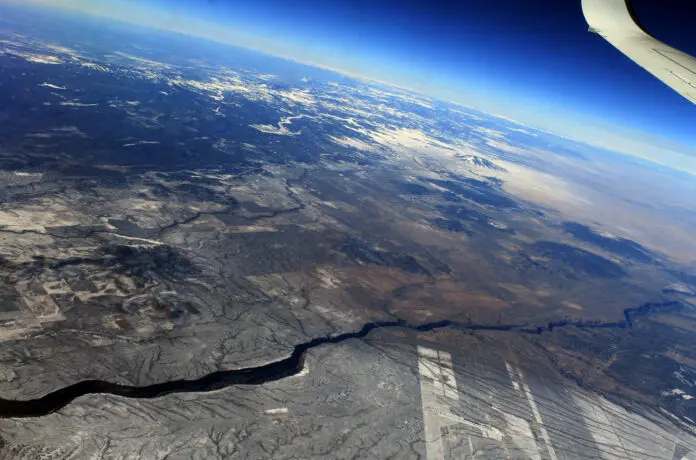

Earth is tearing apart beneath the Pacific Northwest in the sense that part of the oceanic tectonic plate beneath northern Cascadia is gradually tearing and fragmenting. Scientists say this slab tearing is occurring over millions of years as the Cascadia subduction system evolves, rather than indicating that Earth’s surface is suddenly splitting apart.
KumDi.com
Earth is not literally splitting open beneath the Pacific Northwest. Instead, scientists have discovered evidence that a section of the oceanic tectonic plate being pulled beneath North America is tearing and fragmenting deep beneath the seafloor off Vancouver Island.
The discovery provides an unusually detailed view of how a major subduction zone can gradually shut down. Rather than stopping in one enormous event, the northern Cascadia system appears to be breaking into smaller pieces, with individual sections of the descending plate becoming detached over geological time. The research, published in Science Advances, combines deep seismic-reflection images with earthquake data to reconstruct this process.
For people living in Washington, Oregon, British Columbia, and northern California, however, this does not mean the Cascadia earthquake threat is disappearing. The newly observed plate fragmentation operates on a timescale of millions of years, while the Cascadia Subduction Zone remains capable of producing major earthquakes and tsunamis on human timescales. The U.S. Geological Survey continues to classify the Pacific Northwest as a significant earthquake-hazard region.
Table of Contents
What Does “Earth Is Tearing Apart” Actually Mean?
The phrase refers to tectonic slab tearing, not a giant crack opening through the Earth’s surface.
The Earth’s rigid outer shell is divided into tectonic plates. In the Pacific Northwest, the Juan de Fuca Plate and related oceanic plates are moving toward and beneath the North American Plate along the Cascadia Subduction Zone.
A subduction zone is a region where one tectonic plate sinks beneath another. As the oceanic plate descends into the mantle, it can generate earthquakes, contribute to volcanic activity, and gradually recycle oceanic lithosphere back into Earth’s interior.
The Cascadia Subduction Zone stretches from northern California through Oregon and Washington to southern British Columbia. It is capable of generating earthquakes as large as approximately magnitude 9, although such earthquakes are infrequent.
The new research focuses farther north, near the complex meeting point between the Explorer microplate, Juan de Fuca Plate, Pacific Plate, and North American Plate.
Instead of one continuous slab behaving uniformly, scientists found evidence that part of the system is becoming mechanically separated.
In simple terms:
A large tectonic plate is being divided into smaller pieces while part of it continues to sink beneath North America.
That distinction is critical.
It does not mean the Pacific Northwest is about to split apart.
Why Is the Cascadia Plate Breaking Apart?
The process is closely related to the unusual geometry of the northern Cascadia plate boundary.
The researchers describe the region as a ridge-trench-fault triple junction. This is a complicated tectonic environment where a mid-ocean ridge, a subduction trench, and a transform fault interact.
Oceanic crust is continuously created at spreading ridges. When a spreading ridge approaches a subduction trench, unusually young oceanic lithosphere can enter the system.
Young oceanic crust is:
- hotter,
- weaker,
- less dense,
- and more buoyant
than older, colder oceanic lithosphere.
That makes it more resistant to being pushed downward into the mantle.
The new study proposes that this interaction gradually weakened and segmented the incoming plate. A broad zone of deformation began approximately 4 million years ago, eventually becoming concentrated into a transform boundary. This helped separate an oceanic microplate from the surrounding plate system.
The process can be visualized as a sheet of rigid material being pulled in different directions. Instead of breaking everywhere simultaneously, stress becomes concentrated along particular weak zones.
Eventually, those zones become faults capable of separating one tectonic block from another.
How Scientists Detected the Hidden Tearing
One of the most important aspects of the discovery is how scientists were able to see structures that are tens of kilometers beneath the seafloor.
Researchers used deep-penetrating marine seismic-reflection imaging as part of the Cascadia Seismic Imaging Experiment, known as CASIE21.
The basic principle is similar to medical ultrasound.
Researchers generate controlled seismic energy, which travels through the Earth’s crust and reflects from boundaries between different geological structures. Instruments towed behind a research vessel record those returning signals.
Scientists can then process the data to construct images of structures that cannot be observed directly from the surface.
The team combined these seismic images with regional earthquake catalogs.
That combination is especially important.
A seismic image can reveal the geometry of a fault or slab, while earthquake locations provide information about where the crust and descending plate are actively deforming.
The study therefore did not rely on a single observation. It integrated subsurface imaging, earthquake distribution, plate geometry, and tectonic reconstruction to develop its interpretation.
What Did the Researchers Actually Find?
The evidence points to a complex, multi-stage breakup rather than a single catastrophic fracture.
Researchers identified:
- A broad zone of shearing within young oceanic lithosphere.
- Development of a more concentrated transform boundary.
- Formation and isolation of an oceanic microplate.
- Evidence for tearing within the descending slab beneath the seafloor.
- Continued subduction of adjacent portions of the plate.
This last point is particularly important.
The entire Cascadia Subduction Zone is not shutting down simultaneously.
Instead, one part can become detached while neighboring sections continue to subduct.
The authors describe this as segmented or piecewise subduction termination.
That finding changes how scientists can think about the death of a subduction zone.
What Is a Slab Tear?
A slab tear is a fracture or separation within a descending tectonic plate.
Imagine a large, relatively rigid sheet being pulled downward into the mantle. If different parts of that sheet experience different forces, the sheet can deform and eventually fracture.
In a subduction system, slab tearing can occur because of differences in:
- plate thickness,
- temperature,
- density,
- direction of plate motion,
- stresses along transform faults,
- and interactions with spreading ridges.
Once a tear forms, the two sides of the slab can begin behaving differently.
One section may continue sinking.
Another may become partially detached.
The geometry can therefore become increasingly complex over time.
USGS mapping of the Cascadia system has previously identified complex slab structures and earthquake patterns, including evidence that linear earthquake trends can mark possible tears within the subducting Juan de Fuca slab. The newer research provides a much more detailed view of how such fragmentation can develop near the northern end of the system.
Why Do Transform Faults Matter?
Transform faults are one of the keys to understanding this discovery.
At a transform boundary, tectonic blocks move primarily sideways relative to one another.
Instead of simply pushing one plate beneath another, a transform fault can act as a segmentation boundary.
The new study proposes that transform tectonics helped interrupt the propagation of slab tears.
This means that the descending plate did not necessarily rip apart along its entire length at once.
Instead, the transform boundary helped isolate individual sections.
The result is a geological process resembling piece-by-piece dismantling.
This provides a possible explanation for why ancient tectonic environments contain numerous small fragments of former oceanic plates.
Does This Mean the Cascadia Subduction Zone Is Dying?
Yes, in the geological sense—but not on a human timescale.
Subduction zones are not permanent structures. They eventually terminate because the tectonic configuration that drives them changes.
The new research provides evidence that northern Cascadia is undergoing an early-to-late stage of this termination process.
But “ending” is misleading if it makes the process sound imminent.
The geological changes described by the study take place over millions of years.
The researchers’ model suggests that individual pieces of the subducting plate can detach at different times, while neighboring sections continue to sink.
So the most scientifically accurate description is:
Northern Cascadia appears to be undergoing gradual, segmented subduction termination.
That is very different from saying that the Pacific Northwest is about to lose its subduction zone.
Could the Plate Tearing Affect Volcanoes?
Potentially, yes.
One reason geologists are interested in slab tearing is that a tear can create what is called a slab window.
A slab window is an opening that forms when a section of subducting lithosphere separates or moves away. Hot mantle material can potentially rise through the opening.
That can change the thermal and chemical conditions beneath the overriding plate.
In some geological settings, slab windows have been associated with unusual volcanic activity and changes in magma composition.
The new Science Advances study argues that segmented slab detachment could contribute to diachronous slab-window volcanism, meaning volcanic effects could develop at different locations and times as individual sections of the slab detach.
This concept also provides a useful connection to older volcanic features in the Pacific Northwest.
For example, the National Park Service notes that geologists have proposed slab tearing as part of the explanation for volcanic activity associated with the Picture Gorge Basalts in Oregon approximately 17 million years ago.
However, scientists should distinguish between established observations and interpretations of how specific ancient volcanic events were generated.
Does the Discovery Change the Risk of a “Big One”?
Not in the simple way headlines might suggest.
The Pacific Northwest remains exposed to three major categories of earthquake hazard:
| Earthquake source | Typical setting | Potential significance |
|---|---|---|
| Cascadia megathrust | Boundary between Juan de Fuca and North American plates | Can produce extremely large earthquakes and tsunamis |
| Deep intraslab earthquakes | Within the descending oceanic plate | Can cause damaging shaking beneath populated areas |
| Shallow crustal faults | Faults within the overriding North American Plate | Can produce strong local shaking |
USGS estimates published in 2025 put the chance of an approximately magnitude 9 Cascadia earthquake at 10–15% over the next 50 years. The same assessment estimated an 85% chance of a magnitude 6.5 or greater deep earthquake in the Puget Sound region over that period and a 17% chance of a magnitude 6.5 or greater shallow crustal earthquake there. These are regional probability estimates, not predictions of when a specific earthquake will occur.
The most recent great Cascadia earthquake occurred on January 26, 1700, with an estimated magnitude of approximately 8.7–9.2. Geological evidence, Indigenous oral histories, tree-ring evidence, coastal land-level changes, tsunami deposits, and historical records from Japan all contribute to the reconstruction of Cascadia’s earthquake history.
Therefore, the newly observed slab tearing should not be interpreted as evidence that a major Cascadia earthquake is either imminent or becoming impossible.
Could a Slab Tear Stop a Future Earthquake?
This is one of the most interesting unanswered questions.
Earthquakes occur when accumulated stress is released through sudden movement along faults.
If the geometry of a subducting plate changes, it could potentially influence:
- where stress accumulates,
- how faults connect,
- how seismic rupture propagates,
- how different sections of the plate interact,
- and how the subduction system evolves over geological time.
But there is an important distinction between influencing earthquake behavior and predicting earthquakes.
The current study does not provide a method for predicting the date, magnitude, or location of a future Cascadia megathrust earthquake.
Instead, it gives researchers a more detailed structural model that can eventually be incorporated into earthquake and tectonic simulations.
The authors specifically note that the adjacent Juan de Fuca portion of the system appears to continue subducting relatively normally even as the neighboring microplate undergoes fragmentation.
Why This Discovery Matters Beyond the Pacific Northwest
The significance of this research extends far beyond Vancouver Island.
Geologists have long known that ancient tectonic plates have disappeared from Earth’s surface.
One famous example is the Farallon Plate, which was once much larger than the modern Juan de Fuca Plate and was subducted beneath western North America.
Today, fragments and geological signatures of that ancient system remain buried deep within the Earth or preserved as smaller tectonic remnants.
The problem is that scientists normally see only the final geological products.
They rarely get to observe a subduction system while it is actually breaking apart.
Northern Cascadia offers something unusual: a modern laboratory for studying the process while it is happening.
That makes the discovery valuable for understanding how ancient subduction zones ended and how plate boundaries reorganize themselves.
A Simple Step-by-Step Model of What Is Happening
The process can be simplified into six stages:
1. Oceanic crust forms
New oceanic lithosphere is created at a spreading ridge.
2. The plate moves toward Cascadia
The oceanic plate travels toward the North American margin.
3. Subduction begins
The denser oceanic lithosphere descends beneath North America.
4. A transform boundary develops
Stress becomes concentrated along zones that separate portions of the oceanic plate.
5. The slab begins to tear
Faults extend downward into the subducting plate, separating individual sections.
6. Individual pieces detach
Some sections gradually lose their connection, while neighboring parts continue subducting.
Over millions of years, this can progressively reduce the length and strength of the subduction system.
What Happens Next?
Scientists still have important questions to answer.
Future research will need to determine:
- how quickly individual slab tears propagate;
- how large detached slab fragments become;
- whether earthquake activity changes systematically around the tears;
- how transform faults control rupture and plate fragmentation;
- whether slab windows produce measurable changes in volcanism;
- and whether similar processes are occurring elsewhere around the world.
The researchers also emphasize the value of additional geophysical imaging to identify remaining slab fragments and reconstruct the evolution of the plate boundary in greater detail.
This is where modern geophysics becomes especially powerful. Earth scientists can combine seismic reflection, earthquake catalogs, GPS measurements, plate reconstructions, marine magnetic data, and volcanic records to reconstruct a four-dimensional picture of Earth’s interior—three dimensions of space plus geological time.
FAQs
Is Earth literally splitting apart beneath the Pacific Northwest?
No. The phrase describes tectonic slab tearing deep beneath the seafloor. A section of the oceanic plate involved in Cascadia subduction is fragmenting, rather than the Earth’s surface opening into a giant crack.
Where is the tearing happening?
The newly documented structures are in northern Cascadia near Vancouver Island, around the complex boundary involving the Explorer and Juan de Fuca plates, the Pacific Plate, and the North American Plate.
Is the Cascadia Subduction Zone shutting down?
A portion of northern Cascadia appears to be undergoing segmented subduction termination, but the process occurs over geological timescales. Other parts of the Cascadia system continue to subduct.
Does this mean the “Big One” will not happen?
No. The slab-tearing discovery does not eliminate the earthquake hazard. USGS assessments continue to identify Cascadia megathrust earthquakes, deep earthquakes, and shallow crustal earthquakes as significant hazards in the Pacific Northwest.
How long will the breakup take?
The overall process of subduction termination occurs over millions of years. Individual slab fragments can detach during different stages, so the system does not necessarily disappear simultaneously along its entire length.
The Bigger Picture: Earth Changes One Plate at a Time
The most important lesson from the Cascadia discovery is not that the Pacific Northwest is suddenly becoming unstable.
It is that tectonic plates are more dynamic and structurally complex than a conventional map of rigid plates suggests.
A subduction zone can look like a continuous line on the Earth’s surface while behaving very differently at depth. Individual fragments can slow down, detach, rotate, or continue moving independently.
The northern Cascadia observations give scientists a rare opportunity to watch this transition while it is occurring.
The phrase “Earth is tearing apart beneath the Pacific Northwest” therefore captures a real geological phenomenon—but the scientifically accurate story is more subtle.
A section of the oceanic lithosphere beneath northern Cascadia is undergoing progressive slab fragmentation and piecewise subduction termination. The process is driven by the interaction of subduction, transform faulting, and the approach of young oceanic lithosphere near a ridge-trench-fault junction.
It is happening far beneath the seafloor, unfolds over millions of years, and does not mean the Pacific Northwest is about to split apart.
Yet scientifically, it is an extraordinary event: researchers have obtained a rare modern snapshot of a subduction system in the process of dismantling itself.
That glimpse may help explain not only what is happening beneath Cascadia today, but also how some of Earth’s long-vanished tectonic plates disappeared in the distant geological past.
References
- Shuck, B., et al. (2025). “Slab tearing and segmented subduction termination driven by transform tectonics.” Science Advances, 11(39), eady8347.
This is the primary scientific source for the article. The study combines deep-penetrating seismic-reflection imaging from the 2021 Cascadia Seismic Imaging Experiment (CASIE21) with regional earthquake data to investigate active slab fragmentation and subduction termination in northern Cascadia.
Read the full peer-reviewed study (PMC) - Louisiana State University — Research News, September 24, 2025.
LSU’s research announcement provides additional background on the study, the CASIE21 seismic-imaging expedition, and the participating research institutions. It describes the seismic-reflection method as effectively an “ultrasound” of Earth’s subsurface and explains how researchers identified the fragmenting plate beneath northern Cascadia.
LSU — Earth’s Crust Is Tearing Apart Off the Pacific Northwest




 and then