









What is “farmear aura”?
KumDi.com
“Farmear aura” is Spanish-language internet slang derived from “aura farming.” It means deliberately—or seemingly effortlessly—showing charisma, confidence, style or presence to gain imaginary “aura points.” The meme grew through TikTok and gaming culture before evolving into offline “aura battles,” where participants compete through dance, poses, facial expressions and humor while an audience decides who has the strongest aura.
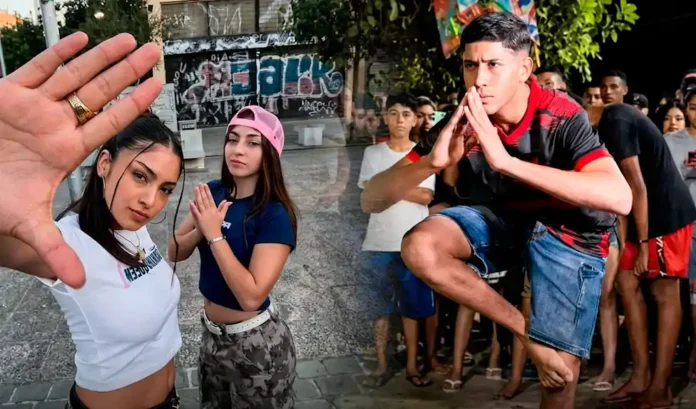
If you have recently seen teenagers staring each other down, performing exaggerated poses, dancing for a few seconds, or trying to make a crowd laugh before an audience declares a winner, you may have encountered an “aura battle.” The trend comes from the internet slang “aura farming,” or in Spanish-speaking communities, “farmear aura.” It describes deliberately—or seemingly effortlessly—projecting charisma, confidence, style and presence in order to gain imaginary “aura points.” The points are not real, and there is no official scoring system. The joke is that social presence is being treated like a video-game resource that can be collected, increased or lost. Cambridge Dictionary now defines aura farming as doing things intended to show a personality that other people find attractive or interesting.
What began as internet slang associated with gaming, anime and short-form videos has evolved into something more physical in 2026: informal street competitions in which participants perform brief acts of confidence, humor, creativity or style while spectators decide who has the most “aura.” Recent reporting from Mexico shows the meme moving from TikTok-style clips into live events, where the contests are generally not physical fights at all. Instead, competitors use dance moves, facial expressions, poses and improvisation to capture the crowd’s attention.
Table of Contents

What Does “Farmear Aura” Mean?
“Farmear aura” is essentially the Spanish-language expression for “aura farming.”
The phrase combines two ideas.
“Farmear” comes from the English farm, a term heavily associated with video-game culture. In gaming, “farming” means repeatedly performing activities to collect resources, experience, currency or other advantages.
“Aura” has developed a different meaning in internet slang. It generally refers to the impression someone gives off: charisma, confidence, coolness, style, presence or an ability to command attention.
Put together, “farmear aura” means behaving in a way that appears to accumulate social “cool points.”
The imaginary scoreboard might look like:
- +1,000 aura: Pulling off something impressive without reacting.
- +10,000 aura: Remaining completely calm during a dramatic moment.
- +100,000 aura: Doing something spectacular and walking away as though nothing happened.
- -1,000 aura: Making an embarrassing mistake.
- Aura bankruptcy: Losing so much imaginary aura that the joke is that the person’s balance has fallen below zero.
None of these numbers has an objective meaning.
That is precisely what makes the expression funny.
Cambridge and Collins both treat aura farming as slang rather than a scientific or psychological measurement. Collins defines it as the deliberate cultivation of a distinctive and charismatic persona.
Is Aura Farming a Real Competition?
Yes—but only in the social and entertainment sense.
There is no universally recognized sport called aura farming, no official international federation and no standardized scoring system.
However, by 2026, informal “aura battles” have emerged in physical spaces.
A recent Euronews report from Mexico documented young participants facing one another in live aura contests. Rather than fighting, competitors use short performances involving dance, poses, expressions, gestures, humor and confidence. Spectators decide who wins.
This distinction is important because the word “battle” can be misleading.
An aura battle is closer to:
- a freestyle performance;
- a meme challenge;
- a short dance competition;
- an improvisational comedy contest;
- a charisma contest;
- or a social-media challenge performed offline.
It is generally not a physical confrontation.
How Did Aura Farming Become Popular?
The term did not suddenly appear because of one viral video.
Available evidence points to early 2024 for documented online use of “aura farming.” Know Your Meme records a January 28, 2024 TikTok post captioned “Aura Farming” as one of the earliest documented examples. The expression subsequently spread through TikTok, X, Instagram and anime-related online communities. Importantly, this does not prove that the creator of that early post invented the phrase; internet slang rarely has a single verifiable inventor.
The concept was especially compatible with anime and gaming culture.
Anime characters frequently become memes because they can appear powerful without saying much. A character walking slowly into a scene, standing silently while others react, or performing a simple gesture with extraordinary confidence can be described humorously as “farming aura.”
That gave the phrase a visual grammar.
The audience did not need a long explanation.
Do something cool → look completely unbothered → gain aura.
Why the Indonesian “Aura Farming Kid” Became the Face of the Trend
The most important turning point came in 2025 with Rayyan Arkan Dikha, an 11-year-old from Riau, Indonesia.
A short video showed Dikha dancing on the bow of a long traditional racing boat during a Pacu Jalur competition. He wore sunglasses and maintained an unusually calm expression while performing rhythmic movements on the front of the moving boat.
The internet quickly recognized the scene as the perfect visual example of “aura farming.”
But there is an important distinction between the meme’s interpretation and the original cultural context.
Dikha was not originally performing for TikTok.
He was participating in a traditional Indonesian boat-racing culture.
His role is known as Togak Luan, a position in which a young performer stands at the front of the boat and encourages the rowers. Reporting from ABC explains that the role involves standing at the bow and celebrating when the boat is leading. Dikha’s mother also said he had trained with his father, a Pacu Jalur athlete.
Dikha himself told BBC Indonesia that the dance was spontaneous and that he created the movements himself.
That detail matters.
The boy did not necessarily set out to “farm aura” according to the internet definition.
The internet turned a traditional performance into an example of aura farming.
Why Did the Boat Video Go Viral?
The video contained several elements that work exceptionally well in short-form video.
1. Immediate visual recognition
The viewer can understand what is happening within seconds.
There is a child.
There is a long racing boat.
He is standing at the front.
The boat is moving quickly.
He is dancing.
He looks completely calm.
That creates a strong visual contrast.
2. Apparent effortlessness
Aura farming depends heavily on the idea that the person appears unbothered.
The less someone appears to care about receiving attention, the more internet users can joke that they have “aura.”
3. Repeatable movements
The dance was simple enough to imitate.
Once viewers can reproduce a movement, the original video becomes a template rather than merely something to watch.
4. Meme compatibility
The same dance could be placed into different situations, songs and contexts.
This is one reason short-form platforms are powerful engines for meme culture.
5. Cultural novelty
For international viewers, Pacu Jalur itself was unfamiliar.
The combination of a traditional Indonesian boat race and a highly expressive performer created a visual format that felt new to global audiences.
The video subsequently inspired imitations from creators and athletes. CNA reported that the viral clip helped make Dikha an international internet sensation and that he was later appointed a cultural ambassador by the governor of Riau.
Aura Farming Is Not the Same as “Having Aura”
These two expressions are related but not identical.
Having aura means someone naturally—or apparently naturally—projects charisma, confidence or presence.
Aura farming means performing actions that increase or appear to increase that perception.
For example:
A person walks into a room and immediately commands attention.
That person is said to have aura.
Now imagine the same person deliberately performs a dramatic entrance, gives a confident look, executes a perfect move and walks away without reacting.
Internet users might say:
“He is farming aura.”
The distinction is important because aura farming often contains an element of performance.
It can be sincere, ironic or deliberately exaggerated.
Why Are There “Aura Points”?
The imaginary scoring system is one of the most important parts of the meme.
The concept borrows directly from gaming logic.
In a game, a player can accumulate:
- experience points;
- coins;
- weapons;
- levels;
- abilities;
- reputation;
- resources.
Aura farming applies the same logic to personality.
Instead of collecting gold, the person is supposedly collecting coolness.
This creates a simple social equation:
Impressive action = positive aura
Embarrassing action = negative aura
The joke becomes even stronger when users exaggerate the numbers.
Someone who performs a spectacular move might receive:
+100,000 aura
Someone who immediately trips afterward might lose:
−100,000 aura
This allows viewers to turn ordinary human behavior into a fictional game.
Why Did the Trend Move From TikTok to the Street?
This transition is one of the most interesting developments in the trend.
Most internet memes remain digital.
Aura farming is different because its core activity—projecting presence in front of other people—already works offline.
A person does not need a phone to demonstrate confidence.
That makes the trend easy to reproduce in a public setting.
By 2026, young people in Mexico and other parts of Latin America were participating in live aura battles. Euronews reported that similar events had appeared beyond Mexico, including in Brazil, Argentina, Bolivia, Paraguay and Peru.
The format generally works like this:
Step 1: Two participants face each other
The setup resembles a conventional battle.
Step 2: Each participant gets a short turn
The performance may last only a few seconds.
Step 3: The performer demonstrates “aura”
They may use:
- dance;
- facial expressions;
- poses;
- exaggerated confidence;
- humor;
- meme references;
- improvisation;
- unexpected movements.
Step 4: The crowd reacts
The audience becomes the unofficial scoring system.
Step 5: A winner is selected
The winner is the person judged to have generated the strongest overall impression.
This structure explains why the trend works so well on both TikTok and in public.
It has instant conflict, quick resolution and a visually obvious winner.
Are Aura Battles Similar to Freestyle Battles?
There are similarities, but they are not the same.
A freestyle rap battle typically emphasizes:
- lyrics;
- rhythm;
- wordplay;
- improvisation;
- verbal competition.
A dance battle emphasizes:
- movement;
- musicality;
- choreography;
- technical ability.
An aura battle is broader.
Its primary objective is social presence.
A participant might win without being the best dancer if their timing, facial expression or comedic delivery gets the strongest reaction.
That makes aura battles closer to a hybrid of meme culture, performance art and informal social competition.
Why Gen Z and Gen Alpha Understand the Joke So Quickly
Aura farming is particularly compatible with younger internet culture because it combines several established digital languages.
Gaming language
“Farming” turns personality into a resource.
Anime culture
Characters with dramatic presence provide endless examples of “aura.”
TikTok culture
Short videos reward instantly understandable visual moments.
Meme culture
The meaning does not need to be completely serious.
Social validation
Likes, comments, shares and audience reactions provide an informal measurement of popularity.
In that sense, aura farming is more than a random phrase.
It reflects how digital-native audiences increasingly describe social status through game mechanics.
Instead of saying:
“That person looked incredibly confident.”
Users can simply say:
“+10,000 aura.”
The second expression is shorter, more humorous and more compatible with meme culture.
What Does “Lost Aura” Mean?
The opposite of aura farming is often described as losing aura.
A person loses aura when something destroys the impression of confidence or coolness.
Examples include:
- attempting a difficult trick and failing;
- delivering an awkward response;
- falling immediately after a confident entrance;
- trying too hard to look cool;
- visibly reacting to criticism;
- making an embarrassing mistake.
This is where the meme becomes self-aware.
Trying too hard can itself cause an aura loss.
Cambridge specifically notes that attempting to aura-farm in real life can backfire and make someone look “cringe.”
That paradox is central to the trend:
The harder you try to look effortless, the less effortless you may appear.
Is Aura Farming Good or Bad?
There is no universal answer.
The term can be complimentary, neutral or mocking depending on context.
Positive use
Someone performs an impressive action naturally.
“He gained so much aura.”
Neutral use
Someone intentionally creates a cool-looking moment for entertainment.
“She is aura farming.”
Negative use
Someone is perceived as trying too hard.
“Bro is desperately farming aura.”
Therefore, context and tone matter.
A headline that describes someone as an “aura farmer” should not automatically be interpreted as praise.
The Cultural Context Behind the Viral Boat Dance Matters
One of the biggest risks of viral internet culture is that a short clip can become detached from its original context.
For many international viewers, Rayyan Arkan Dikha’s performance became simply:
“the aura farming kid.”
But the original setting was a longstanding Indonesian tradition.
Pacu Jalur is a traditional boat-racing event in Riau, and the Togak Luan role is connected to the performance and encouragement of the racing team. ABC reported that Dikha had been involved with the tradition through his family and trained regularly with his father.
That context changes how the video should be understood.
It was not simply a child inventing a TikTok dance.
It was a traditional cultural performance that the global internet subsequently reinterpreted through its own vocabulary.
That is an important distinction for responsible reporting.
Could Aura Battles Become a Real Youth Sport?
It is too early to call aura battles an established sport.
However, the transition from meme to live competition is significant.
A successful youth trend usually needs three things to move beyond social media:
- A simple format
- An audience-friendly scoring mechanism
- Easy participation
Aura battles have all three.
The rules can be understood immediately.
The audience can determine a winner.
And almost anyone can participate without expensive equipment.
That makes the format unusually adaptable.
The next stage could involve organized events, creator competitions, school activities or commercial entertainment. But those developments should be described as possibilities rather than established facts unless specific evidence emerges.
Why “Farmear Aura” Matters Beyond the Meme
At first glance, aura farming looks like another disposable internet phrase.
But it reveals something meaningful about contemporary digital culture.
People have always competed for social status.
What has changed is the language used to describe it.
Previous generations might have talked about:
- charisma;
- reputation;
- confidence;
- popularity;
- style;
- social status.
Internet-native communities can compress all of those ideas into one fictional statistic:
aura.
The meme also demonstrates how modern cultural trends move in both directions.
A traditional Indonesian performance entered global digital culture.
The internet transformed it into a meme.
The meme then became a physical activity.
The physical activity was filmed again.
Those new videos returned to social platforms.
The cycle therefore becomes:
Traditional culture → viral video → meme → social-media challenge → live competition → new viral videos.
That is the real story behind the rise of aura battles.
FAQs
What does “farmear aura” mean?
“Farmear aura” means intentionally displaying confidence, charisma, style or impressive behavior to appear cool and gain imaginary “aura points.” It comes from the English internet slang “aura farming.”
What is an aura battle?
An aura battle is an informal performance competition in which participants face off using dance, poses, facial expressions, humor or other creative movements. Unlike a physical fight, the winner is generally determined by audience reaction and perceived charisma.
Who is the famous “aura farming kid”?
The term became strongly associated with Rayyan Arkan Dikha, an Indonesian boy whose performance at a traditional Pacu Jalur boat-racing event went viral internationally in 2025. His performance was part of an existing cultural tradition rather than originally being created as a TikTok trend.
Where did aura farming come from?
The phrase “aura farming” developed through internet and gaming culture and became increasingly popular on TikTok and other social platforms. It was later amplified by viral videos, anime references and the Indonesian boat-racing clip.
Is “farmear aura” a real sport?
Not in the formal sense. There is no universally recognized international sport or standardized scoring system for aura farming. However, by 2026, informal aura battles have emerged as live entertainment events in which participants compete for audience approval.
The Bottom Line
“Farmear aura” is internet slang for building or displaying perceived charisma, confidence and coolness as if those qualities were points in a video game. The phrase emerged from gaming and online meme culture, became widely associated with TikTok and anime communities, and received a huge international boost from Rayyan Arkan Dikha’s 2025 Pacu Jalur boat-racing video.
By August 2026, the idea has moved beyond the screen. Young people in places such as Mexico are turning the meme into live aura battles, where participants compete through short performances and audiences decide who has the strongest presence.
The most important point is that “battle” does not normally mean a physical fight. It is a playful contest built around charisma, creativity, humor and audience reaction.
What makes the phenomenon especially interesting is the journey it has taken: a gaming-inspired slang term became a meme, a traditional Indonesian performance became its most famous visual example, and the meme eventually became an offline youth competition.
In other words, aura farming is no longer just something people say about a viral video. In 2026, it has become a format for performing identity in front of an audience—both online and on the street.




 and then