








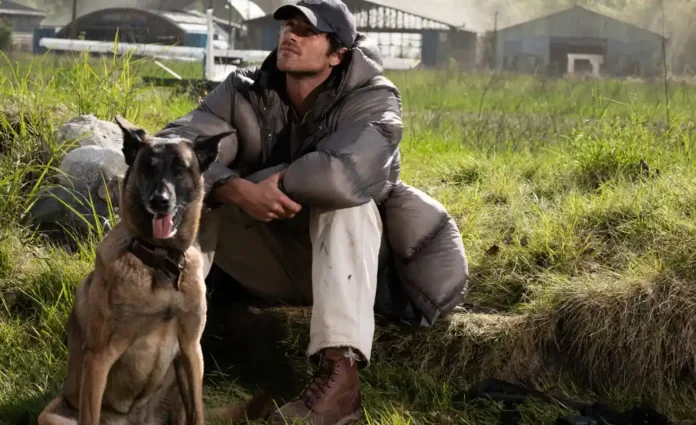

Ridley Scott’s The Dog Stars is a 2026 post-apocalyptic survival drama based on Peter Heller’s novel. The film follows Hig, a pilot surviving with his dog Jasper after a devastating pandemic. It combines striking landscapes, emotional character drama, isolation, survival, and questions about human connection.
KumDi.com
The Dog Stars is Ridley Scott’s 2026 post-apocalyptic survival drama, adapted from Peter Heller’s acclaimed 2012 novel. Starring Jacob Elordi, Josh Brolin, Margaret Qualley, Guy Pearce, Allison Janney, and Benedict Wong, the film follows Hig, a pilot and mechanic trying to survive with his dog Jasper after a devastating flu pandemic destroys most of civilization.
Is The Dog Stars worth watching? The answer depends heavily on what you expect. If you want a fast-paced apocalypse thriller packed with action, monsters, or constant survival tension, the film may feel slow and familiar. If you are more interested in isolation, grief, companionship, rebuilding trust, and the possibility of human connection after societal collapse, Scott’s adaptation offers considerably more to explore. Early critical reaction has been mixed: reviewers consistently praise the film’s landscapes, performances, and quieter humanistic ambitions, while criticizing its pacing, screenplay, character development, and reliance on familiar post-apocalyptic conventions.
Table of Contents

What Is The Dog Stars About?
The Dog Stars takes place in a near-future America after a deadly influenza pandemic has devastated the population. The story centers on Hig, played by Jacob Elordi, a former pilot and mechanic living at an isolated Colorado airfield.
His closest companions are Jasper, his loyal dog, and Bangley, a heavily armed former Marine played by Josh Brolin. Their relationship is based less on friendship than necessity. Bangley protects their compound, while Hig flies his small aircraft through the surrounding wilderness looking for supplies and signs of other survivors.
The discovery of a mysterious radio transmission changes Hig’s routine. The signal suggests that other people may still be alive and potentially points toward something resembling a functioning community.
This gives the story its central question:
When civilization disappears, is survival enough—or do people still need other people to have a reason to live?
That question separates The Dog Stars from a conventional action-oriented apocalypse movie. Its focus is not simply on defeating enemies or finding food. Much of the film concerns what happens psychologically when everyday human relationships, routines, institutions, and social expectations disappear.
The Dog Stars Cast and Characters

Jacob Elordi as Hig
Jacob Elordi plays Hig as a physically capable but emotionally isolated survivor. He is a pilot, mechanic, and outdoorsman, but those practical skills do not solve his deeper problem: grief.
Hig’s memories of his deceased wife remain important to his character, and his connection with Jasper gives him a tangible link to his former life.
Several critics have viewed Elordi’s performance as one of the film’s strengths, although opinions differ on whether his restrained approach creates emotional subtlety or simply makes Hig appear detached. Variety describes the film as centered on Elordi’s sensitive survivalist, while other critics have found the character insufficiently developed.
Josh Brolin as Bangley
Josh Brolin plays Bangley, the hardened former Marine who approaches the post-collapse world with extreme suspicion.
Bangley represents the survivalist philosophy: assume strangers are dangerous, protect your resources, and act before someone else attacks.
Brolin brings considerably more force and personality to the film. Time Out specifically highlights his performance as a major strength, describing him as a dominant presence whose scenes provide some of the film’s energy.
Margaret Qualley as Cima
Margaret Qualley plays Cima, a survivor Hig encounters after following the mysterious signal.
Her arrival creates an opportunity for Hig to move beyond the closed survival system he has established with Bangley and Jasper. Cima therefore serves an important thematic function: she represents the possibility of rebuilding human relationships rather than merely preserving individual life.
Guy Pearce as Pops
Guy Pearce plays Pops, Cima’s father. His character introduces another variation on survival and family responsibility.
The dynamic between Hig, Cima, and Pops expands the film beyond the isolated partnership at the airport and allows the story to examine whether trust can exist in a world where resources are scarce and violence is always possible.
Is The Dog Stars a Horror Movie?
Not exactly.
Although The Dog Stars contains violence, threatening survivors, weapons, and a world devastated by disease, it is better classified as a post-apocalyptic science-fiction drama, survival film, and adventure thriller rather than straightforward horror.
This distinction matters because the movie’s pacing reflects its priorities.
There are stretches devoted to flying, landscape, memories, conversation, observation, and everyday survival. Time Out characterizes it as a surprisingly sensitive meditation on what has been lost rather than a nonstop survival thriller.
Viewers expecting something closer to Mad Max: Fury Road, 28 Days Later, or an action-heavy zombie movie should therefore adjust their expectations.
The Film’s Biggest Strength: Atmosphere
One area where Ridley Scott’s filmmaking experience remains immediately recognizable is visual scale.
The film uses Colorado’s landscapes, abandoned infrastructure, empty roads, aircraft sequences, and isolated settlements to create a convincing sense of geographical emptiness.
The contrast is important. In a conventional disaster movie, destruction is often represented through spectacular explosions and collapsing buildings. The Dog Stars instead emphasizes absence.
Empty spaces become part of the storytelling:
- abandoned buildings suggest a vanished society;
- empty roads emphasize isolation;
- overgrown areas suggest nature reclaiming human infrastructure;
- aircraft provide a visual connection between isolated communities;
- the night sky reinforces the characters’ smallness within the landscape.
Several early reviews singled out the cinematography and large-scale imagery as among the film’s strongest elements.
Suggested visual aid
For a film-review article, a useful visual would be a three-column comparison graphic:
| Element | Before the collapse | After the collapse |
|---|---|---|
| Cities | Dense population | Abandoned infrastructure |
| Transportation | Public systems | Personal aircraft and vehicles |
| Communication | Global networks | Weak radio signals |
| Community | Institutions and neighborhoods | Small survivor groups |
| Security | Law enforcement | Individual protection |
This helps readers understand why the film’s quiet moments are narratively important.
The Central Theme: Survival vs. Connection
The most interesting aspect of The Dog Stars is not necessarily its apocalypse scenario. The pandemic is primarily the mechanism that removes normal society.
The deeper subject is human connection after social structures disappear.
Hig has food, shelter, weapons, an aircraft, technical skills, and Jasper. In purely biological terms, he has many of the things necessary for survival.
But survival alone does not eliminate grief.
That distinction gives the film its emotional foundation.
Bangley believes survival depends on suspicion and force. Hig is more interested in exploration and connection. Their opposing philosophies create one of the movie’s central tensions.
The film consequently asks a practical question that is relevant to many survival narratives:
What is the value of surviving if there is nobody left with whom to share that survival?
This is where the movie’s relationship with Jasper becomes especially important.
Why the Dog Matters
Jasper is not simply an animal companion added for emotional appeal.
The dog functions as an emotional bridge between Hig’s past and present.
Ridley Scott has also discussed Elordi’s ability to work naturally with the dogs used to portray Jasper, emphasizing the actor’s physical comfort around animals. The production reportedly used three dogs for the role.
From a storytelling perspective, Jasper represents something civilization has lost but Hig still possesses: loyalty without calculation.
Human survivors may lie, steal, attack, or abandon one another. Jasper’s relationship with Hig is comparatively uncomplicated.
That makes the dog one of the clearest emotional anchors in the story.
The Problem With The Dog Stars: Familiarity
The biggest weakness identified across critical reactions is not the premise itself but its lack of novelty.
Post-apocalyptic cinema has already explored abandoned cities, isolated survivors, armed scavengers, mysterious radio signals, improvised communities, and the conflict between cooperation and violence.
Consequently, a new film in the genre needs either:
- an original world,
- unusually complex characters,
- a distinctive visual language,
- a genuinely surprising narrative structure, or
- a fresh philosophical perspective.
The Dog Stars achieves some of these goals but not consistently.
Rotten Tomatoes’ compilation of early reviews highlights a recurring critical consensus: the cinematography and cast are strong, but the film is considered too familiar and somewhat unfocused.
The Guardian similarly criticizes the movie’s familiar premise, underdeveloped characters, and uneven execution.
Does the Slow Pacing Work?
This is probably the most important question for potential viewers.
Yes—but only if you accept the movie’s intended rhythm.
The film is not structured like a conventional action thriller in which one crisis immediately follows another. Long passages allow Hig to exist within the environment.
That approach can create atmosphere, but it also creates a significant risk: when the dramatic conflict finally arrives, viewers may feel that the story has taken too long to establish its destination.
Time Out describes the film as deliberately leisurely and argues that this slower rhythm contributes to its distinctive character.
Other reviewers reach the opposite conclusion, arguing that the slow pacing becomes lethargic rather than contemplative. RogerEbert.com, for example, describes the movie as unusually tedious and argues that its survivalist framework lacks sufficient psychological tension.
Both reactions are useful because they identify the movie’s central creative gamble.
The Dog Stars vs. Other Post-Apocalyptic Movies
| Film | Primary Strength | Tone | Action Level |
| The Dog Stars | Isolation and human connection | Melancholic | Moderate |
| Mad Max: Fury Road | Action and world-building | Aggressive | Very high |
| 28 Days Later | Horror and tension | Frightening | High |
| The Road | Human survival and morality | Bleak | Low |
| I Am Legend | Isolation and survival | Dark | Moderate |
| The Last of Us | Relationships and social collapse | Emotional | Moderate |
This comparison illustrates why The Dog Stars may appeal more to viewers looking for a reflective survival drama than to audiences seeking relentless action.
Performances: Who Stands Out?
The ensemble is one of the film’s most reliable assets.
Josh Brolin appears to have the clearest opportunity to inject energy into the movie through Bangley’s aggressive survivalist personality. Jacob Elordi takes the opposite approach, playing Hig through restraint and vulnerability.
Margaret Qualley and Guy Pearce help expand the story’s emotional and social dimensions, while Benedict Wong appears as Aaron.
Allison Janney also has a memorable supporting role as Darlene, a character whose presence introduces a sharply different tone into the story. Time Out identifies this sequence as a particularly strange tonal shift, while other reviews also mention Janney’s role as a memorable element.
What Does the Ending Mean?
Spoiler-free interpretation: the ending is less interested in providing a definitive explanation of the post-pandemic world than in resolving the film’s argument about connection.
The story begins with isolation as a survival strategy.
It gradually asks whether isolation can become its own form of death.
That makes the emotional destination more important than simply determining which characters survive. The film’s ultimate question is whether people can move from protecting what remains to building something new.
For readers who have not seen the movie, avoiding detailed ending information is preferable because several late developments significantly change the tone and direction of the story.
Is The Dog Stars Worth Watching?
Watch it if you enjoy:
- Ridley Scott’s visual filmmaking
- post-apocalyptic science fiction
- survival stories without nonstop action
- character-driven dystopian dramas
- aviation and wilderness imagery
- stories about grief and companionship
- Jacob Elordi or Josh Brolin
- adaptations of literary science fiction
You may want to skip it if you prefer:
- fast-paced action
- complex dystopian world-building
- horror-driven apocalypse stories
- heavily explained fictional universes
- constant suspense
- highly original post-apocalyptic concepts
Final Verdict
The Dog Stars is an ambitious but uneven Ridley Scott adaptation that works better as a melancholic survival drama than as a conventional post-apocalyptic action movie.
Its strongest elements are its cast, landscapes, atmosphere, aviation imagery, and focus on human connection. Its weaknesses are equally clear: slow pacing, familiar genre mechanics, uneven characterization, and a screenplay that does not always provide enough dramatic momentum. Critics are divided precisely because the film appears to be attempting something quieter than its premise initially suggests.
For viewers expecting another Mad Max-style apocalypse, The Dog Stars may feel frustratingly subdued. For audiences willing to approach it as a story about loneliness, grief, companionship, and the possibility of rebuilding trust, there is more substance beneath its familiar survival framework.
The Dog Stars Rating: 6/10
Bottom line: The Dog Stars is visually impressive and occasionally moving, but its restrained approach and familiar post-apocalyptic ingredients prevent it from reaching the level of Ridley Scott’s most memorable science-fiction films.
As of August 2026, the critical response is notably mixed. Rotten Tomatoes’ early-review roundup reported a 39% Tomatometer score, while individual critics range from appreciative of its warmth and visual craftsmanship to strongly negative about its pacing and screenplay.
That split is arguably the most useful takeaway: this is not a universally acclaimed apocalypse blockbuster—it is a deliberately subdued, imperfect film whose appeal depends heavily on whether atmosphere and character reflection matter more to you than action and originality.
FAQs

What is The Dog Stars about?
The Dog Stars follows Hig, a pilot and mechanic living with his dog Jasper and former Marine Bangley after a devastating pandemic has destroyed much of civilization. A mysterious radio transmission leads Hig toward other survivors and forces him to reconsider his isolated approach to survival.
Who directed The Dog Stars?
The film was directed by Ridley Scott, with a screenplay based on Peter Heller’s 2012 novel. Screen Daily identifies the film as a 2026 US/UK production running approximately 118 minutes.
Who stars in The Dog Stars?
The principal cast includes Jacob Elordi, Josh Brolin, Margaret Qualley, Guy Pearce, Allison Janney, and Benedict Wong.
Is The Dog Stars based on a book?
Yes. The film adapts Peter Heller’s 2012 novel The Dog Stars. The author has spoken positively about seeing the book brought to the screen by Scott and his cast.
Is The Dog Stars a zombie movie?
Yes, with the right expectations. It is worth considering for viewers who appreciate slow-burn post-apocalyptic dramas, strong landscapes, literary adaptations, and stories centered on companionship. Viewers seeking constant action or radically innovative dystopian world-building may find it disappointing.




 and then